
A standard NBA basketball court covers 4,700 square feet. This foundational question about the size of a basketball court is crucial for anyone involved in the sport, from players and coaches to facility managers and casual enthusiasts. Understanding the basketball court area is key to comprehending the dynamics of the game played within its boundaries.
This comprehensive guide will delve into the precise basketball court dimensions, breaking down the square footage for various levels of play. We’ll explore the differences between leagues, the impact of court location, and the methods used for basketball court measurement. Whether you’re building a new court, planning a game, or simply curious about the playing surface, this information will provide a clear picture of the basketball court area.
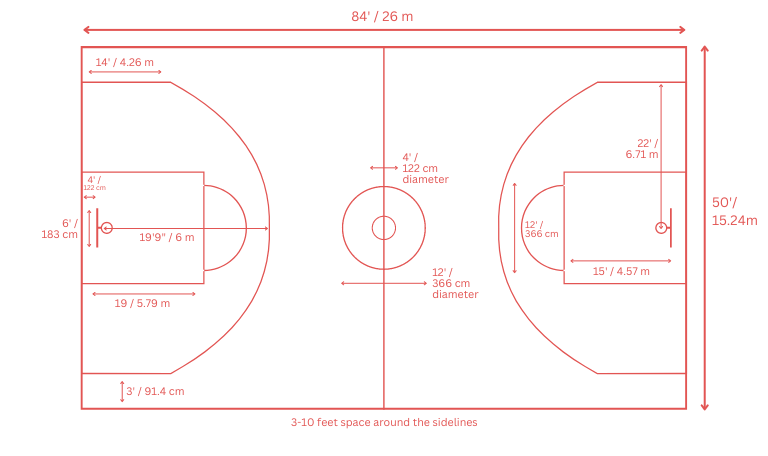
Image Source: sportsvenuecalculator.com
Deciphering Basketball Court Dimensions
The physical space of a basketball court is a carefully defined rectangle, with specific lines and zones dictating the flow and rules of the game. The total basketball court area is derived from its basketball court length and width. While the general shape remains consistent, the exact measurements can vary depending on the governing body and the level of competition.
NBA Court Size: The Pinnacle of Professional Play
The National Basketball Association (NBA) adheres to a very specific set of dimensions for its courts. The NBA court size is renowned for its expansive nature, offering ample room for the fast-paced, athletic play characteristic of professional basketball.
- Length: 94 feet
- Width: 50 feet
To calculate the total basketball court area for an NBA court, we multiply the length by the width:
94 feet * 50 feet = 4,700 square feet
This 4,700 square feet provides the canvas for incredible athletic feats, strategic plays, and the overall spectacle of professional basketball. It’s important to note that this measurement does not include the surrounding space or out-of-bounds areas, focusing solely on the playing surface.
College Basketball Court: A Slight Variation
While very close to NBA specifications, college basketball courts have a minor difference in their dimensions. This is a crucial point for those looking to understand the nuances of different leagues.
- Length: 94 feet (same as NBA)
- Width: 50 feet (same as NBA)
Therefore, a standard NCAA (National Collegiate Athletic Association) college basketball court also measures 4,700 square feet. The consistency in these dimensions at the professional and collegiate levels helps players transition smoothly between different leagues, as they are familiar with the playing surface.
High School Basketball Court: A More Compact Space
High school basketball courts are typically smaller than their professional and collegiate counterparts. This reduction in size can influence gameplay, often leading to a more condensed and potentially faster-paced game.
- Length: 84 feet
- Width: 50 feet
Calculating the basketball court area for a high school court:
84 feet * 50 feet = 4,200 square feet
This difference of 500 square feet might seem small, but it can have a noticeable impact on defensive strategies, the effectiveness of certain offensive plays, and the overall spacing of players on the court.
FIBA Court Size: The International Standard
The Fédération Internationale de Basketball (FIBA) governs international basketball competitions. Their court dimensions are slightly different from those used in North America. These differences are important for understanding the global game of basketball.
- Length: 28 meters (approximately 91.86 feet)
- Width: 15 meters (approximately 49.21 feet)
Let’s calculate the basketball court area in square feet for a FIBA court:
28 meters * 15 meters = 420 square meters
To convert square meters to square feet, we use the conversion factor 1 square meter ≈ 10.764 square feet:
420 square meters * 10.764 square feet/square meter ≈ 4,520.88 square feet
So, a FIBA court is approximately 4,521 square feet. This difference, while not dramatic, can still be felt by players accustomed to the NBA or NCAA dimensions. The slightly shorter length and narrower width can influence passing lanes, defensive positioning, and the overall rhythm of the game.
Factors Influencing Basketball Court Area
While the primary measurements define the basketball court area, other factors can contribute to the overall space required for a functional court.
Indoor vs. Outdoor Basketball Courts
The concept of an indoor basketball court and an outdoor basketball court often refers to the location and environment. The playing surface itself typically adheres to standard dimensions regardless of whether it is indoors or outdoors. However, outdoor courts might have slightly more variability due to the nature of their construction and public access.
- Indoor Courts: These are usually found in gymnasiums, sports complexes, and recreational centers. They are built to precise specifications to ensure fair play and player safety. The basketball court measurement here is strictly controlled.
- Outdoor Courts: These can range from dedicated public parks to recreational areas. While many aim for regulation size, some may be slightly smaller or have non-standard markings due to space constraints or the nature of their construction. However, when discussing a regulation outdoor basketball court, the dimensions and resulting area will align with the league standards they are intended to represent.
Surrounding Space and Safety Zones
It’s important to distinguish the basketball court area from the total space required for a court. Safety is paramount in basketball, and regulations often dictate a minimum amount of clear space around the court’s perimeter. This “run-off” area provides a safety buffer for players who may go out of bounds or make sudden movements.
- Minimum Run-Off: Typically, a minimum of 3 feet of clear space is recommended on all sides of the court. Professional and collegiate facilities often provide even more, sometimes 5 feet or more, especially behind the baskets.
- Total Facility Area: When planning a basketball facility, the total square footage needed will be significantly larger than just the court itself, accounting for bleachers, walkways, locker rooms, and the safety zones.
Specialized Courts and Variations
While we’ve focused on regulation sizes, it’s worth noting that not all basketball courts are built to these exact specifications.
- Half-Courts: Many recreational areas or driveways feature half-courts, which are significantly smaller and often not to regulation basketball court dimensions.
- Youth Leagues: Younger players might use courts with adjusted dimensions or lower basket heights to better suit their physical development.
Calculating Basketball Court Area: A Practical Approach
The calculation of basketball court area is straightforward multiplication of its length and width. Let’s reiterate with a focus on practical application.
The Formula for Area
The fundamental formula for the area of a rectangle is:
Area = Length × Width
This simple formula allows us to determine the basketball court area for any set of dimensions.
Example Calculations Recap:
- NBA/College Court: 94 ft * 50 ft = 4,700 sq ft
- High School Court: 84 ft * 50 ft = 4,200 sq ft
- FIBA Court: 28 m * 15 m ≈ 4,521 sq ft
These figures represent the playable surface, the foundation upon which every game is played. The basketball court measurement ensures a consistent playing field across different venues.
Why Do Dimensions Matter?
The precise basketball court dimensions are not arbitrary; they are carefully chosen to influence the game’s strategy, pacing, and fairness.
Offensive and Defensive Spacing
The size of the court directly impacts how teams spread out on offense and defense.
- Wider Courts: On larger courts like the NBA, there’s more space for players to operate, allowing for more isolation plays, effective pick-and-rolls, and greater defensive challenges in covering vast areas.
- Narrower Courts: On smaller courts, defenses can often recover more quickly, and offenses might find it harder to create separation. Passing lanes can become tighter, and backcourt pressure can be more effective.
Pace of Play
The court’s dimensions can also affect the game’s tempo.
- Faster Pace: Smaller courts can sometimes contribute to a faster pace, as players have less distance to cover and can transition more quickly from defense to offense.
- Strategic Pace: Larger courts can allow for more deliberate offensive sets and a more strategic approach, as teams have more room to execute plays.
Player Development and Skill Sets
The dimensions can subtly influence the development of player skills.
- Shooting: A larger court might reward long-range shooters more, while a smaller court could emphasize drives and mid-range game.
- Passing: The length of passes and the tightness of passing lanes are directly related to court width.
Measuring a Basketball Court Accurately
Ensuring an accurate basketball court measurement is crucial for official games and for anyone looking to replicate regulation dimensions.
Tools for Measurement
- Measuring Tapes: Long, durable measuring tapes (steel or fiberglass) are essential for measuring the length and width accurately.
- Chalk or Paint: For marking out the court lines, specialized court marking paint or chalk is used.
- Plumb Bob: To ensure that lines are perfectly straight and perpendicular, a plumb bob can be helpful.
- Laser Measures: For larger projects, laser distance measurers can offer quick and precise readings.
Key Markings to Measure
When measuring a court, several key lines and areas need to be accurately placed:
- Boundary Lines: The sidelines and endlines that define the basketball court area.
- Free Throw Lines: Located 15 feet from the front of the backboard.
- The Key (Lane): The rectangular area extending from the baseline under the basket. Its dimensions are also standardized.
- Three-Point Line: The arc that dictates a three-point shot. The distance of this line varies between leagues.
- Center Circle: The circle in the middle of the court for jump balls.
FIBA vs. NBA 3-Point Lines
A notable difference in basketball court dimensions between FIBA and NBA courts is the three-point line.
- NBA: The three-point line is an arc with a distance of 23 feet 9 inches (7.24 meters) from the basket in the corners, extending to 22 feet (6.71 meters) in the corner.
- FIBA: The FIBA three-point line is a uniform arc at a distance of 6.75 meters (22 feet 1.75 inches) from the basket.
These variations in the three-point line, while not affecting the overall basketball court area, can significantly influence offensive strategies and scoring patterns.
Tables Summarizing Court Dimensions and Areas
To provide a clear overview, let’s consolidate the key figures in tables.
Table 1: Standard Basketball Court Dimensions
| League/Level | Length (feet) | Width (feet) | Area (sq ft) | Length (meters) | Width (meters) | Area (sq m) |
|---|---|---|---|---|---|---|
| NBA | 94 | 50 | 4,700 | 28.65 | 15.24 | 436.96 |
| NCAA (College) | 94 | 50 | 4,700 | 28.65 | 15.24 | 436.96 |
| High School | 84 | 50 | 4,200 | 25.60 | 15.24 | 390.50 |
| FIBA (International) | ~91.86 | ~49.21 | ~4,521 | 28 | 15 | 420 |
(Note: FIBA dimensions are often cited in meters, with feet conversions being approximate.)
Table 2: Comparison of Key Court Features
| Feature | NBA / NCAA | FIBA | High School |
|---|---|---|---|
| Court Length | 94 ft (28.65 m) | 28 m (91.86 ft) | 84 ft (25.60 m) |
| Court Width | 50 ft (15.24 m) | 15 m (49.21 ft) | 50 ft (15.24 m) |
| 3-Point Line | 23 ft 9 in (22 ft corners) | 6.75 m (22 ft 1.75 in) | 19 ft 9 in (6.02 m) |
| Free Throw Line | 15 ft (4.57 m) | 4.6 m (15.09 ft) | 15 ft (4.57 m) |
These tables clearly illustrate that while the overall basketball court area might differ, specific line placements also contribute to the distinct characteristics of each league’s playing surface.
Frequently Asked Questions About Basketball Court Square Footage
Q1: What is the exact square footage of a regulation NBA basketball court?
A regulation NBA basketball court has a basketball court area of exactly 4,700 square feet.
Q2: Is a college basketball court the same size as an NBA court?
Yes, the college basketball court dimensions are the same as an NBA court, resulting in the same basketball court area of 4,700 square feet.
Q3: How much smaller is a high school basketball court than an NBA court?
A high school basketball court is 10 feet shorter than an NBA court (84 ft vs. 94 ft), while the width is the same (50 ft). This makes the high school court’s basketball court area 500 square feet smaller, totaling 4,200 square feet.
Q4: Does FIBA have different court dimensions?
Yes, FIBA courts are slightly different, typically measuring 28 meters by 15 meters, which equates to approximately 4,521 square feet. This is a key difference in basketball court measurement for international play.
Q5: Does the surface of the court (wood vs. asphalt) affect the square footage?
No, the basketball court area is determined by the basketball court length and width, not the material of the surface. Whether it’s an indoor basketball court with hardwood or an outdoor basketball court with asphalt, the playing dimensions are what define the square footage.
In conclusion, the basketball court area is a fundamental aspect of the sport, with variations that reflect different levels of play and international standards. From the expansive 4,700 square feet of an NBA court to the slightly more compact FIBA and high school courts, each dimension plays a role in shaping the game. Understanding these measurements provides valuable insight into the strategic and physical demands placed upon players and coaches alike.