
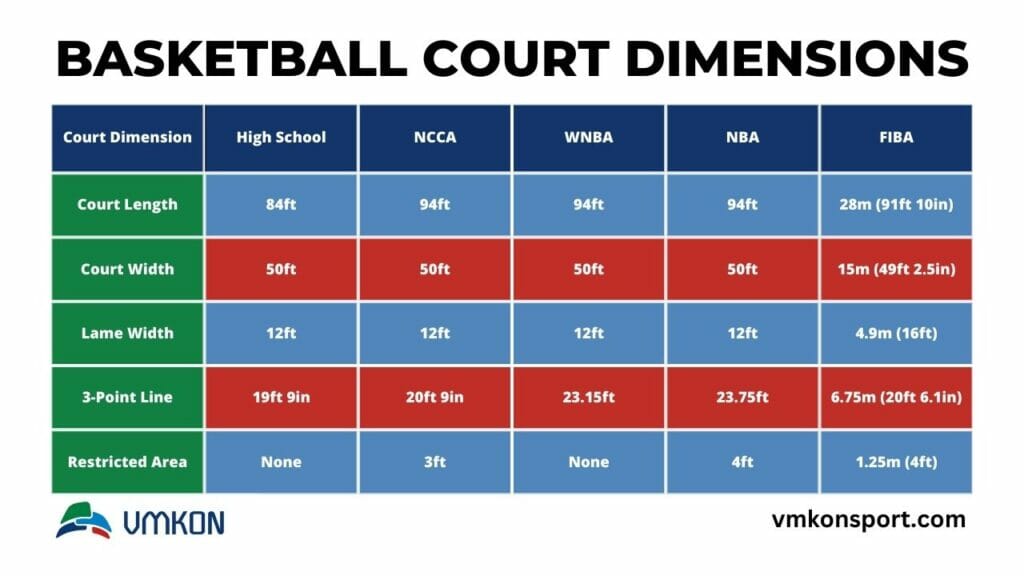
Image Source: vmkonsport.com
How Many Laps Around A Basketball Court Is A Mile?
To determine how many laps around a basketball court equal a mile, you first need to know the court dimensions. A standard NBA basketball court length is 94 feet. The total court perimeter – the distance around the entire court – is what we need to calculate. If you’re running on a basketball court, knowing this court measurement is key for tracking your exercise distance.
Deciphering the Court Perimeter
A standard basketball court is a rectangle. The length is 94 feet. The width is 50 feet. To find the distance of one lap, we need to calculate the perimeter. The formula for the perimeter of a rectangle is 2 * (length + width).
So, for a standard NBA court:
- Length = 94 feet
- Width = 50 feet
- Perimeter = 2 * (94 feet + 50 feet)
- Perimeter = 2 * (144 feet)
- Perimeter = 288 feet
This means one full lap around a regulation NBA basketball court size is 288 feet.
The Mile Conversion: From Feet to Laps
Now, we need to figure out how many of these 288-foot laps it takes to reach a mile. A mile is a unit of distance, and we need to convert it to feet to compare it with our court measurement.
- 1 mile = 5,280 feet
To find the number of laps, we divide the total distance of a mile by the distance of one lap around the court.
- Number of laps = Total distance (in feet) / Distance per lap (in feet)
- Number of laps = 5,280 feet / 288 feet
Let’s do the math:
5,280 / 288 = 18.333…
This means it takes approximately 18.33 laps around a standard NBA basketball court to complete one mile.
Different Court Sizes, Different Laps
It’s important to remember that not all basketball courts are the same size. While the NBA sets a standard, other leagues and recreational courts might have different dimensions.
High School and College Courts
- High School courts are typically 84 feet long and 50 feet wide.
- College courts are also 94 feet long and 50 feet wide, just like NBA courts.
Let’s calculate the perimeter for a high school court:
- Length = 84 feet
- Width = 50 feet
- Perimeter = 2 * (84 feet + 50 feet)
- Perimeter = 2 * (134 feet)
- Perimeter = 268 feet
Now, let’s see how many laps it takes to make a mile on a high school court:
- Number of laps = 5,280 feet / 268 feet
- Number of laps = 19.701…
So, on a high school court, it’s closer to 19.7 laps to make a mile. This is a good example of how court dimensions affect your exercise distance when running laps.
FIBA (International Basketball) Courts
International courts have different specifications:
- FIBA courts are 28 meters long and 15 meters wide.
Let’s convert these to feet for consistency:
- 1 meter ≈ 3.28084 feet
- Length = 28 meters * 3.28084 feet/meter ≈ 91.86 feet
- Width = 15 meters * 3.28084 feet/meter ≈ 49.21 feet
Now, calculate the perimeter of a FIBA court:
- Perimeter = 2 * (91.86 feet + 49.21 feet)
- Perimeter = 2 * (141.07 feet)
- Perimeter = 282.14 feet
And the number of laps to a mile on a FIBA court:
- Number of laps = 5,280 feet / 282.14 feet
- Number of laps = 18.714…
As you can see, even slight variations in court measurement can change the number of running laps needed to hit your mile conversion goal.
Making the Most of Running on a Basketball Court
Running laps on a basketball court can be a great way to get in your cardio. Here’s why it’s a good option and how to approach it:
Benefits of Running on a Basketball Court
- Consistent Surface: Unlike outdoor tracks or sidewalks, a basketball court offers a smooth, predictable surface. This can reduce the risk of tripping or uneven impact on your joints.
- Defined Space: The clear boundaries of the court make it easy to track your distance and stay focused on your workout.
- Varied Workout: You can incorporate interval training, sprints, or steady-state running. You can also use the lines on the court for different training drills.
- Weather Independent: Indoor courts allow you to exercise regardless of rain, snow, or extreme heat.
Tips for Running Laps
- Warm-up: Always start with a dynamic warm-up to prepare your muscles. This could include leg swings, high knees, and butt kicks.
- Cool-down: After your run, cool down with some static stretches, focusing on your hamstrings, quads, and calves.
- Pacing: Try to maintain a consistent pace for each lap. If you’re new to running laps, start with a comfortable pace and gradually increase intensity.
- Footwear: Wear supportive athletic shoes designed for running.
- Hydration: Bring water to stay hydrated, especially during longer sessions.
Practical Applications and Considerations
Knowing the exact number of laps is crucial for anyone using a basketball court for structured training.
Training for a 5K or Marathon
If you’re training for longer races, you might use the court as a consistent place to build mileage. You can string together multiple mile-equivalents to reach your weekly distance goals. For example, if you need to run 3 miles, you’d complete about 55 laps on an NBA court (18.33 laps/mile * 3 miles).
Interval Training
The lines on a basketball court can be used for interval training. You could sprint from one baseline to the other, jog to the half-court line, and then sprint back to the baseline. This adds variety and intensity to your exercise distance.
Fitness Tracking Apps
Many fitness trackers and apps allow you to input the custom distance of your “track” or “lap.” This way, you can accurately log your exercise distance when running on a basketball court. You would input the perimeter of the court (e.g., 288 feet for an NBA court) into the app’s settings.
What if the Court Isn’t Standard?
If you’re unsure about the exact dimensions of the court you’re using, it’s a good idea to measure it. You can use a long measuring tape or even a smartphone app designed for measuring distances. Once you have the precise court perimeter, you can perform the same calculation to determine your specific mile conversion. Don’t rely solely on assumptions about basketball court size if accuracy is important.
Frequently Asked Questions (FAQ)
Q1: How many laps around a basketball court is a mile?
A1: It depends on the size of the court. For a standard NBA court (94 feet long x 50 feet wide), it’s approximately 18.33 laps.
Q2: Can I use any basketball court for mile tracking?
A2: Yes, but you need to know its dimensions to accurately calculate the number of laps. High school courts or international courts will have different lap counts.
Q3: What is the standard NBA basketball court length?
A3: The standard NBA basketball court length is 94 feet.
Q4: What is the perimeter of a standard basketball court?
A4: The perimeter of a standard NBA court is 288 feet.
Q5: How do I calculate the number of laps for a mile on a non-standard court?
A5: Measure the length and width of the court. Calculate the perimeter using the formula: 2 * (length + width). Then, divide 5,280 feet (the number of feet in a mile) by the court’s perimeter in feet. This will give you the number of laps required for one mile.
Q6: Is running on a basketball court good for exercise?
A6: Yes, running on a basketball court provides a consistent surface, a defined space for running laps, and can be used for various types of workouts, making it excellent for exercise distance tracking.
Q7: Are there differences in basketball court sizes internationally?
A7: Yes, FIBA (International Basketball Federation) courts have different dimensions than NBA courts, affecting the court measurement and the mile conversion.
Q8: How can I improve my running laps on a basketball court?
A8: Focus on consistent pacing, warm-ups and cool-downs, proper footwear, and staying hydrated. You can also incorporate interval training using the court lines.