
A proper basketball bounce typically reaches about half the height from which it was dropped, indicating optimal inflation and a healthy ball. This bounce height is a critical indicator of a basketball’s pressure and readiness for play.
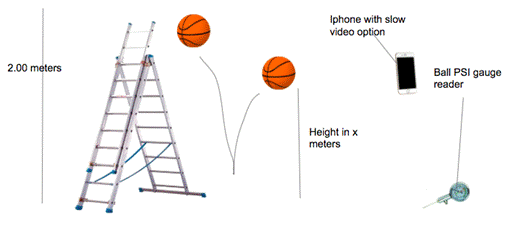
Image Source: tuhsphysics.ttsd.k12.or.us
The Physics Behind a Perfect Bounce
The way a basketball bounces is a fascinating interplay of physics. When you drop a basketball, it possesses potential energy due to its height. As it falls, this potential energy converts into kinetic energy, the energy of motion. Upon impact with the ground, this kinetic energy is momentarily stored as elastic potential energy within the deformed ball. The ball then uses this stored energy to push back against the ground, propelling itself upwards. The height it returns to is influenced by how much energy is lost during the impact and how efficiently the ball can store and release that energy.
Energy Transformations in a Bounce
- Potential Energy to Kinetic Energy: As the ball drops, gravity pulls it down, increasing its speed and therefore its kinetic energy.
- Kinetic Energy to Elastic Potential Energy: Upon hitting the court, the ball deforms. This deformation stores the kinetic energy as elastic potential energy.
- Elastic Potential Energy to Kinetic Energy (Upward): The ball’s inherent elasticity causes it to spring back to its original shape, converting the stored elastic energy back into kinetic energy, pushing it upward.
- Energy Loss: Not all the initial energy is returned. Some energy is lost as heat and sound during the impact. A well-inflated, properly constructed ball minimizes these losses.
Factors Influencing Basketball Bounce Height
Several factors contribute to how high a basketball bounces. These can be broadly categorized into the ball’s condition and external environmental factors.
Ball Inflation: The Primary Determinant
The most significant factor influencing a basketball’s bounce height is its inflation level. An under-inflated ball lacks the internal pressure to store and release energy effectively, resulting in a “dead” bounce. Conversely, an over-inflated ball can be too rigid, leading to a loss of energy through excessive deformation and poor grip, potentially causing it to bounce erratically or too high.
Basketball Pressure Check: The Ideal Range
Manufacturers typically recommend a specific pressure range for basketballs, usually printed on the ball itself or in its accompanying literature. This range is crucial for achieving the proper basketball bounce. A common guideline is to have the ball bounce to approximately half the height from which it was dropped. For instance, if you drop a properly inflated basketball from waist height (around 3 feet), it should rebound to about knee height (around 1.5 feet). This basketball bounce test is a simple yet effective way to gauge if your ball is correctly inflated.
How to Perform a Basketball Pressure Check
- Find a Hard Surface: A basketball court or a smooth concrete floor works best.
- Stand the Ball Up: Place the ball on the surface.
- Drop from Waist Height: Hold the ball at your waist and drop it straight down.
- Observe the Rebound: Watch how high the ball bounces back up.
What is the ideal basketball bounce?
The ideal basketball bounce is one that returns to about 50% of the original drop height. This signifies the correct internal air pressure for optimal playability and responsiveness.
Ball Material and Construction
The materials used in a basketball’s construction also play a role.
- Outer Cover: Whether it’s genuine leather, composite leather, or rubber, the texture and durability of the cover affect grip and how the ball interacts with the court.
- Bladder: The internal bladder, typically made of butyl rubber, holds the air. Its integrity and elasticity are vital for a consistent bounce.
- Lining: Layers of nylon or polyester thread are wound around the bladder to help the ball maintain its shape and contribute to its bounce characteristics.
A well-constructed ball with a good quality bladder will exhibit a more predictable and lively bounce compared to a cheaply made ball.
Court Surface
The surface on which the basketball is dropped also impacts the bounce height.
- Hardwood Courts: These are designed to provide excellent grip and consistent bounce, absorbing minimal energy.
- Concrete: Concrete is also hard but can be more abrasive. It generally provides a good bounce, though it might feel slightly different from hardwood.
- Asphalt: Asphalt courts are often rougher and can absorb more energy, leading to a slightly lower bounce.
- Grass or Sand: These surfaces are too soft and will absorb a significant amount of the ball’s energy, resulting in a very poor bounce.
The basketball performance bounce is therefore dependent on the interaction between the ball and the court surface.
Temperature
The temperature of the air inside the ball and the surrounding environment can affect bounce.
- Warmer Temperatures: Air expands in warmer temperatures, increasing the internal pressure slightly and potentially leading to a slightly higher bounce.
- Colder Temperatures: Cold air contracts, decreasing internal pressure and resulting in a lower bounce. This is why basketballs can feel “flat” in cold weather.
Achieving the Proper Basketball Bounce for Dribbling
The proper basketball bounce is not just about checking inflation; it’s also about mastering dribbling technique height. The height at which you dribble the ball has a significant impact on your control, speed, and ability to perform various moves.
How High to Dribble: Different Scenarios
The ideal basketball dribbling height varies depending on the situation:
Low Dribble (Control and Protection)
- Height: Typically bounces to about knee height or lower.
- Purpose: Used when closely guarded or trying to protect the ball. This low bounce makes it difficult for defenders to steal.
- Technique: Requires a controlled, forceful push down with the fingertips. The ball stays close to the ground.
Medium Dribble (General Play)
- Height: Bounces to about waist height.
- Purpose: This is the most common dribble height for general movement up the court. It allows for good control while maintaining a reasonable pace.
- Technique: A fluid motion where the hand stays over the ball, and the dribble is controlled with the palm and fingertips.
High Dribble (Speed and Open Court)
- Height: Bounces to chest or shoulder height.
- Purpose: Used in open court situations when you need to move quickly and are not under immediate defensive pressure.
- Technique: A more powerful push with the arm, allowing the ball to rebound higher and faster. Requires good hand-eye coordination to track the higher bounce.
Dribbling Technique Height and Control
Mastering different dribbling technique height levels is crucial for effective basketball play.
- Hand Position: Keep your hand on top of the ball, fingers spread.
- Wrist Action: Use your wrist for quick, responsive dribbles, especially at lower heights.
- Arm Extension: For higher dribbles, a full arm extension is necessary.
- Vision: Always try to keep your head up to see the court, even when dribbling. This is easier with a consistent, predictable bounce.
The Basketball Bounce Test: More Than Just Pressure
While the bounce test is primarily a basketball pressure check, it also reveals aspects of the ball’s overall condition and basketball performance bounce.
What the Bounce Test Reveals
- Inflation: As discussed, it’s the primary indicator of correct air pressure.
- Ball Integrity: A ball that bounces inconsistably or in a strange direction might have internal issues, like a misaligned bladder or damage to the lining.
- Wear and Tear: An old, worn-out ball might lose some of its elasticity, resulting in a lower bounce even when properly inflated. The cover’s texture can also degrade, affecting grip and bounce.
When to Re-inflate or Replace Your Ball
- Low Bounce: If your ball consistently fails to reach half the drop height, it needs more air.
- Inconsistent Bounce: If the ball bounces differently on various spots or seems to veer off course, it might be damaged.
- Hardness: If the ball feels unusually hard and “dead” even when dropped from a significant height, it might be over-inflated or have a compromised bladder.
- Worn Cover: If the grip is significantly reduced due to wear, it’s time for a replacement, as this affects dribbling control.
The Science of the Basketball Bounce: Deeper Dive
The basketball bounce physics involve concepts like the coefficient of restitution, a measure of how “bouncy” an object is. It’s the ratio of the speed of separation to the speed of approach.
Coefficient of Restitution (COR)
The COR for a basketball is influenced by:
- Internal Pressure: Higher pressure generally leads to a higher COR.
- Material Elasticity: The materials of the bladder and cover contribute to how well the ball stores and releases energy.
- Temperature: As mentioned, temperature affects air pressure and material properties.
A basketball with a COR of 0.5 (meaning it returns to half its original height) is generally considered to be within the optimal range for play.
Why Different Balls Bounce Differently
Even when inflated to the same pressure, different basketballs will have slightly different bounce characteristics due to variations in:
- Materials: The quality and type of leather, composite, or rubber used.
- Construction: The way the panels are stitched or bonded, and the type of lining used.
- Weight Distribution: Subtle differences in how the internal components are assembled can affect balance and bounce.
Optimizing Basketball Performance Bounce
Achieving the basketball performance bounce means ensuring your ball is in prime condition.
Tips for Maintaining Your Basketball
- Regular Pressure Checks: Use a pressure gauge for accuracy, or rely on the drop test.
- Proper Storage: Store the ball in a cool, dry place, away from direct sunlight or extreme temperatures.
- Cleanliness: Wipe down the ball with a damp cloth after use to remove dirt and oils. Avoid harsh cleaning agents.
- Avoid Over-Inflation: Stick to the recommended pressure to prevent damage to the ball.
- Use on Appropriate Surfaces: Reserve your best balls for indoor courts or clean outdoor surfaces to prolong their lifespan.
The Role of Inflation in Dribbling
A properly inflated ball makes basketball dribbling much more effective.
- Predictability: You know how the ball will react, allowing for smoother transitions and better control.
- Responsiveness: The ball springs back quickly, enabling faster dribbles and sharper changes in direction.
- Grip: The correct inflation provides the optimal surface texture for your hand to grip and control the ball. A ball that’s too soft offers poor grip, while one that’s too hard can be slippery.
How to Achieve the Ideal Basketball Bounce
To ensure you have the ideal basketball bounce:
- Inflate Correctly: Aim for the recommended pressure, confirmed by the drop test.
- Use a Quality Ball: Invest in a reputable brand for better durability and consistent performance.
- Play on Suitable Courts: Minimize wear and tear by using the ball on appropriate surfaces.
- Maintain the Ball: Keep it clean and stored properly.
Common Questions About Basketball Bounce
FAQ
- How do I know if my basketball is over-inflated?
An over-inflated ball will feel very hard and may bounce erratically or excessively high, often with less grip. It might also feel uncomfortable to dribble. - Can I use a basketball indoors if it’s designed for outdoors?
Yes, but an outdoor ball may be more abrasive and wear down faster on indoor courts. Indoor balls are typically made with softer materials for better grip and feel. - Does the brand of basketball matter for its bounce?
Yes, higher-quality brands generally use better materials and construction, leading to more consistent and durable bounce characteristics. - What is the best way to pump up a basketball?
Use a ball pump with a needle and inflate slowly, checking the pressure periodically with a gauge or the bounce test. Ensure the needle is lubricated with a drop of water or glycerin before inserting it. - How often should I check my basketball’s pressure?
It’s a good practice to check the pressure before each play session, especially if the ball has been stored for a while or if there have been significant temperature changes.
By paying attention to the science behind the bounce and ensuring your ball is properly inflated and maintained, you can significantly enhance your game and enjoy a more responsive and controlled dribbling experience. The basketball bounce height is your most reliable guide to a ball that’s ready for action.