
Can you train to be better at basketball? Yes, you absolutely can! Effective basketball training involves a blend of skill development, physical conditioning, and mental preparation. This comprehensive guide will walk you through how to train for basketball to dominate on the court.
Basketball is a game of skill, speed, agility, and endurance. To truly excel, you need a well-rounded training regimen that targets every aspect of your game. This isn’t just about showing up for practice; it’s about dedicated, smart training that pushes your limits and refines your abilities. Whether you’re aiming for your school team, a local league, or just want to impress your friends, this guide will provide the roadmap to elevate your basketball performance.
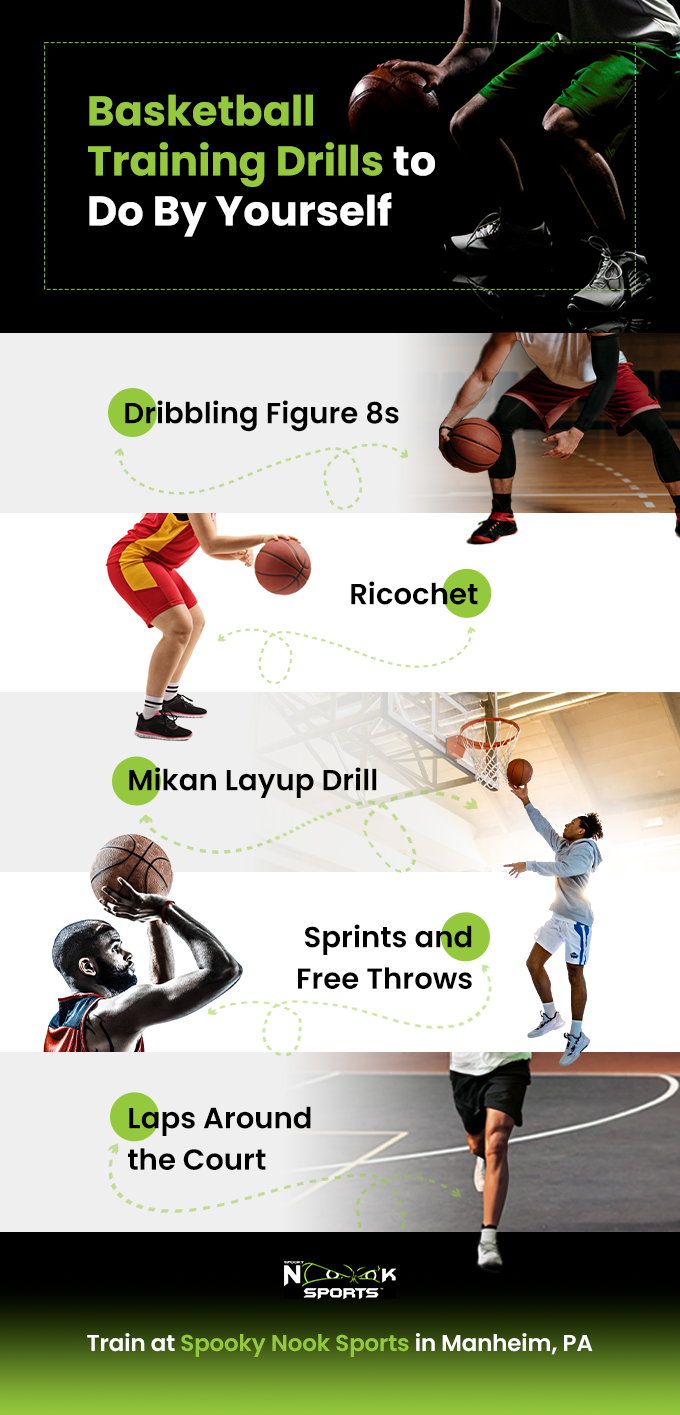
Image Source: www.spookynooksports.com
Mastering the Fundamentals: Core Basketball Skills
Every great basketball player starts with strong fundamentals. These are the building blocks of your game, and consistent practice is key.
Basketball Drills for Skill Enhancement
To truly improve, you need to engage in specific basketball drills that target different aspects of play. Repetition and focus are paramount.
Ball Handling and Dribbling Skills
Dribbling is the lifeblood of offensive play. You need to be comfortable with the ball in your hands, able to dribble effectively with both hands, and execute various moves to evade defenders.
- Stationary Dribbling:
- Low Dribble: Keep the ball low to the ground, chest over the ball, and use your fingertips. This protects the ball from defenders.
- High Dribble: Dribble at waist height to build confidence and control.
- Crossover Dribble: Practice switching the ball from one hand to the other in front of your body.
- Between-the-Legs Dribble: Master crossing the ball over between your legs.
- Behind-the-Back Dribble: Develop the ability to switch hands behind your back.
- Dribbling on the Move:
- Full Court Dribbling: Dribble the length of the court, changing pace and direction.
- Cone Drills: Set up cones and practice dribbling around them using various moves (crossover, between-the-legs, behind-the-back).
- Two-Ball Dribbling: Dribbling two balls simultaneously significantly improves hand-eye coordination and control. Start with stationary drills and progress to moving.
Shooting Practice for Precision and Power
Shooting is how you score, so it needs to be a top priority. A consistent shooting form is crucial.
- Form Shooting: Start close to the basket, focusing solely on your shooting mechanics: B.E.E.F. (Balance, Eyes, Elbow, Follow-through).
- Balance: Feet shoulder-width apart, knees slightly bent.
- Eyes: Focus on the rim or the back of the rim.
- Elbow: Keep your shooting elbow tucked in, forming an “L” shape.
- Follow-through: Extend your shooting arm fully, with your wrist flicked and fingers pointed towards the basket.
- Mid-Range Jumpers: Step back gradually from the basket, focusing on maintaining your form.
- Three-Point Shooting: Once your mid-range game is solid, extend your range. Practice shooting from various spots on the court.
- Free Throws: Develop a consistent routine for free throws. Practice them when you’re tired to simulate game pressure.
- Shooting Off the Dribble: Practice pulling up for a shot after dribbling or making a move.
- Shooting Off the Catch: Simulate receiving a pass and immediately shooting.
Basketball Footwork for Agility and Balance
Good footwork is essential for everything you do on the court, from defense to offense. It provides stability, allows for quick changes of direction, and helps you create space.
- Defensive Slides: Stay low in a defensive stance and slide laterally, keeping your feet active and your chest up. Practice sliding without crossing your feet.
- Pivoting: Learn to pivot on your dominant foot without traveling. Practice front and reverse pivots.
- Jab Steps: A jab step is a quick forward jab with your non-pivot foot. It’s used to create space, fake a drive, or freeze a defender.
- Jump Stops: Coming to a controlled stop on both feet simultaneously. This allows you to survey the court and make a play.
- Triple Threat Position: This is the fundamental offensive stance where you can shoot, pass, or dribble. It involves being balanced, with your knees bent and your eyes up.
Defensive Techniques for Lockdown Play
Defense wins championships. Mastering defensive techniques will make you a valuable asset to your team.
- Stance: A low, balanced stance with knees bent, back straight, and arms out.
- On-Ball Defense: Staying in front of your man, mirroring their movements, and using your arms to contest shots without fouling.
- Off-Ball Defense: Maintaining vision of both your man and the ball. Positioning yourself to deny passes and help on drives.
- Closeouts: Rapidly closing the distance to a shooter, forcing them to make a tough decision and maintaining defensive balance.
- Rebounding: Proper box-out technique is crucial. Get low, use your body, and pursue the ball.
Building the Engine: Conditioning for Basketball
Basketball is a demanding sport that requires excellent cardiovascular fitness, strength, and endurance. Conditioning is not optional; it’s a cornerstone of success.
Aerobic and Anaerobic Conditioning
You need to be able to sprint, stop, jump, and change direction repeatedly throughout a game.
- Sprints: Timed sprints over various distances (e.g., 10, 20, 40 yards) to improve explosive speed.
- Suicides/Line Drills: Running to different lines on the court and back. This mimics the stop-and-start nature of basketball.
- Interval Training: Alternating periods of high-intensity activity with periods of rest or low-intensity recovery. This builds both aerobic and anaerobic capacity.
- Tempos: Running at a sustained, challenging pace for a set distance or time.
Stamina and Endurance
Games can be long and grueling. You need the stamina to perform at a high level for the entire duration.
- Long-Distance Running: While not the primary focus, some longer runs can build a solid aerobic base.
- Circuit Training: Combining a series of exercises with minimal rest in between. This keeps your heart rate elevated and builds endurance.
Fortifying Your Frame: Strength Training for Basketball
Strength training is vital for developing explosive power, preventing injuries, and improving overall athleticism.
Key Muscle Groups to Target
Focus on compound movements that work multiple muscle groups simultaneously.
- Legs: Squats, lunges, deadlifts, calf raises. These are critical for jumping, running, and defensive movements.
- Core: Planks, Russian twists, crunches, leg raises. A strong core provides stability for all movements.
- Upper Body: Bench press, overhead press, rows, pull-ups. These contribute to shooting power, passing strength, and finishing through contact.
Incorporating Strength Training into Your Routine
- Frequency: Aim for 2-3 strength training sessions per week, ideally with a rest day in between.
- Progression: Gradually increase the weight, repetitions, or sets as you get stronger.
- Weight Selection: Choose weights that challenge you to complete the target number of repetitions with good form.
- Rest Periods: Allow adequate rest between sets (60-90 seconds) to recover.
Unleashing Explosive Power: Plyometrics for Basketball
Plyometrics are exercises that involve explosive movements to increase muscular power and improve your vertical jump.
Essential Plyometric Exercises
- Squat Jumps: Jump as high as possible from a squat position.
- Box Jumps: Jump onto a stable platform or box from a standing position.
- Lunge Jumps: Alternate lunging forward and jumping to switch legs in mid-air.
- Broad Jumps: Jump forward as far as you can from a standing start.
- Medicine Ball Throws: Overhead throws, chest passes, and rotational throws can improve core and upper body power.
Vertical Jump Training
A higher vertical jump means better rebounding, shot blocking, and finishing at the rim.
- Proper Technique: Ensure you are performing plyometric exercises with correct form to avoid injury and maximize results.
- Progression: Start with lower intensity exercises and gradually increase the height of jumps or the number of repetitions.
- Frequency: Plyometrics are taxing on the body. 1-2 sessions per week are usually sufficient, integrated with your other training.
- Listen to Your Body: Rest and recovery are crucial when incorporating plyometrics.
Enhancing Quickness: Agility Drills for Basketball
Agility is your ability to change direction quickly and efficiently. This is a game-changer in basketball.
Drills to Boost Agility
- Ladder Drills: Various footwork patterns through an agility ladder (e.g., Icky Shuffle, Two Feet In/Out).
- Cone Drills:
- T-Drill: Sprint forward, shuffle sideways, shuffle back, then shuffle sideways again to the starting point.
- Pro Agility (5-10-5 Shuttle): Start at the center line, sprint 5 yards to one side, touch the line, sprint 10 yards to the other side, touch that line, and then sprint back to the center.
- Zig-Zag Drills: Dribble through a series of cones in a zig-zag pattern.
- Defensive Shuffle Drills: Practice quick lateral movements and changes of direction.
Footwork Drills for Basketball
Integrating specific footwork into agility training makes it directly applicable to the game.
- Defensive slides with a quick change of direction.
- Jab steps followed by a quick burst.
- Pivoting out of a defensive slide.
The Mental Game: Preparation and Mindset
Basketball isn’t just physical; it’s also a mental battle. A strong mindset can be the difference between winning and losing.
Visualization and Focus
- Visualize Success: Imagine yourself making shots, executing defensive plays, and contributing to your team’s victory.
- Stay Present: Focus on the current play, not past mistakes or future anxieties.
- Develop Routines: Pre-game routines can help you get into the right mindset.
Resilience and Confidence
- Learn from Mistakes: Every player makes errors. The key is to learn from them and move on.
- Positive Self-Talk: Encourage yourself and maintain a positive attitude.
- Teamwork: Basketball is a team sport. Communicate, support your teammates, and work together.
Sample Training Week Structure
Here’s a sample structure for a training week. This can be adjusted based on your current fitness level, available time, and specific goals.
Table 1: Sample Basketball Training Week
| Day | Focus Area | Activities |
|---|---|---|
| Monday | Skill Development & Light Conditioning | Dribbling drills (stationary & on the move), Shooting practice (form, mid-range), Agility drills (ladder drills), Light cardio (jogging) |
| Tuesday | Strength Training & Explosive Power | Lower body strength (squats, lunges), Plyometrics (box jumps, squat jumps), Core work |
| Wednesday | Skill Development & Defensive Focus | Shooting practice (free throws, off-dribble), Defensive footwork, On-ball/off-ball drills, Conditioning sprints |
| Thursday | Strength Training & Agility | Upper body strength (bench press, rows), Agility drills (cone drills), Core work, Vertical jump drills |
| Friday | Skill Refinement & Game Simulation | Shooting practice (game-speed), Dribbling drills with defensive pressure, Full-court transition drills, Light conditioning |
| Saturday | Active Recovery or Rest | Light stretching, foam rolling, walking, or complete rest. |
| Sunday | Rest | Complete rest to allow the body to recover and adapt. |
Note: This is a general template. Adjust intensity and volume based on your body’s response. Ensure you have at least one full rest day per week.
Frequently Asked Questions (FAQ)
Q1: How often should I practice basketball?
For significant improvement, aim to practice basketball skills at least 3-5 times per week. Combine skill-specific drills with strength and conditioning work.
Q2: What is the most important skill in basketball?
While all skills are important, dribbling and shooting are often considered the most critical for offensive success. However, defense and rebounding are equally vital for winning.
Q3: How can I improve my vertical jump for basketball?
Improving your vertical jump involves a combination of strength training (squats, deadlifts), plyometrics (box jumps, squat jumps), and proper technique. Consistency and progressive overload are key.
Q4: Can I train for basketball at home?
Yes, you can do a lot of basketball training at home. This includes ball-handling drills, shooting practice (if you have access to a hoop), bodyweight strength exercises, and plyometrics. Many agility drills can also be adapted for a smaller space.
Q5: How do I prevent injuries while training for basketball?
Proper warm-up, cool-down, listening to your body, using correct technique during exercises, and adequate rest are crucial for injury prevention. Cross-training and focusing on flexibility can also help.
By dedicating yourself to consistent, smart training across all these areas—skill development, strength, conditioning, and mental preparation—you’ll be well on your way to dominating the basketball court. Remember, progress takes time and effort, but the rewards of becoming a skilled and impactful player are immense.