
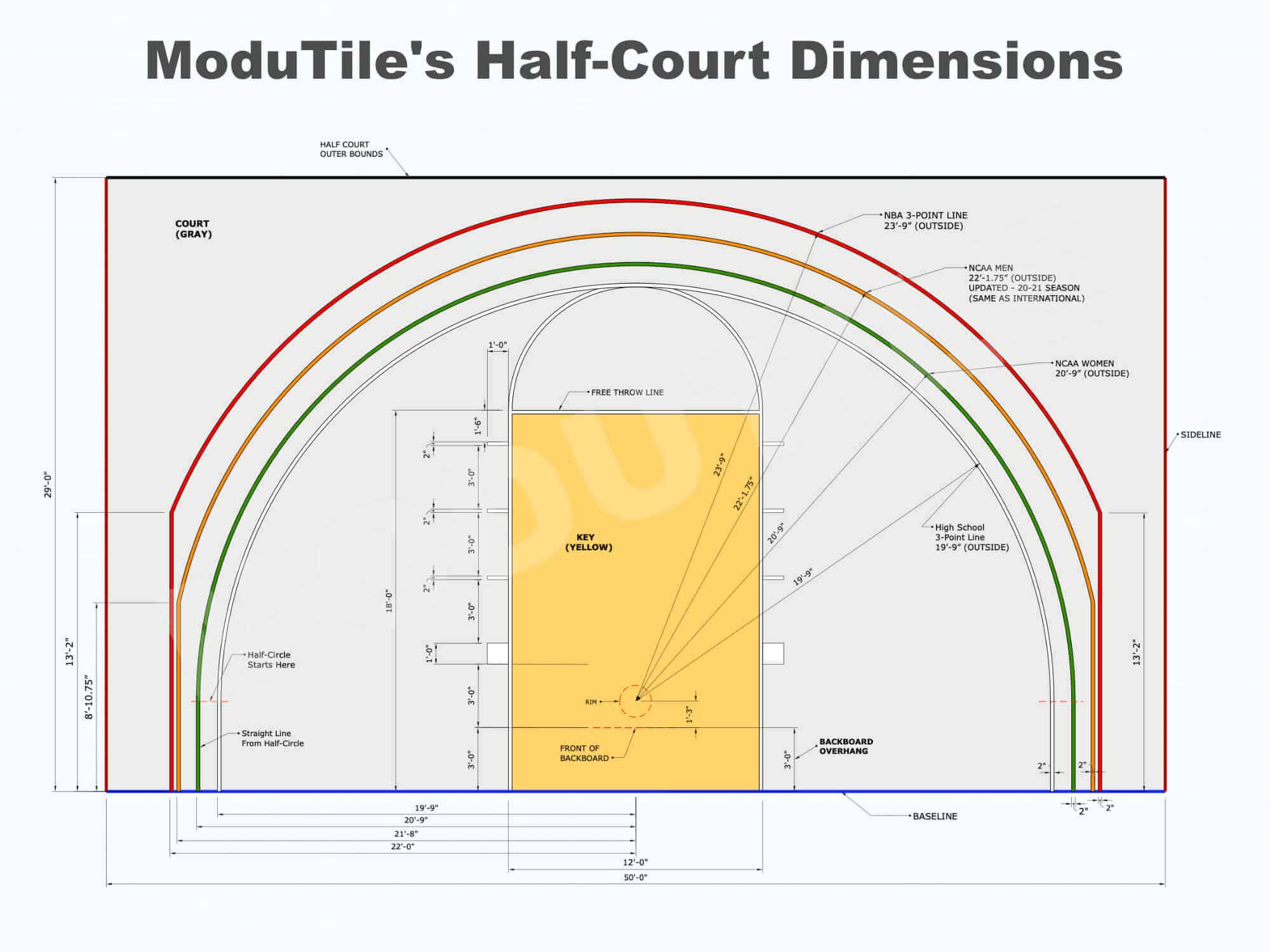
Image Source: modutile.com
How Many Square Feet Is A Half Basketball Court?
A half basketball court, generally speaking, occupies approximately 2,350 square feet. This figure is based on the standard half court measurement of 50 feet in length and 47 feet in width, accounting for the free-throw line and semicircle.
The world of basketball is filled with varied court sizes, from professional arenas to backyard setups. When we talk about a half basketball court, we’re often referring to a scaled-down version of the full court, designed for more intimate games or specific training purposes. Fathoming the exact square footage involves looking at the established dimensions. The typical half basketball court dimensions are a crucial starting point. While a full NBA court measures 94 feet by 50 feet, a half court often takes up half of this length, but the width usually remains the same, or is adjusted for space constraints.
Deciphering the Dimensions of a Half Basketball Court
To accurately calculate the half court size in square feet, we need to examine the key measurements that define this space. The primary elements are the length and the width.
Standard Half Court Measurement
The most common configuration for a standard half court is derived from dividing a full court in half lengthwise. A standard NBA court is 94 feet long. Therefore, half of that length is 47 feet. The width of a standard basketball court is 50 feet.
So, for a standard half court, we are looking at a rectangular area measuring approximately 47 feet in length by 50 feet in width.
Calculating the Area
To find the area in square feet, we simply multiply the length by the width:
Area = Length × Width
Area = 47 feet × 50 feet
Area = 2,350 square feet
This 2,350 square feet is the basic rectangular area. However, real-world half courts often include additional features that can slightly alter the usable or designated space.
Beyond the Basic Rectangle: What Else Influences Half Court Size?
While the 2,350 square feet provides a solid baseline, several factors can influence the overall space required for a functional half basketball court. These can include:
- Free Throw Line and Arc: The free-throw line is a critical component. It’s positioned 15 feet from the backboard. The semi-circular arc at the top of the key (the “charge arc” or “restricted area arc”) extends from this point. This adds a small but defined area to the court’s geometry.
- Three-Point Line: Depending on the league or intended use, a half court might include a three-point line. The distance of the three-point line varies. For example, in the NBA, it’s 23 feet 9 inches at the top of the arc and 22 feet in the corners. In FIBA, it’s 20 feet 6 inches. Including this line means more of the court’s length is utilized.
- Sidelines and Baselines: While the court itself has defined lines, there’s usually some buffer space around it for player safety and movement. This “out-of-bounds” area isn’t part of the court’s playing surface but contributes to the total square footage needed for the setup.
Variations in Half Court Sizes: Mini, Youth, and 3v3 Courts
Not all half basketball courts are created equal. The term “half basketball court” can encompass a range of sizes, particularly when catering to different age groups or game formats.
Mini Basketball Court Dimensions
A mini basketball court is specifically designed for younger children. These courts are significantly smaller to accommodate the developmental stage of young players. While there isn’t one single standardized dimension for a mini court, a common setup might be around 30 feet by 30 feet or even smaller. This would translate to an area of approximately 900 square feet. The hoops are also lowered to make shooting easier. This smaller scale is crucial for developing fundamental skills without the frustration of a full-sized court.
Youth Basketball Court Size
For youth leagues and training, a youth basketball court size is often a scaled-down version of the regulation court, but larger than a mini court. These courts aim to provide a more realistic playing experience while still being manageable for younger athletes. A typical youth half court might be around 42 feet in length by 40 feet in width, giving an area of approximately 1,680 square feet. Some youth leagues might use a half-length of the full court (47 feet) but a narrower width, or a combination that suits their available space.
Size of a 3v3 Basketball Court
The increasingly popular game of 3×3 basketball also has specific court dimensions. A size of a 3v3 basketball court is actually the same as a standard basketball court, but only half of it is used. The FIBA 3×3 rules state that the court is played on a standard basketball court half-court. This means the playing area is still effectively the standard half court measurement we discussed earlier (47 feet by 50 feet, totaling 2,350 square feet). However, the key difference is that only one basket is used, and the game is played within the markings of that half. The 3×3 three-point line is also a circular arc, similar to the FIBA line.
Small Basketball Court Square Footage Considerations
When planning for a small basketball court square footage is a primary concern. Many homeowners, for instance, want to build a basketball court in their backyard. The available space often dictates the final dimensions.
Backyard Basketball Court Dimensions
Backyard basketball court dimensions are highly variable. A homeowner might have space for a full court, a half court, or even just a shooting area.
- Full Court: Requires significant space, at least 94 feet by 50 feet, plus safety run-off.
- Half Court: As we’ve established, around 47 feet by 50 feet (2,350 sq ft) is standard for a half court, but backyard versions can be adjusted. For example, if space is limited lengthwise, it might be 40 feet by 50 feet (2,000 sq ft). If width is more constrained, it could be 47 feet by 40 feet (1,880 sq ft).
- Shooting Area: These are much smaller, perhaps 20 feet by 20 feet, designed purely for practicing shots.
The key for backyard courts is to create a safe and functional playing surface that fits the available area. This often involves compromises on exact dimensions.
Indoor Half Court Size
An indoor half court size often mirrors the standard half court dimensions (47 feet x 50 feet) if the facility allows. However, indoor spaces, such as gymnasiums in schools or community centers, might have different configurations. Some may have a full court marked, with the intention for it to be used as two half courts simultaneously. Others might have dedicated smaller courts for specific training or recreational play. The height of the ceiling is also a critical factor for indoor play, ensuring there’s enough clearance for shots.
Basketball Court Area Calculation: Putting it All Together
The basketball court area calculation is fundamental to understanding the space needed. Whether you’re building a new court, refurbishing an existing one, or simply curious about the game’s spatial requirements, knowing how to calculate the area is useful.
The formula remains simple: Area = Length x Width.
Let’s look at some common scenarios:
| Court Type | Typical Length (ft) | Typical Width (ft) | Approximate Area (sq ft) | Notes |
|---|---|---|---|---|
| Standard Half Court | 47 | 50 | 2,350 | Based on half of a full NBA court lengthwise. |
| Youth Half Court (approx) | 42 | 40 | 1,680 | Scaled down for younger players. |
| Mini Basketball Court | 30 | 30 | 900 | For very young children. |
| 3v3 Basketball Court | 47 | 50 | 2,350 | Uses one half of a regulation court. |
| Narrower Half Court | 47 | 40 | 1,880 | Space-saving variation. |
| Shorter Half Court | 40 | 50 | 2,000 | Space-saving variation. |
It’s important to remember that these are typical dimensions. Actual measurements can vary based on specific regulations, the available space, and the intended use of the court. For example, a professional or college court might adhere strictly to NBA or NCAA dimensions, while a community center or backyard court might have slightly adjusted measurements due to space limitations.
Factors Affecting the “Perceived” Size
Sometimes, the feeling of a court’s size can be influenced by factors other than just the raw square footage.
- Markings and Lines: The presence and clarity of lines (including the key, free throw line, and three-point arc) define the playing boundaries. A well-marked court can feel more organized and “correctly” sized.
- Hoop Placement: The position of the basketball hoop is central. On a half court, the hoop is at one end, and the gameplay revolves around it, influencing how the space is used.
- Surrounding Area: As mentioned, the run-off area around the court is crucial for safety. If this area is very cramped, the court itself might feel smaller and less conducive to dynamic play.
Practical Applications of Knowing Half Court Size
Why is it important to know how many square feet a half basketball court is?
- Planning and Construction: For anyone looking to build a basketball court, whether in their backyard, a school, or a park, knowing the required square footage is essential for site selection, material ordering, and budget estimation.
- Facility Management: Sports facilities need to know the dimensions and area of their courts for scheduling, maintenance, and ensuring compliance with relevant sporting body regulations.
- Youth Development: Understanding youth basketball court size helps coaches and parents create appropriate training environments that foster skill development and enjoyment for young players.
- Recreational Play: For casual players, knowing the size helps set up games like 3v3 or one-on-one effectively in available spaces.
Conclusion: A Space for Skill and Fun
In summary, while the most common answer to “How many square feet is a half basketball court?” hovers around 2,350 square feet (based on a 47ft x 50ft measurement), the actual size can be flexible. From the compact mini basketball court dimensions for the smallest players to the more spacious youth basketball court size and the precisely defined size of a 3v3 basketball court, each variation serves a specific purpose. Whether for competitive play, skill development, or simply backyard fun, a half basketball court provides a dedicated and manageable space to enjoy the sport. The basketball court area calculation is straightforward, but the context of its use dictates the precise dimensions that will be implemented.
Frequently Asked Questions (FAQ)
Q1: What is the standard length of a half basketball court?
A1: The standard length of a half basketball court is typically 47 feet, derived from half of a regulation NBA court’s length.
Q2: Can I fit a half basketball court in my backyard if I have a 50×60 foot area?
A2: Yes, a 50×60 foot area (3,000 sq ft) is ample space to accommodate a standard half basketball court (approximately 2,350 sq ft). You would have extra space around the court for safety run-off.
Q3: Who determines the dimensions of a youth basketball court size?
A3: The dimensions for youth basketball court sizes are typically determined by the governing bodies of youth sports leagues, schools, or by organizations like USA Basketball or FIBA Youth, often based on age groups and developmental needs.
Q4: How does the size of a 3v3 basketball court compare to a standard half court?
A4: The playing area for a 3v3 basketball court is generally the same as a standard half court (approximately 2,350 sq ft), as it utilizes one half of a full-sized court.
Q5: What are the typical backyard basketball court dimensions if space is limited?
A5: If space is limited in a backyard, typical backyard basketball court dimensions for a half court might be adjusted to around 40 feet by 50 feet or 47 feet by 40 feet, depending on which dimension is more constrained.
Q6: Is the indoor half court size the same as an outdoor half court?
A6: The ideal indoor half court size aims to match the outdoor standard dimensions (47ft x 50ft), but indoor gymnasiums may have variations due to building constraints. However, the playing markings and functional area are usually consistent.