
A standard basketball court, for professional leagues like the NBA, is 94 feet long and 50 feet wide, totaling 4,700 square feet.
Basketball is a game of precision, strategy, and athleticism. From the slam dunk to the buzzer-beater, every element thrives on the meticulously defined playing surface. But have you ever stopped to wonder about the actual size of this arena of action? How many square feet does a basketball court truly encompass? The answer isn’t a single, universal number, as variations exist across different levels of play and governing bodies. However, we can certainly delve into the specifics to paint a clear picture of the standard basketball court area.
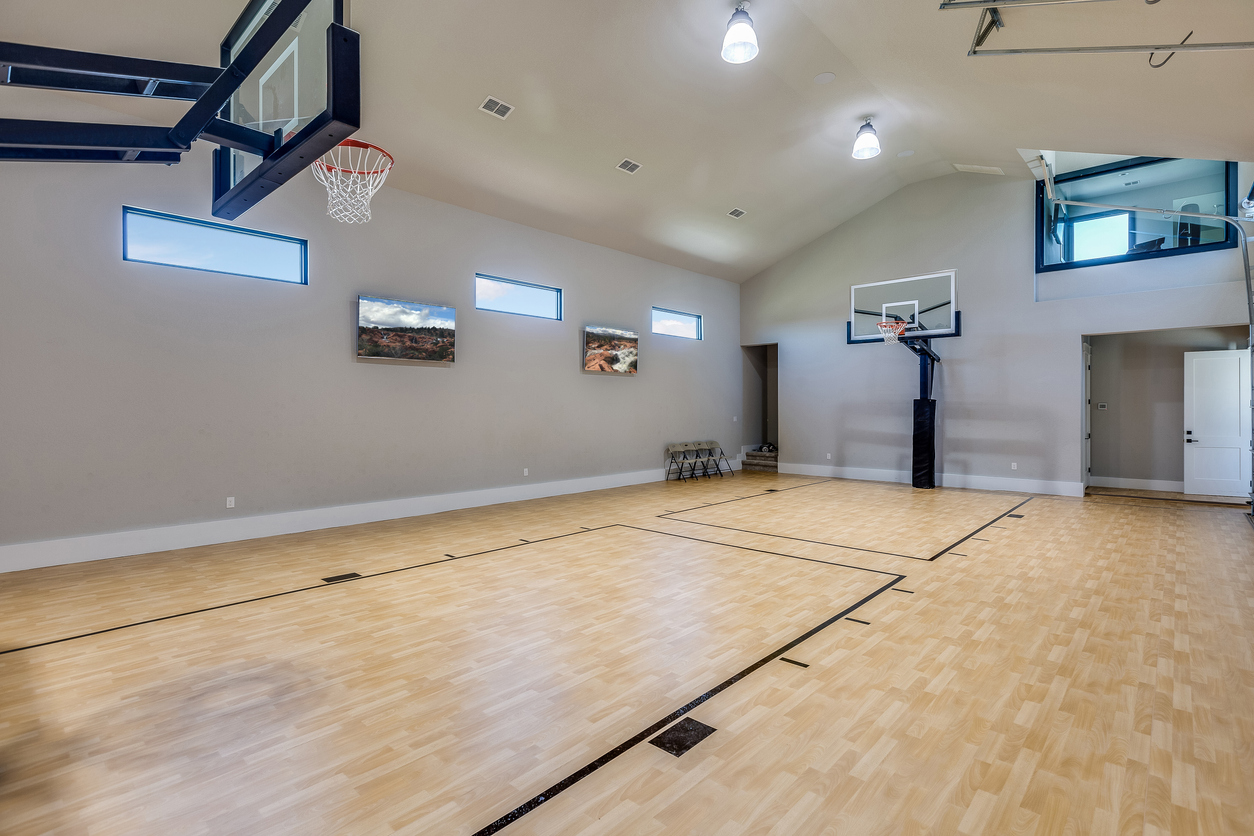
Image Source: www.dominatorhoop.com
Deciphering Basketball Court Dimensions
The physical layout of a basketball court is crucial for fair play and consistent competition. These dimensions dictate player movement, strategic positioning, and the overall flow of the game. When we talk about basketball court dimensions, we are referring to its length and width, the key factors determining its total area.
NBA Court Size: The Professional Standard
The National Basketball Association (NBA) has a very specific set of basketball court dimensions that players and fans are most familiar with. An NBA court size is set at 94 feet in length and 50 feet in width.
To calculate the total square footage, we simply multiply the length by the width:
94 feet (length) × 50 feet (width) = 4,700 square feet
This 4,700 square feet is the official regulation basketball court square footage for the NBA. It’s a generous space designed to accommodate the fast-paced, high-flying action of professional basketball.
FIBA Court Measurements: Global Variations
While the NBA sets a high standard, international basketball operates under different guidelines. The International Basketball Federation (FIBA) governs international competitions, including the Olympics and the FIBA World Cup. FIBA court measurements are slightly different from the NBA.
A FIBA court measures 28 meters (approximately 91.86 feet) in length and 15 meters (approximately 49.21 feet) in width.
Let’s calculate the square footage for a FIBA court:
28 meters × 15 meters = 420 square meters
To convert this to square feet, we use the conversion factor: 1 square meter ≈ 10.764 square feet.
420 square meters × 10.764 square feet/square meter ≈ 4,521 square feet
So, a FIBA court is approximately 4,521 square feet. This difference, while seemingly small, can influence offensive and defensive strategies on a global scale.
Comparing Court Sizes: NBA vs. FIBA
The difference between an NBA court size and FIBA court measurements primarily lies in the length and width.
| Feature | NBA Court | FIBA Court |
|---|---|---|
| Length | 94 feet | 28 meters (91.86 ft) |
| Width | 50 feet | 15 meters (49.21 ft) |
| Total Area | 4,700 sq ft | ~4,521 sq ft |
As you can see, the NBA court is slightly longer and wider, resulting in a larger overall playing area.
Beyond the Professionals: College and High School Courts
The standard basketball court area can also vary depending on the level of play. While professional leagues adhere to strict regulations, collegiate and high school levels often align with or adapt these standards.
College Basketball Court Size
In the United States, college basketball courts generally follow the same dimensions as NBA courts. Therefore, a college basketball court size is typically 94 feet long and 50 feet wide, equating to the same 4,700 square feet. This uniformity ensures a consistent playing experience for athletes transitioning from high school to college.
High School Basketball Court Size
The dimensions for high school basketball courts can sometimes differ slightly. While many high school facilities are built to accommodate the full 94×50 feet, some older or smaller gymnasiums might feature courts that are slightly shorter.
However, the National Federation of State High School Associations (NFHS) generally recommends dimensions that align with the professional standards for championship-level play. A typical high school basketball court size is often 84 feet in length and 50 feet in width.
Let’s calculate the square footage for this common high school dimension:
84 feet (length) × 50 feet (width) = 4,200 square feet
In this case, a high school court would be 4,200 square feet. This slight reduction in length can influence the pace of the game, particularly in transition plays. Some high schools might even have courts as short as 74 feet by 40 feet, though this is less common for competitive play.
Indoor vs. Outdoor Basketball Courts
The environment in which a basketball court is situated can also play a role in its design and, consequently, its size.
Indoor Basketball Court Size
Indoor basketball court size is where we most often see the standard 94×50 feet dimensions. These courts are typically found in dedicated sports facilities, gymnasiums, and arenas. The controlled environment of an indoor court allows for consistent playing conditions, free from the influences of weather. The 4,700 square feet of an NBA or college regulation court is the benchmark for these indoor spaces.
Outdoor Basketball Court Dimensions
Outdoor basketball court dimensions can be more varied. While many outdoor courts, particularly those in parks and recreational areas, aim to replicate the official dimensions, space constraints or local regulations might lead to slight variations. You might find outdoor courts that are slightly shorter or narrower than their indoor counterparts. However, the ideal regulation basketball court square footage is still the target for most well-maintained outdoor facilities. The basketball court length and width can sometimes be adjusted to fit available space, but the fundamental proportions are usually maintained to facilitate proper gameplay.
The Importance of Court Dimensions
The precise basketball court dimensions are not arbitrary; they are foundational to the game itself.
- Player Movement and Strategy: The basketball court length and width dictate how players move, where they position themselves, and the strategies teams employ. A larger court allows for more spacing, faster transitions, and different defensive schemes. A smaller court can lead to more congestion and potentially faster offensive attacks.
- Fairness and Consistency: Standardized dimensions ensure that competition is fair across different teams and venues. Players can practice and develop skills with a clear understanding of the playing field they will encounter.
- Rule Enforcement: Lines on the court, such as the three-point line, the free-throw line, and the boundary lines, are all placed according to specific measurements. These lines are critical for calling fouls, determining scoring, and ensuring the integrity of the game.
Frequently Asked Questions About Basketball Court Size
Here are answers to some common questions about basketball court dimensions.
What are the official dimensions of a basketball court?
The official dimensions of a basketball court depend on the governing body. For the NBA and most collegiate play in the US, the court is 94 feet long and 50 feet wide, totaling 4,700 square feet. For FIBA-sanctioned games, the court is 28 meters (approximately 91.86 feet) long and 15 meters (approximately 49.21 feet) wide, totaling around 4,521 square feet.
Can I play on a court with slightly different dimensions?
Yes, you can play basketball on a court with slightly different dimensions. Many recreational courts, especially outdoor ones, may not adhere to the exact professional standards. While it might slightly alter the game’s dynamics, the fundamental skills remain the same. However, for competitive or official play, adhering to the specific basketball court dimensions is crucial.
Who sets the rules for basketball court sizes?
Basketball court sizes are set by the governing bodies of the sport. For professional basketball in North America, the NBA dictates the dimensions. Internationally, FIBA sets the standards for most major competitions. In the United States, the NCAA sets standards for college basketball, and the NFHS sets standards for high school basketball, though these often align with NBA dimensions.
How does the court size affect the game?
The basketball court length and width significantly impact the game. A larger court can favor teams with good conditioning and fast breaks, as there is more space to cover. It also allows for better spacing, which can be advantageous for offensive players who excel at driving to the basket or shooting from distance. A smaller court might lead to a more physical game, with quicker transitions and potentially more turnovers due to increased player density.
Is a high school basketball court the same size as an NBA court?
Generally, a high school basketball court size is very similar to, but can sometimes be slightly smaller than, an NBA court size. While many high schools strive to meet the 94×50 foot standard, some may have courts that are 84 feet long by 50 feet wide, resulting in 4,200 square feet. This is a common variation, though the ideal remains the larger professional size.
What is the area of a FIBA court in square feet?
A FIBA court measures 28 meters by 15 meters. This converts to approximately 4,521 square feet. This is slightly smaller than an NBA court, which measures 4,700 square feet.