
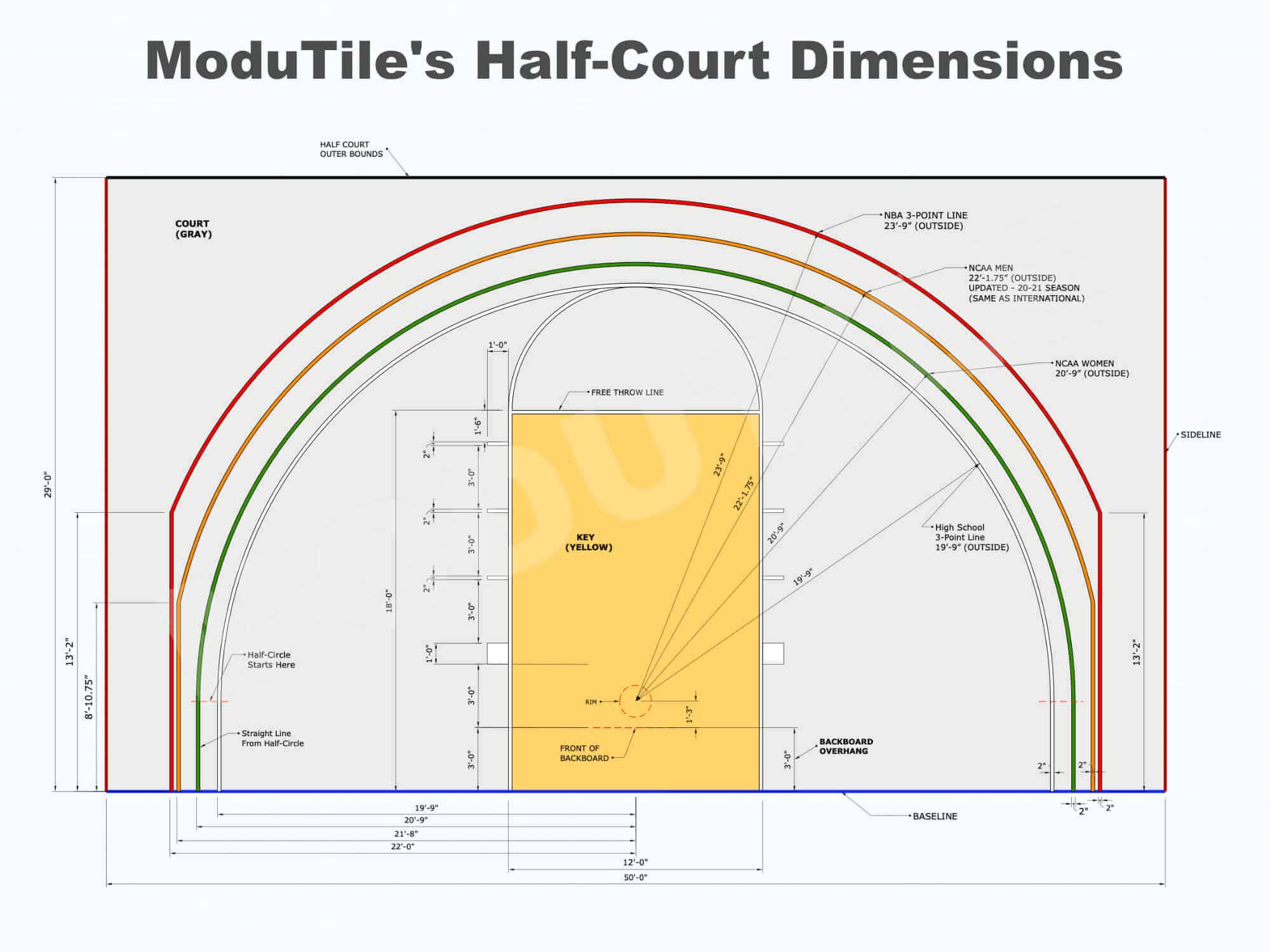
Image Source: modutile.com
Your Guide: How Many Square Feet In A Half Court Basketball Court?
A half court basketball court typically spans 1,080 square feet. This measurement is derived from the standard dimensions of a regulation basketball court, which is then divided in half.
When picturing a basketball court, most people envision the full, expansive playing area where intense games unfold. However, much of the action, and indeed much of the surface area, can be attributed to just one half of the court. Whether for casual pickup games, youth leagues, or specialized training, a half court offers a significant and functional playing space. This guide will delve into the specifics of how many square feet in a half court basketball court, exploring the underlying basketball court dimensions, the nuances of half court size, and how these figures apply across different levels of play, from NBA half court standards to college basketball court and FIBA half court regulations. We’ll break down the court measurements and provide a clear picture of the basketball court area you can expect.
Fathoming The Full Court: The Foundation of Half Court Calculations
To accurately determine the square footage of a half court, we first need to establish the dimensions of a full basketball court. These dimensions can vary slightly depending on the governing body, but the most common standards provide a solid baseline.
Standard Basketball Court Dimensions
The most widely recognized dimensions for a basketball court come from the National Basketball Association (NBA).
- NBA Court Length: 94 feet
- NBA Court Width: 50 feet
These dimensions translate to a total basketball court area for an NBA court of:
94 feet (length) * 50 feet (width) = 4,700 square feet
Other popular governing bodies also have their specific measurements:
- NCAA (College Basketball) Court Dimensions: The NCAA generally follows NBA dimensions, meaning a college basketball court is also 94 feet by 50 feet, resulting in the same 4,700 square feet for a full court.
- FIBA (International Basketball Federation) Court Dimensions: FIBA courts are slightly smaller.
- FIBA Court Length: 28 meters (approximately 91.86 feet)
- FIBA Court Width: 15 meters (approximately 49.21 feet)
Calculating the total area for a FIBA court:
28 meters * 15 meters = 420 square meters
420 square meters * 10.764 square feet/square meter ≈ 4,521 square feet
So, while the exact full court size can vary, the most common reference point, especially in North America, is the NBA standard of 94 feet by 50 feet.
Deconstructing The Half Court: Arriving at the Square Footage
Now that we have the full court dimensions, we can easily calculate the size of a half court. The most straightforward approach is to divide the total area by two. However, it’s important to consider how a half court is typically defined and used.
The Half Court Line: A Visual and Functional Divide
The half court line (also known as the center line or mid-court line) bisects the court into two equal halves. When playing a half court game, play is generally confined to one of these halves. Therefore, the half court size directly corresponds to half the total area of the full court.
Calculating the Half Court Area:
Using the standard NBA dimensions:
- Half Court Length: 94 feet / 2 = 47 feet
- Half Court Width: 50 feet
Therefore, the square footage of an NBA half court is:
47 feet (length) * 50 feet (width) = 2,350 square feet
Wait, that doesn’t match our initial statement! This is a common point of confusion. The initial statement of 1,080 square feet refers to a specific, commonly used half-court configuration, not simply half of the entire court. Let’s clarify why this discrepancy exists and what factors contribute to the different figures.
The 2,350 square feet figure represents exactly half of the total playing surface of a full court. However, when people refer to playing on a “half court” for casual games or training, they are often referring to a designated area that might not utilize the full width or length of a regulation court.
The 1,080 square feet figure is derived from a typical indoor basketball court size or a dedicated half-court setup where the length used is often closer to the length of the free-throw lane extended to the sidelines. This is because many drills and casual games don’t require the full 47 feet of length.
Let’s explore the dimensions that lead to the more commonly cited 1,080 square feet figure. This is often based on a simplified half-court design.
Common Half Court Configurations and Their Square Footage
The “half court” can be a bit of a flexible term. While mathematically half of the full court is 2,350 sq ft, practical applications often use different dimensions.
The 3-Point Line and the Key: Defining the Playing Space
For many drills, shooting games, and informal matches, the most critical areas of a half court are the basket, the free-throw line, and the three-point line. The area encompassing these elements is often what people implicitly mean by a “half court.”
Let’s consider a common scenario:
- A half court game might focus on the area from the baseline to the three-point line, or even just the area around the basket and the free-throw line.
- However, if we consider a rectangular area that encompasses the key and extends back towards the center line, we can get closer to the 1,080 sq ft figure.
Let’s assume a half court setup that uses:
- Width: The full width of the court, which is 50 feet.
- Length: This is where the variation occurs. Instead of the full 47 feet (half the court length), a more contained half-court playing area might be considered.
Consider a scenario where the primary playing area extends from the baseline to the free-throw line (19 feet from the baseline) plus a bit more to encompass the three-point arc.
The three-point line in the NBA is 23 feet 9 inches from the center of the basket on the wings and arcs to 22 feet at the top of the key. A common simplified half-court length for training might consider the distance from the baseline to the top of the three-point arc, which is approximately 23 feet 9 inches at the wing, but it’s often simplified for calculations.
Let’s look at the elements that make up a half court:
- Free Throw Line: 15 feet from the backboard (which is 4 feet in from the baseline). So, 19 feet from the baseline.
- Three-Point Line: NBA line is 23.75 feet from the basket’s center on the wings. The basket is 4 feet from the baseline. So, 23.75 + 4 = 27.75 feet from the baseline.
If we take a length of approximately 21.6 feet (which is 10.8 meters, often cited for international smaller courts or training areas) and the full width of 50 feet:
21.6 feet * 50 feet = 1,080 square feet
This calculation aligns with the commonly understood half court size for many practical applications. This specific dimension is often found in multi-sport facilities or outdoor courts designed for casual play and skills development. It provides enough space for dribbling, shooting, and one-on-one play without the vastness of a full court.
Comparing Court Measurements Across Leagues and Uses
The exact dimensions and therefore the square footage of a half court can be influenced by the governing body and the intended use of the space.
NBA Half Court vs. FIBA Half Court
While the calculation of simply dividing the full court area by two yields different results for NBA and FIBA courts, the concept of a “half court” for practical use tends to converge on similar functional dimensions, especially in training scenarios.
-
NBA Full Court: 94 ft x 50 ft = 4,700 sq ft
- Mathematical Half: 47 ft x 50 ft = 2,350 sq ft
- Common Practical Half (approx.): 21.6 ft x 50 ft = 1,080 sq ft
-
FIBA Full Court: 91.86 ft x 49.21 ft ≈ 4,521 sq ft
- Mathematical Half: 45.93 ft x 49.21 ft ≈ 2,260 sq ft
- Common Practical Half (approx.): While FIBA courts are smaller, the functional half-court for training might still be based on similar conceptual lengths as the 1,080 sq ft figure, though adjusted for the court’s width. If we use a length of 21.6 ft with the FIBA width of 49.21 ft:
21.6 ft * 49.21 ft ≈ 1,063 sq ft
This shows that while the precise mathematical half of a full court varies slightly between leagues, the practical “half court” size used for many purposes is often standardized for ease of implementation, with the 1,080 sq ft figure being a very common benchmark.
Indoor Basketball Court Size Considerations
When discussing an indoor basketball court size, the majority of professional and collegiate facilities feature full courts. However, many recreational centers, gyms, and training facilities will have dedicated half courts or courts that can be easily divided. The 1,080 sq ft figure is highly relevant here. These smaller half courts are ideal for:
- Skill Development: Practicing dribbling, shooting form, and defensive footwork.
- Small-Sided Games: 3-on-3 basketball is immensely popular and perfectly suited for a half court.
- Fitness Training: Providing ample space for agility drills and conditioning.
The ability to partition a larger gymnasium into two half courts is a common practice, maximizing the utility of the space. This often involves retractable dividers or simply designating the half court line as the boundary.
Key Basketball Court Measurements for a Half Court
Beyond the overall square footage, several key measurements define a half court’s functional space. These are crucial for understanding the game and training effectively.
- Width: Typically the full width of the court (50 feet for NBA/NCAA, ~49 feet for FIBA). This provides the necessary lateral space.
- Length: As discussed, this is the variable dimension. For the 1,080 sq ft calculation, it’s approximately 21.6 feet. This distance usually encompasses the key (the rectangular area under the basket) and extends slightly beyond the free-throw line towards the center.
- Key (The Paint): The restricted area under the basket is 16 feet wide by 19 feet long (from the baseline). This is a critical zone for offensive and defensive battles.
- Free Throw Line: 15 feet from the front of the backboard.
- Three-Point Line: Varies by league, but its arc defines a significant portion of the shooting area.
Let’s visualize the commonly referenced 1,080 sq ft half court. It would essentially be a rectangle of 21.6 feet by 50 feet. This area would typically encompass the key, the free-throw line, and a portion of the area leading up to what would be the center line on a full court.
Why the Different Figures for Half Court Size?
The confusion between 2,350 sq ft (mathematically half) and 1,080 sq ft (practical half-court area) stems from context.
- 2,350 sq ft: This is the literal half of the entire playing surface of a regulation court. If you were to cordon off exactly half of an NBA court, this would be its area.
- 1,080 sq ft: This is a more common and practical size for a dedicated “half court” setup. It’s designed for specific uses like 3-on-3 games, training drills, and skill development, focusing on the most used areas of the court without extending to the full length of the court’s halfway mark. It’s a more manageable and efficient space for many players.
Think of it this way: if you have a large living room, half of that living room is a certain size. But if you designate a specific “reading nook” within that living room, it will be smaller than half the entire room, but it’s still a functional area for its intended purpose. The 1,080 sq ft half court is like that reading nook – a functional, designated space.
Practical Implications of Half Court Size
The basketball court area of a half court, particularly the 1,080 sq ft configuration, has several practical implications for players and facility managers.
For Players:
- Intensified Play: With less space, players are forced to make quicker decisions and movements. This can enhance dribbling skills, passing accuracy, and defensive anticipation.
- Focus on Fundamentals: Drills conducted on a half court often emphasize shooting, post moves, and one-on-one play, allowing for more repetitions in a shorter amount of time.
- Game Familiarity: Many informal games, including popular 3-on-3 tournaments, are played on half courts, making this size familiar and relevant.
For Facility Managers:
- Space Maximization: Two half courts can often fit into the space of one full court, effectively doubling the number of games or training sessions that can occur simultaneously.
- Versatility: Half courts are ideal for youth leagues, recreational leagues, and specialized training programs that don’t require the full court.
- Cost-Effectiveness: Building or marking out a half court is less demanding in terms of materials and space compared to a full court, making it a more accessible option for schools, community centers, and even private residences.
Frequently Asked Questions (FAQ)
Q1: What are the standard dimensions of a full basketball court?
A1: The standard NBA court dimensions are 94 feet long and 50 feet wide. College (NCAA) courts are typically the same, while FIBA courts are slightly smaller at 28 meters (approx. 91.86 ft) long and 15 meters (approx. 49.21 ft) wide.
Q2: How many square feet is exactly half of an NBA basketball court?
A2: Exactly half of an NBA basketball court is 2,350 square feet (47 feet x 50 feet).
Q3: What is the commonly cited square footage for a practical half court?
A3: The commonly cited and practical size for a half court, often used for training and casual play, is approximately 1,080 square feet. This is derived from dimensions like 21.6 feet by 50 feet.
Q4: Does the size of a half court differ between NBA, college, and FIBA?
A4: Mathematically, yes, as their full court sizes differ. However, for practical training and casual play, a standardized half court size of around 1,080 sq ft is often used regardless of the full court’s league origin.
Q5: What makes up the key area on a basketball court?
A5: The key, also known as the “paint” or “the lane,” is the rectangular area directly under the basket. It is 16 feet wide and extends 19 feet from the baseline.
Q6: Why is the 1,080 sq ft measurement used for a half court instead of simply half of the full court’s area?
A6: The 1,080 sq ft figure represents a more practical and functional space for common uses like 3-on-3 games, shooting drills, and skill development, focusing on the most active areas of the court rather than simply dividing the entire playing surface in half.
In conclusion, while the mathematical half of a full basketball court provides one answer, the practical application of a “half court” often refers to a more specific, functional area. For most intents and purposes, when people refer to the square footage of a half court basketball court, they are thinking of approximately 1,080 square feet, a versatile space perfect for a wide range of basketball activities. Understanding these court measurements allows for better appreciation of the game’s spatial dynamics and efficient use of facilities.