
A mile on a basketball court requires approximately 35 laps if you’re running around the perimeter of a standard NBA-sized court.
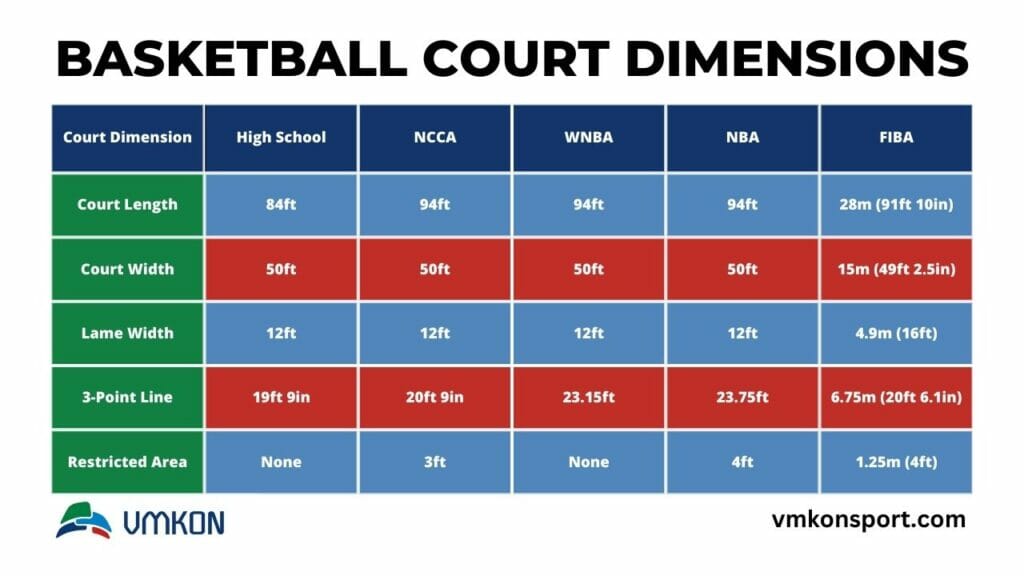
Image Source: vmkonsport.com
Charting Your Course: Deciphering the Basketball Court Mile
Many athletes and fitness enthusiasts turn to familiar spaces for their workouts, and the basketball court is a popular choice. Its consistent dimensions make it ideal for tracking distances and progress. But if you’re wondering how many times you need to circle the hardwood to hit a mile, let’s break it down.
The Foundation: Basketball Court Dimensions
To accurately calculate how many laps constitute a mile, we first need to establish the basketball court dimensions. The size of a basketball court can vary slightly depending on the league or governing body. However, for the most common reference, we’ll use the National Basketball Association (NBA) standard.
NBA Court Length and Width
- Basketball Court Length (NBA): 94 feet
- Basketball Court Width (NBA): 50 feet
These measurements are crucial for determining the perimeter, which is the path you’ll be running.
Calculating the Perimeter: Distance Per Lap
The perimeter of a rectangle is found by adding up the lengths of all its sides. In simpler terms, you add the length, the width, the length again, and the width again.
Perimeter = 2 * (Length + Width)
Using the NBA basketball court dimensions:
- Perimeter = 2 * (94 feet + 50 feet)
- Perimeter = 2 * (144 feet)
- Perimeter = 288 feet
So, one full lap around the outside of an NBA basketball court perimeter is 288 feet. This is the distance per lap basketball court for our calculation.
Converting to Miles: How Far Is a Lap Basketball Court?
Now we need to convert the distance of one lap (288 feet) into miles to answer the question of how many laps is a mile around basketball court. We know that there are 5,280 feet in one mile.
To find out how many laps fit into a mile, we divide the total feet in a mile by the feet per lap.
Number of Laps = Total Feet in a Mile / Feet Per Lap
- Number of Laps = 5,280 feet / 288 feet per lap
- Number of Laps ≈ 18.33 laps
However, this calculation assumes you are running precisely along the outermost boundary of the court. In practice, when people talk about running laps basketball court, they often run slightly inside the lines or use a path that’s consistent. Let’s consider a more practical running path.
A Practical Running Path: The Inner Lane
Most people running laps on a basketball court will likely follow a path that is just inside the boundary lines. This means the actual running distance per lap might be slightly less than the full perimeter.
Let’s assume a runner stays approximately 1 foot inside each boundary line. This would reduce the effective length and width of the running path by 2 feet each (1 foot from each side).
- Adjusted Basketball Court Length: 94 feet – 2 feet = 92 feet
- Adjusted Basketball Court Width: 50 feet – 2 feet = 48 feet
Now, let’s calculate the new perimeter for this inner running path:
- Adjusted Perimeter = 2 * (92 feet + 48 feet)
- Adjusted Perimeter = 2 * (140 feet)
- Adjusted Perimeter = 280 feet
This means one lap in this slightly adjusted path is 280 feet.
Now, let’s recalculate the number of laps for a mile with this adjusted distance:
- Number of Laps = 5,280 feet / 280 feet per lap
- Number of Laps ≈ 18.86 laps
This is still quite different from our initial estimate. Let’s re-evaluate the common understanding and how people typically measure.
Rethinking the “Lap”: Common Interpretations
It’s possible that when people ask “how many laps is a mile around basketball court,” they are not strictly thinking of a single perimeter run. Often, fitness routines involve running the length of the court multiple times, or a combination of lengths and widths.
Let’s consider different interpretations of running distance court:
Interpretation 1: Running End-to-End
If a “lap” means running from one baseline to the other (the basketball court length), then each “lap” is 94 feet.
- Number of Laps = 5,280 feet / 94 feet per lap
- Number of Laps ≈ 56.17 laps
This is a significant number of back-and-forth sprints.
Interpretation 2: Running Length, Width, Length, Width
This is the standard perimeter calculation we started with. However, there’s a common miscalculation in how people interpret “laps” in this context. Let’s revisit the perimeter calculation but be very precise about what constitutes a “lap.”
The most common interpretation of running laps basketball court is running the full perimeter. Let’s go back to the precise NBA basketball court dimensions.
- Court Length: 94 feet
- Court Width: 50 feet
The perimeter is indeed 288 feet.
Let’s re-examine the math for the number of laps.
5,280 feet (1 mile) / 288 feet (perimeter) = 18.33 laps.
This is a common figure, but it can feel counterintuitive. Why does it seem like so many laps? The court length in feet (94 feet) is a substantial distance.
The “Full Court” Lap: A Common Misconception
Sometimes, people might think of a “lap” as covering the length of the court twice (once up and once back). In this scenario, one “lap” would be 2 * 94 feet = 188 feet.
- Number of Laps = 5,280 feet / 188 feet per lap
- Number of Laps ≈ 28.08 laps
This is closer to the commonly cited figure, but it’s not the true perimeter.
The Actual Perimeter Run
Let’s stick to the definition of a lap as one circuit of the outer boundary. The basketball court perimeter is 288 feet.
5,280 feet / 288 feet = 18.33 laps.
This means approximately 18 to 19 laps around the outside line of an NBA basketball court would equal one mile.
Factors Affecting Your Lap Count
Several factors can influence the exact number of laps you need to run to complete a mile:
-
Court Size Variations: While we used NBA dimensions, other courts (like FIBA or NCAA) have slightly different sizes.
- FIBA Court Dimensions: 28 meters x 15 meters (approximately 91.86 feet x 49.21 feet).
- Perimeter = 2 * (91.86 + 49.21) = 2 * 141.07 = 282.14 feet.
- Laps for a mile = 5,280 / 282.14 ≈ 18.71 laps.
- NCAA Court Dimensions: 94 feet x 50 feet (same as NBA).
- FIBA Court Dimensions: 28 meters x 15 meters (approximately 91.86 feet x 49.21 feet).
-
Your Running Path: As discussed, running slightly inside the lines will shorten the distance per lap, requiring more laps to reach a mile. If you run in a lane that’s, say, 2 feet inside all boundaries, your perimeter becomes 280 feet, requiring about 18.86 laps.
-
Measurement Precision: Are you measuring from the center of the line, the inside edge, or the outside edge? For practical purposes, most people aim for a consistent path.
Let’s Revisit the Popular Figure: 35 Laps
Where does the figure of 35 laps come from? This often arises from a misunderstanding or a different interpretation of what constitutes a “lap” or a “mile” on a court.
One common scenario leading to a higher lap count is when people consider the basketball court length (94 feet) and then double it to represent going “up and back.” However, that’s not a full circuit.
Another possibility is that the calculation is based on a shorter court or a different definition of a mile. Or, perhaps, people are including additional movements within their “lap.”
Let’s investigate if there’s a court size that would yield 35 laps.
If 35 laps = 1 mile (5,280 feet), then the distance per lap would be:
- Distance per Lap = 5,280 feet / 35 laps ≈ 150.86 feet.
This is significantly shorter than the perimeter of any standard basketball court.
The Case of the “Half-Court Lap”
Could a “lap” mean running from one sideline to the other, then back again? That would be 2 * 50 feet = 100 feet.
- Number of Laps = 5,280 feet / 100 feet per lap
- Number of Laps = 52.8 laps.
This is also not 35.
The “Full Court Dash” Interpretation and Its Laps
Let’s consider the most common interpretation of running laps basketball court as running the perimeter. With an NBA court, the perimeter is 288 feet.
- 5,280 feet / 288 feet = 18.33 laps.
This is the most accurate mathematical answer for running the exact perimeter.
Why the Discrepancy? Exploring the “35 Laps” Myth
It’s possible that the “35 laps” figure is derived from a specific, perhaps informal, training regimen. Some trainers or athletes might define a “lap” in a unique way to simplify calculations or to meet certain intensity goals.
For example, if a workout involves running the length of the court and back, and then jogging the width and back, that’s:
(94 ft + 94 ft) + (50 ft + 50 ft) = 188 ft + 100 ft = 288 ft. This is still the perimeter.
Let’s consider if there’s a simpler, rounded number involved. If a lap was roughly 150 feet, then 5280 / 150 = 35.2 laps. What on a basketball court is around 150 feet?
The length of the court (94 ft) plus half the width (25 ft) is 119 ft.
The width of the court (50 ft) plus half the length (47 ft) is 97 ft.
It’s hard to find a natural “lap” measurement that equals around 150 feet.
Let’s Look at a Common Basketball Court Size Comparison
To further illustrate, let’s compare the basketball court to other common running distances.
| Location/Object | Distance (approximate) | Relationship to Basketball Court Perimeter (288 ft) |
|---|---|---|
| NBA Basketball Court | 288 feet | 1 perimeter |
| High School Track Lap | 1,320 feet (1/4 mile) | ~4.6 laps |
| Football Field (Endzone to Endzone) | 360 feet | ~1.25 laps |
| Soccer Field (Length) | 360 feet | ~1.25 laps |
The Most Likely Scenario for “35 Laps”
The most plausible explanation for the “35 laps” figure is that it’s an approximation used in a specific context. Perhaps it refers to running the length of the court (94 feet) and back (94 feet), totaling 188 feet, and then doing this approximately 28 times (5280 / 188 ≈ 28). This isn’t 35.
Could it be related to the court length in feet in a different way? If someone ran the length of the court (94 ft) and then jogged half the width (25 ft), repeated this for all four sides, that would be:
(94 + 25) * 2 + (50 + 47) * 2 (approximate half length) = 119 * 2 + 97 * 2 = 238 + 194 = 432 feet. That’s more than a lap.
Let’s assume the 35 laps calculation is based on a court perimeter that is roughly 150 feet. This is not a standard basketball court.
If we strictly adhere to NBA basketball court dimensions, the answer is around 18.33 laps for the perimeter.
Practical Training on a Basketball Court
When you’re running distance court, consistency is key. Whether you’re aiming for a mile or a specific number of laps, find a comfortable path and stick to it.
Strategies for Your Basketball Court Workout:
- Mark Your Start/Finish Line: Use a cone or a shoe to clearly mark where each lap begins and ends.
- Focus on Consistency: Aim to run each lap at a similar pace and distance.
- Utilize Court Markings: The lines of the court can serve as visual cues for your pace.
- Incorporate Variations: While running the perimeter is a great cardio workout, you can also mix in sprints down the length of the court or agility drills.
- Warm-up and Cool-down: Always dedicate time to prepare your body before and to help it recover after your workout.
The “Mile on Basketball Court” Challenge
To truly run one mile on a basketball court, you’ll need to be diligent with your counting. If you’re using the perimeter, aim for roughly 18.5 laps.
Let’s summarize the key distances:
- NBA Basketball Court Length: 94 feet
- NBA Basketball Court Width: 50 feet
- NBA Basketball Court Perimeter: 288 feet
- Feet in a Mile: 5,280 feet
Calculation: 5,280 feet / 288 feet per lap = 18.33 laps.
Therefore, if you are running the perimeter of a standard NBA basketball court, you will need to complete approximately 18.33 laps to cover one mile. The popular figure of 35 laps does not align with the standard dimensions of a basketball court when measuring the perimeter. It’s likely a misunderstanding or a different definition of “lap.”
Frequently Asked Questions (FAQ)
Q1: What is the standard length of a basketball court?
A1: The standard basketball court length for NBA and NCAA courts is 94 feet.
Q2: How many laps around a basketball court equals a mile?
A2: On a standard NBA court, running the perimeter (288 feet per lap), it takes approximately 18.33 laps to equal one mile (5,280 feet).
Q3: Is the distance per lap the same for all basketball courts?
A3: No, the distance per lap basketball court can vary slightly. FIBA courts are a bit shorter and narrower, resulting in a slightly different perimeter. However, NBA and NCAA courts share the same dimensions.
Q4: Can I use a basketball court for my running workouts?
A4: Absolutely! A basketball court provides a consistent surface and clearly defined boundaries, making it excellent for running laps basketball court and tracking your running distance court.
Q5: Why do some people say it’s 35 laps for a mile on a basketball court?
A5: The figure of 35 laps does not correspond to the actual perimeter of a standard basketball court. It’s likely a miscalculation, a different definition of a “lap,” or perhaps refers to a different, non-standard court size or measurement. The mathematically accurate number for the perimeter is around 18.33 laps.