
A regulation basketball court is 94 feet long and 50 feet wide for professional and college play. The length of a basketball court can vary slightly depending on the league or governing body, but these are the standard measurements for most games. This article will delve into the specifics of basketball court dimensions across different levels of play, exploring why these measurements are important and how they impact the game.
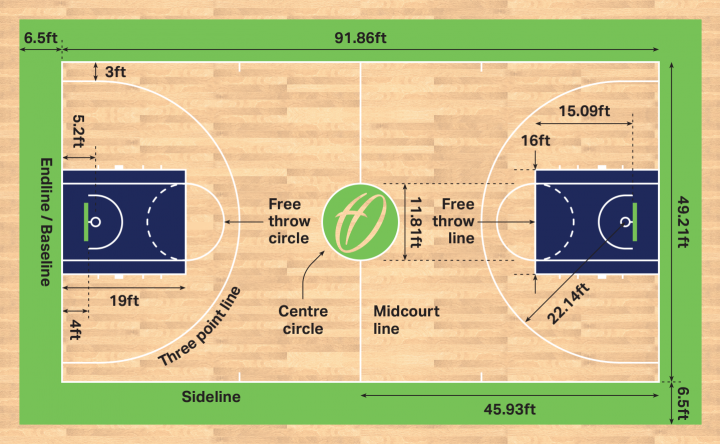
Image Source: www.harrodsport.com
Deciphering Standard Basketball Court Measurements
The precise length of a basketball court is a fundamental aspect of the sport. It’s not just an arbitrary number; it’s a carefully determined measurement that influences strategy, player movement, and the overall flow of the game. From the thunderous dunks in professional arenas to the spirited matches on outdoor courts, the dimensions remain largely consistent, ensuring a fair and exciting playing field. Let’s break down what makes up the standard basketball court.
NBA Court Size: The Pinnacle of Play
The National Basketball Association (NBA) sets the benchmark for professional basketball. An NBA court size adheres to a strict regulation size.
- Length: 94 feet
- Width: 50 feet
These dimensions are consistent across all NBA arenas. This expansive playing surface allows for fast-paced action, impressive offensive drives, and the strategic use of the entire court. The ample space provides room for players to showcase their athleticism, execute complex plays, and maintain defensive integrity. The 94-foot length is crucial for allowing players to get a running start on drives to the basket, execute full-court passes, and implement defensive schemes that cover a significant area. The 50-foot width is equally important, providing spacing for offensive sets and defensive rotations.
WNBA Court Length: Consistency Across Tiers
The Women’s National Basketball Association (WNBA) shares the same court dimensions as the NBA. This commitment to standardized basketball court dimensions ensures a consistent playing environment for elite female athletes, mirroring the professional standards set by the men’s league.
- Length: 94 feet
- Width: 50 feet
The WNBA’s adherence to these regulation basketball court size standards highlights the universality of the game’s requirements. This consistency allows for direct comparisons of performance and strategy between leagues, contributing to a unified understanding of the sport at its highest levels.
FIBA Court Dimensions: Global Standards
While the NBA and WNBA maintain specific measurements, the International Basketball Federation (FIBA), the governing body for international basketball, has slightly different FIBA court dimensions. These differences are generally minor but can influence play, particularly in international tournaments.
- Length: 28 meters (approximately 91.9 feet)
- Width: 15 meters (approximately 49.2 feet)
The FIBA measurements are a touch shorter and narrower than the NBA’s. This slight reduction in space can lead to a more compact game, potentially increasing defensive pressure and requiring quicker decision-making from players. For international players transitioning to NBA or WNBA, adjusting to the slightly larger court can be a factor.
College Basketball Court Size: Nearing Professional Standards
College basketball, particularly at the NCAA Division I level, generally uses the same college basketball court size as the NBA. This prepares collegiate athletes for the transition to professional leagues.
- Length: 94 feet
- Width: 50 feet
The consistency in court size between college and professional play ensures that players are developing their skills on a familiar surface. This commonality simplifies strategic adjustments for players moving up the ranks and allows for a more direct comparison of talent and team performance.
High School Basketball Court Length: A Slight Variation
While many high schools aim to emulate professional standards, high school basketball court length can sometimes vary. However, most high schools adhere to the regulation size to provide their athletes with the closest experience to collegiate and professional play.
- Length: Typically 84 feet
- Width: Typically 50 feet
In some cases, especially in older facilities, the court might be slightly shorter, around 74 feet. However, the standard for organized high school play often aims for the 84-foot length. This slightly shorter length can influence the pace of the game, potentially leading to quicker transitions and a more condensed offensive attack. Nevertheless, the core principles of spacing and strategy remain vital.
Examining Indoor vs. Outdoor Basketball Court Size
The environment in which a basketball game is played can also be considered when discussing court sizes. While the regulation basketball court size often refers to indoor, climate-controlled environments, outdoor basketball court size can sometimes exhibit more variability.
Indoor Basketball Court Dimensions: The Standardized Arena
Indoor basketball court dimensions are where you’ll find the most stringent adherence to official measurements. These controlled environments are built specifically for the sport and are designed to meet the precise requirements of governing bodies.
- NBA/WNBA/College: 94 feet x 50 feet
- FIBA: 28 meters x 15 meters (91.9 feet x 49.2 feet)
These standardized indoor courts are equipped with features like proper lighting, durable flooring (typically hardwood), and well-maintained boundary lines and markings. The consistent surface and predictable lighting contribute to optimal player performance and safety.
Outdoor Basketball Court Size: Adaptability and Accessibility
Outdoor basketball court size can be more diverse. While many public parks and recreational areas strive for regulation dimensions, space constraints or the informal nature of play can lead to variations.
- Common Public Courts: Often aim for 84 feet x 50 feet or similar, but can be shorter.
- Informal Courts: May be significantly shorter or narrower.
Outdoor courts are often made of asphalt or concrete. While these surfaces provide durability and accessibility, they can be more affected by weather conditions, leading to variations in grip and bounce. The slightly shorter lengths sometimes found on outdoor courts can still facilitate enjoyable games, but they do alter the strategic considerations compared to a full-sized NBA court. The key is that the fundamental objective – to shoot the ball through the hoop – remains the same, regardless of minor variations in court dimensions.
Why Basketball Court Length Matters
The length of a basketball court is not merely a number; it’s a critical design element that significantly impacts the game’s dynamics. These dimensions influence everything from offensive strategies to defensive positioning and player fatigue.
Strategic Implications of Court Length
The 94-foot length of an NBA court, for example, allows for significant space to operate.
- Fast Breaks: The length provides ample room for teams to execute full-court fast breaks, a cornerstone of many offensive strategies. A quick defensive rebound and a long pass can lead to uncontested layups.
- Spacing: The generous dimensions enable offensive players to spread out, creating driving lanes and isolation opportunities. This spacing is crucial for breaking down defenses.
- Defensive Coverage: Defenders must cover more ground, requiring excellent conditioning and strong communication to prevent open shots or penetration. Full-court pressure defenses are also more viable on longer courts.
- Transition Play: The ability to quickly transition from defense to offense, and vice-versa, is amplified on a longer court. This rewards teams with superior athleticism and transition offense/defense execution.
Conversely, a shorter court, like some high school or outdoor courts, can compress the game.
- Quicker Pace: Offensive possessions might be shorter, with teams getting to the basket or taking shots more rapidly.
- Increased Defensive Pressure: It’s easier to apply full-court defensive pressure on a shorter court, potentially forcing more turnovers.
- Reduced Fast Break Opportunity: While fast breaks are still possible, the reduced length limits the momentum and distance a player can cover before reaching the basket.
Impact on Player Performance and Fatigue
The length of the court directly correlates with the physical demands placed on players.
- Endurance: Players on longer courts, like NBA courts, must possess superior cardiovascular endurance to constantly sprint from one end of the court to the other, both offensively and defensively.
- Agility and Speed: The ability to change direction quickly and maintain high speeds over extended periods is essential.
- Fatigue Management: Coaches on longer courts often employ deeper rotations to manage player fatigue, ensuring players can perform at a high level throughout the game. On shorter courts, fatigue might set in faster for players who aren’t conditioned for continuous movement.
The Role of Court Markings
Beyond the overall length and width, various markings on the court further define the playing area and dictate rules. These include:
- Sidelines and Baselines: These lines mark the outer boundaries of the court. Stepping on or over these lines results in a violation.
- Center Circle: The circle at mid-court where jump balls are initiated.
- Free Throw Lines: Located 15 feet from the face of the backboard, these lines are where players shoot free throws. The area around the free-throw line is often referred to as the “key” or “paint.”
- Three-Point Lines: These arcs denote the area from which three points are awarded for a successful shot. The distance of the three-point line varies between leagues (e.g., NBA, FIBA, college). For instance, the NBA three-point line is further out than the FIBA or college line, adding another strategic layer to offensive play.
Frequently Asked Questions (FAQ)
Q1: What is the exact length of a basketball court?
A regulation basketball court for professional and college play is 94 feet long.
Q2: Are all basketball courts the same size?
No, while professional and college courts are standardized, high school and international courts (FIBA) can have slightly different dimensions. Outdoor courts also can exhibit more variability.
Q3: What is the width of a standard basketball court?
A standard basketball court is 50 feet wide for professional and college play.
Q4: How long is a FIBA basketball court?
A FIBA basketball court is 28 meters long, which is approximately 91.9 feet.
Q5: Does the three-point line distance vary based on court size?
Yes, the distance of the three-point line is different in various leagues. For example, the NBA three-point line is further away than in college or FIBA play.
Q6: Can I play basketball on any size court?
Yes, you can play basketball on courts of varying sizes. While regulation courts offer the intended game experience, informal games can be played on any reasonably sized court.
Q7: How does court length affect the game?
Court length influences pace, strategy, the effectiveness of fast breaks, defensive coverage, and player endurance. Longer courts generally allow for more space and faster transitions, while shorter courts can lead to a more condensed and intense game.
Q8: What are the dimensions for an outdoor basketball court?
Outdoor basketball court size can vary, but many public courts aim for similar dimensions to indoor courts, often around 84 feet by 50 feet, though shorter lengths are common.
Q9: Is the WNBA court the same length as the NBA court?
Yes, the WNBA court length is the same as the NBA court size, which is 94 feet.
Q10: Why are basketball court dimensions important for the sport?
Basketball court dimensions are crucial for establishing fair competition, influencing game strategies, dictating player movement, and ensuring player safety and performance by providing appropriate space for athletic actions.