
The basketball hoop height for regulation play is 10 feet from the surface of the court to the rim. This standard applies across most major basketball organizations, including the NBA, FIBA, and NCAA.
Whether you’re a seasoned player, a budding enthusiast, or simply curious about the sport, knowing the correct regulation basketball hoop dimensions is fundamental. It’s a detail that impacts every shot, every rebound, and the overall strategy of the game. This article delves into the specifics of basketball hoop height, exploring its significance and variations across different leagues and age groups. We’ll cover everything from the NBA hoop height to youth basketball hoop height, and discuss how these standards translate to both indoor basketball hoop height and outdoor basketball hoop height settings, as well as the practicality of adjustable basketball hoop height options. The standard basketball hoop height of 10 feet is more than just a number; it’s a carefully chosen measurement that defines the challenge and skill required to succeed in basketball.
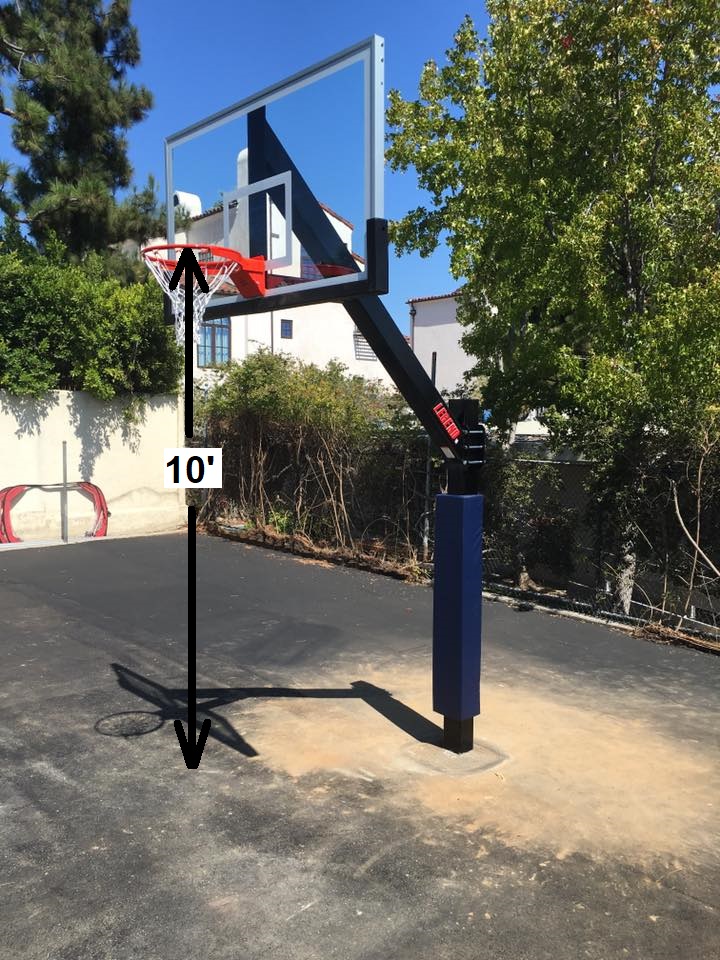
Image Source: www.firstteaminc.com
The Foundation: Why 10 Feet?
The choice of 10 feet for the standard basketball hoop height wasn’t arbitrary. It evolved through the early days of basketball, with gradual adjustments made to enhance the game’s flow and challenge. Early versions of the game used peach baskets, which were much higher, but as dribbling became a key component, the need for a more accessible yet still challenging height became apparent.
The 10-foot mark was established to:
- Challenge Shooting Accuracy: This height demands proper arc, power, and technique for a successful shot. It creates a significant obstacle that requires skill to overcome.
- Promote Strategic Play: The height influences rebounding battles, blocking strategies, and the effectiveness of different offensive plays. It forces players to think about positioning and vertical leap.
- Balance Offense and Defense: A 10-foot rim makes scoring difficult enough to allow for robust defensive strategies, preventing games from becoming purely an offensive shootout.
Deciphering the Measurement: Rim and Backboard
When discussing regulation basketball hoop dimensions, it’s important to clarify what the 10-foot measurement refers to. It’s the distance from the playing surface to the inner top edge of the rim. This is a precise measurement that ensures uniformity across all regulation courts.
The backboard, while crucial for redirects and bank shots, has its own set of dimensions that are also standardized:
- NBA and NCAA Backboard Dimensions: Rectangular backboards are typically 72 inches wide by 42 inches high.
- FIBA Backboard Dimensions: Backboards are usually 1.8 meters wide by 1.05 meters high (approximately 70.8 inches by 41.3 inches). They can also be fan-shaped.
The rim itself has an inner diameter of 18 inches and is typically made of solid steel. The net is usually 15 to 18 inches long and made of white nylon.
League-Specific Standards: A Closer Look
While 10 feet is the universal standard for adult professional and collegiate play, slight variations or considerations might exist depending on the league or governing body.
NBA Hoop Height
The NBA hoop height is the quintessential 10 feet. The National Basketball Association adheres strictly to this regulation for all its games. The dimensions of the court, the size of the ball, and the height of the hoop are all meticulously maintained to ensure fair and consistent competition. The NBA court is larger than those used in other leagues, measuring 94 feet long and 50 feet wide. This larger playing area, combined with the 10-foot rim, contributes to the fast-paced, high-skill nature of professional basketball.
FIBA Basketball Hoop Height
The Fédération Internationale de Basketball (FIBA), the governing body for international basketball, also mandates a basketball hoop height of 3.05 meters (10 feet) for senior competitions. FIBA courts are slightly smaller than NBA courts, measuring 28 meters long by 15 meters wide (approximately 91.9 feet by 49.2 feet). Despite the court size difference, the rim height remains the same, ensuring that the fundamental challenges of shooting and playing near the basket are consistent globally. FIBA rules also specify backboard dimensions and rim construction, ensuring a uniform playing experience worldwide.
NCAA Basketball Hoop Height
The National Collegiate Athletic Association (NCAA), which governs collegiate sports in the United States, also observes the NCAA basketball hoop height of 10 feet. This aligns with the professional standards, preparing college athletes for potential careers in leagues like the NBA. The court dimensions used in NCAA play are the same as those in the NBA, contributing to a consistent competitive environment.
Adapting for Youth and Development
The 10-foot rule is designed for adults and highly skilled players. For younger players, this height can be a significant barrier to learning and enjoying the game. This is where the concept of youth basketball hoop height comes into play, often utilizing adjustable hoops.
Youth Basketball Hoop Height
The youth basketball hoop height is adjusted to be lower, allowing children to develop proper shooting form and build confidence. There is no single universal “youth” height, as it depends on the age and skill level of the children. However, common recommendations include:
- Ages 6-8: A hoop height of 6 to 7 feet is often suitable.
- Ages 9-11: A hoop height of 7.5 to 8.5 feet can be appropriate.
- Ages 12 and Up: As players mature, they can gradually move towards the standard basketball hoop height of 10 feet.
The goal with lower hoop heights for youth is not to make scoring easy, but to allow players to experience success and develop fundamental skills like proper shooting arc, hand-eye coordination, and follow-through without the discouragement of consistently missing shots due to height. Many home and recreational basketball systems offer adjustable basketball hoop height features specifically for this purpose.
Indoor vs. Outdoor: Consistency and Durability
The basketball hoop height of 10 feet is maintained whether the court is indoors or outdoors. However, the type of equipment used can differ.
Indoor Basketball Hoop Height
Indoor basketball hoop height is almost exclusively set at the 10-foot regulation standard in gyms, schools, and professional arenas. These systems are typically permanently installed, often featuring ceiling mounts or robust pole systems that ensure stability and the precise 10-foot measurement. The focus is on durability and consistent performance in a controlled environment.
Outdoor Basketball Hoop Height
Outdoor basketball hoop height also adheres to the 10-foot regulation for serious play. However, outdoor systems, especially those found in driveways or public parks, are often of the adjustable basketball hoop height variety. These systems need to be durable enough to withstand weather conditions. Materials like galvanized steel for poles and acrylic or tempered glass for backboards are common. While the desired height for adult play remains 10 feet, the adjustability allows for different users, including children, to play on the same system.
The Rise of Adjustable Basketball Hoops
The advent of adjustable basketball hoop height systems has revolutionized recreational basketball. These systems allow users to easily change the height of the rim, making them incredibly versatile.
- For Families: Parents can adjust the hoop lower for their children and then raise it back to the regulation height when adults want to play.
- For Training: Coaches can use different heights to train players on specific skills, such as improving shooting form at lower heights or practicing dunks and layups at regulation height.
- For Progression: As a young player grows or improves, the hoop can be adjusted incrementally towards the 10-foot standard.
When choosing an adjustable hoop, it’s important to consider the mechanism for adjustment and the overall stability of the system. A sturdy pole and a reliable lifting or lowering mechanism are crucial for ensuring the hoop stays securely at the desired height and can withstand the force of a shot or dunk.
Factors Affecting Hoop Height (Non-Regulation)
While the 10-foot standard is paramount for official games, several scenarios might involve different hoop heights:
- Beginner Training: As mentioned, lower heights are used for very young children to learn the game.
- Specific Drills: Coaches might lower or raise the hoop temporarily for specialized training exercises.
- Backyard Courts: Many homeowners with backyard courts may opt for adjustable systems to accommodate various ages and skill levels.
- Adaptations for Accessibility: In some cases, adaptations might be made for players with disabilities, though this is typically within the framework of adaptive sports rules.
It’s crucial to differentiate between recreational, training, and official game heights. For anyone aspiring to play competitively, practicing at the standard basketball hoop height of 10 feet is essential.
Equipment Specifications: Beyond the Height
While hoop height is the most discussed dimension, other aspects of the equipment contribute to the game’s feel and challenge:
- Rim Diameter: The 18-inch inner diameter is standard. A smaller diameter makes scoring more difficult, while a larger one can make it easier.
- Rim Material and Strength: Regulation rims are made of sturdy steel. Breakaway rims are common in professional play, designed to flex and spring back after a dunk, reducing stress on the backboard and providing a more satisfying feel.
- Backboard Material:
- Tempered Glass: Offers the best rebound characteristics and is preferred for professional and high-level collegiate play.
- Acrylic: A good alternative, offering decent rebound and durability, often found in mid-range to high-end home systems.
- Polycarbonate: Very durable and weather-resistant, but generally offers less consistent rebound than glass or acrylic. Common in lower-end or portable systems.
- Fiberglass: Offers good durability and moderate rebound.
- Wood: Older backboards were sometimes made of wood, but this is rare today due to durability and rebound inconsistency.
The combination of the 10-foot rim height and these equipment specifications creates the balanced challenge that defines basketball.
The Impact of Hoop Height on Gameplay
The 10-foot basketball hoop height profoundly influences every aspect of the game:
- Shooting: Players must develop a consistent jump shot with proper arc and backspin. Layups require elevation and body control. Dunking becomes a feat of athleticism.
- Rebounding: The height necessitates strong jumping ability and good positioning to secure rebounds, leading to intense battles under the basket.
- Defense: Shot blocking and contesting shots are crucial defensive skills directly influenced by the rim’s elevation.
- Offense: Plays are designed around getting players open for shots at this height, and post-up games require strength and skill to score over defenders.
Imagine playing with a 6-foot hoop. The game would transform into a much higher-scoring affair, with less emphasis on shooting technique and more on quickness and positioning. Conversely, a 12-foot hoop would make scoring incredibly difficult, potentially slowing down the game and favoring sheer vertical leap over shooting finesse. The 10-foot standard strikes a perfect balance.
Frequently Asked Questions (FAQ)
What is the official height of a basketball hoop?
The official basketball hoop height for regulation play in most professional, collegiate, and international leagues is 10 feet (3.05 meters) from the playing surface to the rim’s inner top edge.
Is NBA hoop height different from FIBA hoop height?
No, both the NBA and FIBA have the standard basketball hoop height set at 10 feet.
Can I use an adjustable basketball hoop for official games?
For official games in leagues like the NBA, NCAA, or FIBA, only hoops permanently set at the 10-foot regulation height are used. Adjustable basketball hoop height systems are ideal for recreational play, practice, and home use, but not for official competition.
How high is a basketball hoop for youth players?
The youth basketball hoop height is typically lower than the regulation 10 feet. It is adjusted based on the age and skill level of the children, often ranging from 6 feet to 8.5 feet for younger players, gradually increasing as they mature.
Does indoor basketball hoop height differ from outdoor basketball hoop height?
No, the regulation basketball hoop dimensions regarding height are the same for both indoor basketball hoop height and outdoor basketball hoop height when referring to official play. However, the materials and installation of outdoor hoops often need to be more weather-resistant.
What are the standard basketball hoop dimensions besides height?
Standard dimensions include the rim’s inner diameter (18 inches) and the backboard size, which varies slightly by league but is typically around 72 inches wide by 42 inches high for NBA/NCAA and slightly smaller for FIBA.
Why is the basketball hoop 10 feet high?
The 10-foot height was established to provide a challenging yet achievable height that promotes skill development in shooting, rebounding, and defense, contributing to the strategic depth and excitement of the game.
By adhering to these established dimensions, the sport of basketball maintains a consistent and fair playing field, from backyard courts to professional arenas, ensuring that the fundamental skills and athleticism required to excel remain at the heart of the game.