
A mole of basketballs is an unfathomably large quantity. It’s approximately 6.022 x 10^23 basketballs. To help you visualize this immense number, we’ll explore its size, mass, and the sheer volume it would occupy.
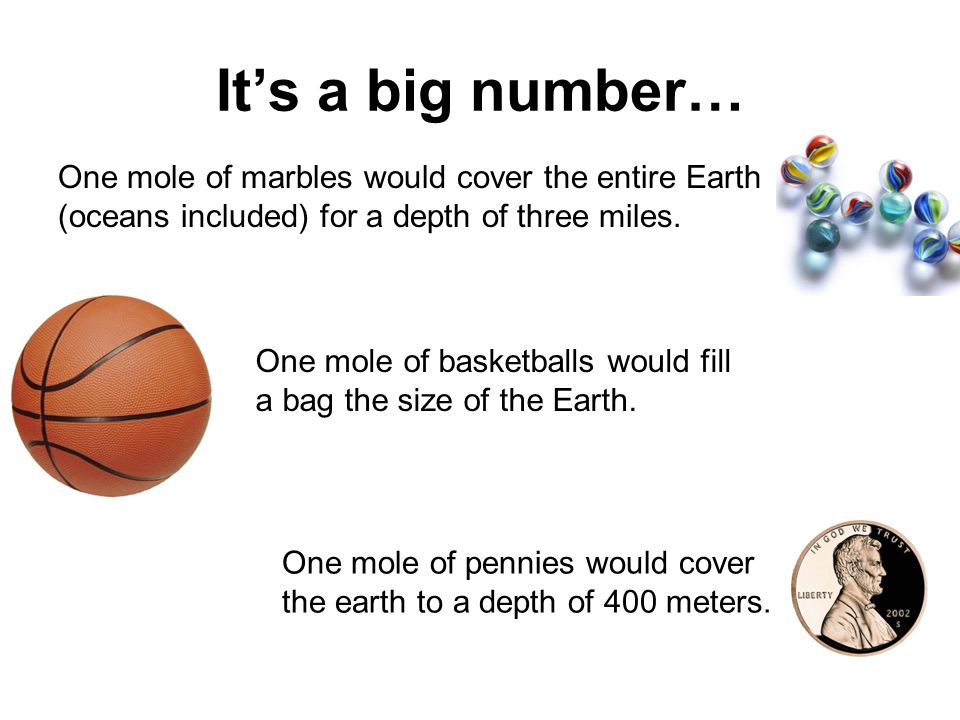
Image Source: images.slideplayer.com
Fathoming the Immensity: A Mole of Basketballs
The question of “how big would a mole of basketballs be?” delves into the mind-bending world of chemistry and our everyday perception of size. When we talk about a “mole” in chemistry, we’re not talking about a furry garden creature, but a specific, incredibly large number of items. This number is known as Avogadro’s number, which is approximately 6.022 x 10^23. So, when we ask about a mole of basketballs, we’re really asking what it would be like to have over 600 sextillion basketballs.
Let’s break down what this means in terms of physical space and mass. We’ll look at the typical properties of a basketball and then scale them up to this astronomical number.
The Humble Basketball: Our Building Block
Before we can stack them up to the heavens, we need to know what a single basketball is like.
Diameter and Circumference
A standard men’s NBA basketball has a diameter of a basketball of about 9.55 inches (24.26 cm). This translates to a circumference of roughly 30 inches (76 cm). For our calculations, we’ll use the diameter in meters for easier conversion to larger units like cubic meters.
- Diameter: 0.2426 meters
Volume of a Basketball
The volume of a sphere is calculated using the formula V = (4/3)πr³, where ‘r’ is the radius. Since the diameter is 0.2426 meters, the radius is half of that, or 0.1213 meters.
- Radius: 0.1213 meters
- Volume of a basketball: (4/3) * π * (0.1213 m)³ ≈ 0.00753 cubic meters
This is the space one basketball takes up, assuming it’s a perfect sphere.
Mass of a Basketball
A standard NBA basketball weighs between 20 and 22 ounces (0.567 to 0.624 kg). Let’s use an average of 0.5955 kg for our calculations.
- Average Mass: 0.5955 kg
Scaling Up: The Sheer Quantity
Now, let’s apply Avogadro’s number to these properties.
Total Volume Calculation
If one basketball occupies 0.00753 cubic meters, then a mole of basketballs would occupy:
6.022 x 10^23 basketballs * 0.00753 m³/basketball ≈ 4.53 x 10^21 cubic meters
To put this into perspective, the Earth’s total volume is approximately 1.08 x 10^21 cubic meters. So, a mole of basketballs would occupy roughly 4.2 times the volume of the entire Earth!
Mass of a Mole of Basketballs
Using the average mass of a basketball:
6.022 x 10^23 basketballs * 0.5955 kg/basketball ≈ 3.59 x 10^23 kg
This is the mass of a mole of basketballs. For comparison, the mass of the Earth is about 5.97 x 10^24 kg. So, a mole of basketballs would weigh approximately 6% of the Earth’s mass.
How Would They Be Arranged? Packing Efficiency
The calculation of total volume assumes we can just add up the individual volumes. However, in reality, if we were to start stacking basketballs, there would be gaps between them. This is where the concept of packing efficiency comes in.
Sphere Packing
When spheres are packed together, they don’t fill all the space perfectly. The most efficient way to pack identical spheres in three dimensions is called close-packing. This can be achieved in arrangements like face-centered cubic (FCC) or hexagonal close-packed (HCP).
- Maximum Packing Efficiency: Approximately 74%
This means that even in the most efficient arrangement, about 26% of the space would be empty.
Re-evaluating the Space Occupied
If we account for this packing efficiency, the total volume required to hold a mole of basketballs would be even larger:
Total Volume (with packing) = Individual Volume / Packing Efficiency
Total Volume (with packing) = (4.53 x 10^21 m³) / 0.74
Total Volume (with packing) ≈ 6.12 x 10^21 cubic meters
This adjusted volume is now slightly larger than the Earth’s volume, making the comparison even more striking.
Table: Key Figures for a Mole of Basketballs
| Property | Value | Comparison |
|---|---|---|
| Number of Balls | 6.022 x 10^23 | Avogadro’s Number |
| Volume per Ball | 0.00753 m³ | |
| Total Volume (Ideal) | 4.53 x 10^21 m³ | ~4.2 times Earth’s volume |
| Total Volume (Packed) | 6.12 x 10^21 m³ | Slightly more than Earth’s volume |
| Mass per Ball | 0.5955 kg | |
| Total Mass | 3.59 x 10^23 kg | ~6% of Earth’s mass |
The Density of a Basketball
The density of a basketball can be calculated by dividing its mass by its volume.
Density = Mass / Volume
Density = 0.5955 kg / 0.00753 m³ ≈ 79.1 kg/m³
This is significantly less dense than water (1000 kg/m³). This low density is due to the air inside the basketball and the relatively thin rubber or synthetic leather material.
Visualizing the Scale: Astronomical Comparisons
When we talk about numbers this large, they often slip into the realm of the cosmic. Let’s try to visualize this using astronomical scales.
A Layer of Basketballs
Imagine laying basketballs flat on a surface, edge to edge.
- Each basketball has a diameter of about 0.24 meters.
- So, a square meter can fit approximately (1 m / 0.24 m)² ≈ 17 basketballs.
If we covered the entire surface of the Earth with a single layer of basketballs:
- Earth’s surface area is about 5.1 x 10^14 m².
- Number of basketballs to cover Earth = 5.1 x 10^14 m² * 17 basketballs/m² ≈ 8.67 x 10^15 basketballs.
This is only a tiny fraction of a mole (0.0000000000014 moles)!
A Cube of Basketballs
Let’s consider a cube of basketballs, packed tightly.
- The total volume occupied by a mole of basketballs, even with packing, is about 6.12 x 10^21 cubic meters.
- To find the side length of a cube with this volume, we take the cube root:
Side Length = (6.12 x 10^21 m³)^(1/3) ≈ 1,830,000 meters
This means a cube containing a mole of basketballs would have sides approximately 1,830 kilometers (or about 1,137 miles) long. This is larger than the distance across many countries!
Comparing Dimensions
- Earth’s Diameter: Approximately 12,742 km
- Cube of Basketballs Side Length: Approximately 1,830 km
So, this cube would fit comfortably within the diameter of the Earth, but it’s still a substantial structure.
A Line of Basketballs
If we were to place all 6.022 x 10^23 basketballs in a single line, touching end to end:
- Total length = 6.022 x 10^23 basketballs * 0.2426 m/basketball
- Total length ≈ 1.46 x 10^23 meters
How far is that?
- The distance from the Earth to the Sun (1 Astronomical Unit or AU) is about 1.5 x 10^11 meters.
- The distance to the nearest star, Proxima Centauri, is about 4.24 light-years, which is roughly 4 x 10^16 meters.
The line of basketballs would be:
- (1.46 x 10^23 m) / (1.5 x 10^11 m/AU) ≈ 9.7 x 10^11 AU (970 billion AU)
- (1.46 x 10^23 m) / (4 x 10^16 m/light-year) ≈ 3.65 x 10^6 light-years (3.65 million light-years)
This line of basketballs would stretch far beyond our solar system, reaching millions of light-years into intergalactic space. For context, the observable universe is about 93 billion light-years in diameter.
How Much Space Would a Mole of Basketballs Occupy?
The question of “how much space” is best answered by its volume. As calculated earlier, even with efficient packing, a mole of basketballs would occupy a volume of roughly 6.12 x 10^21 cubic meters.
To conceptualize this space occupied, imagine filling a region of space with these basketballs. This volume would be a sphere with a diameter of approximately 3,660 kilometers (2,274 miles). This is larger than the planet Mercury, which has a diameter of about 4,880 kilometers.
Filling Different Structures
Let’s consider how this volume might compare to celestial bodies or large structures:
- Earth: As we saw, it’s slightly more than the Earth’s volume.
- Moon: The Moon’s volume is about 2.1958 x 10^19 m³, so our basketballs would fill the Moon over 300 times.
- Mars: Mars’ volume is about 1.6318 x 10^20 m³. Our basketballs would fill Mars about 37 times.
Table: Volume Comparisons
| Celestial Body/Structure | Approximate Volume (m³) | Number of Times a Mole of Basketballs Fits |
|---|---|---|
| Earth | 1.08 x 10^21 | ~0.57 (Our basketballs are slightly larger) |
| Moon | 2.19 x 10^19 | ~307 |
| Mars | 1.63 x 10^20 | ~37 |
| Mercury | 6.083 x 10^19 | ~100 |
Practical Considerations (or Lack Thereof)
It’s important to remember that these calculations are purely theoretical. The practicalities of gathering, transporting, and arranging such a colossal number of basketballs are beyond human comprehension or capability.
The “Why” Behind the Mole: Its Significance
So, why do scientists use the concept of a mole? It’s a fundamental unit in chemistry that allows us to relate the microscopic world of atoms and molecules to the macroscopic world we can measure and observe.
From Atoms to Basketballs
Atoms and molecules are incredibly small. A single gram of water contains billions of billions of water molecules. Trying to count them individually would be impossible. The mole provides a bridge.
- Molar Mass: The molar mass of a substance (in grams per mole) is numerically equal to its atomic or molecular weight (in atomic mass units).
- Relating Mass and Number: This allows chemists to measure out a certain mass of a substance and know precisely how many atoms or molecules they have.
While we’ve used basketballs for this thought experiment, the same principles apply to the tiniest particles of matter.
Common Misconceptions Addressed
Is a Mole a Physical Size?
No, a mole is a number, not a unit of physical size. It’s a count, like a dozen or a gross, but much, much larger. The “size” of a mole of something depends entirely on the size of the individual item.
Can I See a Mole of Basketballs?
You could never physically gather or even comprehend seeing a mole of basketballs in one place. The scale is simply too vast. It exists in the realm of scientific abstraction and thought experiments.
Frequently Asked Questions (FAQ)
How many basketballs are in a mole?
There are approximately 6.022 x 10^23 basketballs in a mole.
How much does a mole of basketballs weigh?
A mole of basketballs would weigh approximately 3.59 x 10^23 kilograms.
How big is a mole of basketballs in terms of volume?
If packed efficiently, a mole of basketballs would occupy a volume of about 6.12 x 10^21 cubic meters.
What is the density of a basketball?
The average density of a basketball is about 79.1 kg/m³.
What is Avogadro’s number used for?
Avogadro’s number is used to count the number of particles (atoms, molecules, ions, etc.) in one mole of a substance.
If I lined up a mole of basketballs, how far would they stretch?
A line of a mole of basketballs would stretch approximately 3.65 million light-years.
Is a mole of basketballs larger than the Earth?
Yes, the volume occupied by a mole of basketballs (even with packing) is slightly larger than the Earth’s volume.
Conclusion: The Power of a Mole
The exercise of calculating the size of a mole of basketballs vividly illustrates the mind-boggling scale of Avogadro’s number. It takes an object as familiar as a basketball and projects it onto an astronomical scale, helping us appreciate the immensity of quantities used in chemistry and physics. From its volume in cubic meters to its sheer mass, a mole of basketballs is a concept that pushes the boundaries of our imagination, revealing the vastness inherent in even the smallest units of measurement when amplified to this degree. The packing efficiency of spheres only adds another layer to this complex spatial puzzle, emphasizing that real-world arrangements are always less space-filling than ideal calculations might suggest.