
A basketball bounces because of a complex interplay of physics, primarily driven by the ball elasticity and the force and motion applied during impact. When a basketball hits a surface, its elastic material deforms, storing energy, and then rapidly returns to its original shape, releasing that stored energy to propel the ball upwards.
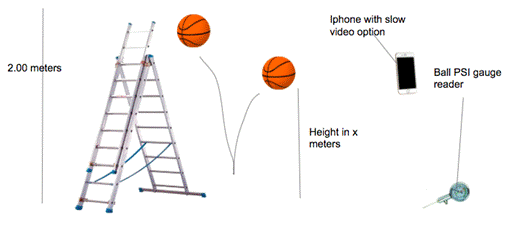
Image Source: tuhsphysics.ttsd.k12.or.us
Deciphering the Bounce: The Core Principles
The seemingly simple act of a basketball bouncing is a beautiful demonstration of fundamental physics. It’s all about how energy is stored and released. Think of it as a tiny, controlled explosion happening every time the ball meets a surface.
The Role of Ball Elasticity
The primary reason a basketball bounces is its ball elasticity. A basketball is made of a rubber bladder surrounded by layers of synthetic or natural fibers, all encased in a leather or synthetic leather cover. This layered structure, especially the air inside and the materials of the ball itself, allows it to deform upon impact without permanently changing shape.
When the ball hits the ground, its spherical form is momentarily squashed. This deformation stores potential energy, much like stretching a rubber band. The more elastic the ball, the more energy it can store and the less is lost as heat or sound during the impact.
Force and Motion in Action
Newton’s laws of motion are at play here. When you drop a ball, gravity pulls it down, giving it kinetic energy. Upon hitting the surface, the ball exerts a force on the ground, and by Newton’s third law, the ground exerts an equal and opposite force back on the ball. This upward force is what initiates the rebound. The force and motion of the impact, combined with the ball’s elasticity, dictate how high it will bounce.
Kinetic Energy Transfer: The Engine of the Rebound
The process involves a transfer of kinetic energy transfer. As the ball falls, its kinetic energy increases. When it hits the surface, this kinetic energy is momentarily converted into elastic potential energy as the ball deforms. The ball’s inherent elasticity then converts this stored potential energy back into kinetic energy, pushing the ball upwards. The efficiency of this energy transfer directly influences the height of the bounce.
Factors Influencing the Rebound
While elasticity is key, many other factors contribute to how a basketball bounces. These elements can alter the rebound dynamics and the resulting ball trajectory.
Hoop Interaction: More Than Just a Target
While the primary bounce happens off the floor, the hoop interaction is crucial in basketball. The backboard and rim are also surfaces that a basketball can rebound off. The material and angle of the backboard, as well as the tension of the net, all affect how the ball ricochets. A hard, angled backboard can send the ball in a predictable, yet often powerful, direction, while a softer bounce off the rim can be more unpredictable. The surface friction of the rim and net also plays a role in slowing the ball down.
Surface Friction: The Unseen Hand
The surface the basketball bounces on significantly impacts the rebound. Surface friction plays a critical role. A smooth, hard surface like polished wood in a gym offers less resistance than a rough concrete court.
- Hardwood Courts: Typically offer good grip but less friction in terms of slowing down the bounce itself. The elasticity of the wood can even contribute slightly to the bounce.
- Asphalt/Concrete: These surfaces are generally rougher and can have more surface friction. This friction can sap some of the ball’s rotational energy, affecting its bounce and trajectory. It can also wear down the ball’s surface over time.
- Grass/Dirt: These surfaces are highly absorbent and possess significant friction. They will significantly dampen the bounce, absorbing most of the kinetic energy transfer.
Impact Absorption: The Enemy of the Bounce
Impact absorption is the opposite of elasticity. Materials that are good at absorbing impact, like soft foam or thick padding, will reduce the height of a bounce. The basketball’s bladder and casing are designed to minimize impact absorption and maximize energy return.
- Ball Pressure: The air pressure inside the basketball is a critical factor. A properly inflated ball will be firm and elastic, leading to a good bounce. An under-inflated ball is softer and absorbs more energy, resulting in a flatter bounce. An over-inflated ball can be too stiff, potentially leading to less efficient energy transfer and a higher risk of damage.
- Ball Material: The type of rubber or synthetic material used for the bladder and the outer casing influences its elasticity. Higher quality materials generally offer better ball elasticity and durability.
Rotational Effects: Spin and Swerve
When a basketball is dribbled, it often has spin. This spin can affect the bounce due to friction between the spinning ball and the court surface.
- Topspin: A ball with topspin hitting the court will have its forward motion increased by friction as it bounces. This can lead to a lower, faster bounce.
- Backspin: A ball with backspin hitting the court will have its forward motion slowed by friction. This can lead to a higher, slower bounce, and the ball may even appear to “hop” backwards slightly.
This is a key element in dribbling mechanics. Players learn to control spin to influence their dribble for better control and movement.
The Physics of Dribbling Mechanics
Dribbling mechanics is where the science of a basketball bounce is applied dynamically. It’s not just about hitting the ball; it’s about controlling its rebound to maintain possession and set up plays.
Force and Motion in Dribbling
When dribbling, a player applies a downward force to the ball. The amount of force, the angle of impact, and the timing of the next push are all critical.
- Force: A stronger downward push generally results in a higher bounce. However, too much force can make the ball harder to control.
- Angle: The angle at which the player strikes the ball influences the ball trajectory after the bounce. A straight-down hit yields a more predictable vertical bounce.
- Timing: The player must time their next push to intercept the ball as it returns, not too early and not too late. This requires precise force and motion control.
Impact Absorption and Control
Good dribblers use their hands and wrists to subtly absorb some of the kinetic energy transfer from the bounce. This allows them to “feel” the ball and keep it close.
- Soft Hands: Players with “soft hands” can adjust the pressure and angle of their hand as the ball hits, effectively reducing the bounce height and making it easier to regain control. This is a form of controlled impact absorption.
- Finger Pad Control: The tips of the fingers are used to guide the ball, applying pressure and minor adjustments to its direction and spin.
Surface Friction in Dribbling
Surface friction is also crucial for dribbling. The friction between the ball and the court surface helps the player control the ball’s movement and direction. A slippery court can make dribbling very difficult, as the ball might slide uncontrollably.
Ball Trajectory: Predicting the Path
The ball trajectory after a bounce is a result of the initial velocity, angle of impact, and the influence of gravity and air resistance.
Projectile Motion
Once the ball leaves the court after a bounce, it becomes a projectile. Its path is governed by the principles of projectile motion.
- Initial Velocity: The speed and direction the ball leaves the surface.
- Gravity: Constantly pulls the ball downwards, causing its upward velocity to decrease, reach zero at the peak of its arc, and then increase downwards.
- Air Resistance: This force opposes the motion of the ball through the air. It depends on the ball’s speed, surface area, and the density of the air. For a basketball, air resistance is usually less significant than gravity for typical dribbling speeds, but it can affect higher, longer shots.
Spin and Trajectory
As mentioned earlier, spin can significantly alter the ball trajectory.
- Magnus Effect: For a spinning ball moving through a fluid (like air), there’s an aerodynamic force called the Magnus effect. This force acts perpendicular to the direction of motion and the axis of rotation. For a basketball, topspin will cause the ball to dip downwards more sharply, while backspin will cause it to stay “aloft” longer or even rise slightly before falling. This is why players might use backspin on a longer pass or shot to control its flight.
The Science Behind Different Bounces
Not all bounces are created equal. The rebound dynamics can vary greatly depending on the ball and the surface.
Ball Inflation Levels and Bounce Height
Here’s a general idea of how inflation affects bounce height (assuming a standard drop from a consistent height):
| Inflation Level | Bounce Characteristic | Energy Transfer Efficiency |
|---|---|---|
| Under-inflated | Lower, “mushy” bounce. Ball deforms significantly. | Lower |
| Properly Inflated | Lively, predictable bounce. Good ball elasticity. | Higher |
| Over-inflated | Can be very high, but sometimes less predictable or “dead”. | Can be high, but may not be optimal. |
Surface Materials and Rebound Coefficient
The rebound coefficient is a measure of how “bouncy” a surface is. It’s the ratio of the speed of the ball after the bounce to the speed of the ball before the bounce.
| Surface Material | Typical Rebound Coefficient (Approximate) | Dominant Factor |
|---|---|---|
| Hardwood (Gym Floor) | 0.75 – 0.85 | Ball elasticity, low surface friction |
| Concrete/Asphalt | 0.65 – 0.75 | Ball elasticity, moderate surface friction |
| Grass | 0.20 – 0.40 | High impact absorption, high surface friction |
| Clay (Tennis Court) | 0.50 – 0.60 | Moderate impact absorption and surface friction |
These are approximate values and can vary greatly based on the specific composition and condition of the surface and the ball.
The Art and Science of a Basketball
A basketball is more than just a toy; it’s a finely tuned piece of equipment where basketball physics are carefully considered during its design and construction.
Designing for Performance
Manufacturers aim to create balls with consistent ball elasticity and durability. The materials used, the way the panels are stitched or molded, and the internal bladder design all contribute to the ball’s performance. A well-made basketball offers predictable rebound dynamics, allowing players to develop their skills with confidence.
Wear and Tear
Over time, the outer surface of a basketball wears down, especially with frequent play on rough surfaces. This wear can reduce the surface friction and slightly alter the ball elasticity, potentially making the bounce less predictable. The internal bladder can also lose air or develop leaks, affecting inflation and bounce.
Frequently Asked Questions (FAQ)
Q1: Why doesn’t a basketball bounce as high indoors as it does outdoors?
A1: This is often due to the difference in playing surfaces. Indoor courts are usually made of polished hardwood, which is very smooth and firm, offering less surface friction and impact absorption than outdoor surfaces like asphalt or concrete. The smoother surface allows for a more efficient kinetic energy transfer, resulting in a higher bounce.
Q2: Can the temperature affect how a basketball bounces?
A2: Yes, temperature can affect ball elasticity. When a basketball is cold, the air inside is less pressurized, and the rubber materials become slightly stiffer and less elastic. This leads to a lower, less lively bounce. Conversely, in warmer temperatures, the air pressure increases, and the materials become more pliable, potentially resulting in a higher bounce.
Q3: What is the best way to maintain a basketball for optimal bouncing?
A3: Keep it properly inflated to the manufacturer’s recommended pressure. Store it in a cool, dry place, away from direct sunlight and extreme temperatures. Clean the ball regularly with a damp cloth to remove dirt and grime, which can affect surface friction and grip. Avoid leaving it exposed to the elements.
Q4: How does the spin on a basketball affect its bounce?
A4: Spin significantly impacts the bounce. Topspin causes friction that can make the ball bounce lower and faster, while backspin creates friction that can make it bounce higher and slower, sometimes even causing it to travel backward slightly after impact. This is a critical aspect of dribbling mechanics and controlling ball trajectory.
Q5: What makes some basketballs “better” for bouncing than others?
A5: This relates to the quality of materials used, the precision of manufacturing, and the overall design that optimizes ball elasticity and durability. Higher-quality balls typically offer more consistent rebound dynamics and better kinetic energy transfer, making them feel more responsive and predictable when dribbling or bouncing. The proper inflation level is also paramount for optimal bouncing.