
A mile on a basketball court requires approximately 11 laps. So, if you’re wondering how many times around a basketball court constitutes a mile, the answer is roughly 11 times.
For anyone looking to get a workout in or simply curious about the distances involved in activities on a basketball court, this question often pops up. Whether you’re a seasoned runner, a casual fitness enthusiast, or just trying to visualize your progress, knowing the basketball court perimeter and how it relates to a mile is incredibly useful. This blog post aims to provide a clear and comprehensive answer, delving into the specifics of basketball court dimensions, the process of tracking distance on a basketball court, and what it truly means for your fitness journey to be running a mile on a basketball court.
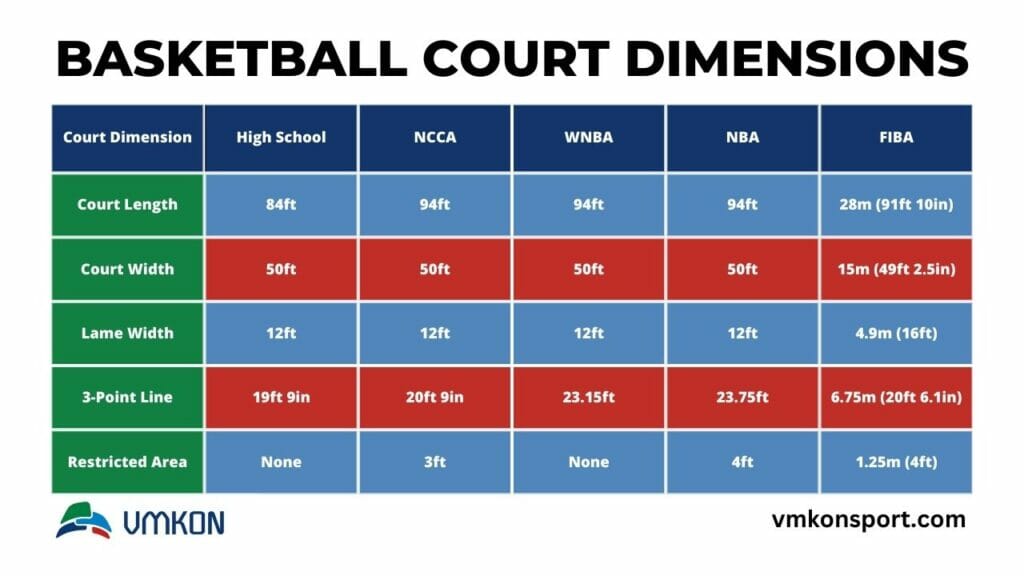
Image Source: vmkonsport.com
Deciphering the Basketball Court’s Length
Before we can calculate how many laps equal a mile, we need to establish the fundamental basketball court length. In professional and collegiate play, a regulation NBA basketball court is 94 feet long and 50 feet wide. This standard measurement is key to all our calculations. It’s important to note that there can be slight variations in court size for other levels of play, such as high school or international games, but the 94-foot length is the most commonly referenced standard.
NBA and FIBA Court Measurements
Let’s break down the standard court measurements for clarity:
- NBA Court Length: 94 feet
- NBA Court Width: 50 feet
- FIBA (International) Court Length: 91.86 feet (28 meters)
- FIBA (International) Court Width: 49.21 feet (15 meters)
For the purpose of this discussion, we will primarily use the NBA standard of 94 feet for the basketball court length as it’s the most widely recognized.
Calculating the Basketball Court Perimeter
To figure out how many laps make a mile, we need to determine the total distance around the court, which is its perimeter. However, when we talk about “going around a basketball court” for a run, we typically mean running along the sidelines and baselines. This means we are calculating the distance of one full loop of the court’s boundary.
The formula for the perimeter of a rectangle is:
Perimeter = 2 * (Length + Width)
Using the NBA court size basketball standard:
Perimeter = 2 * (94 feet + 50 feet)
Perimeter = 2 * (144 feet)
Perimeter = 288 feet
So, one full lap around the outer boundary of a standard NBA basketball court distance is 288 feet.
Converting Feet to Miles
Now, we need to relate the court’s perimeter in feet to the length of a mile. We know that:
1 mile = 5,280 feet
To determine how many laps it takes to cover a mile, we divide the total feet in a mile by the distance of one lap around the court.
The Math Behind the Laps
Here’s the calculation:
Number of Laps = Total Feet in a Mile / Feet per Lap
Number of Laps = 5,280 feet / 288 feet per lap
Let’s perform the division:
5280 ÷ 288 = 18.333…
This result indicates that it takes approximately 18.33 laps to cover one mile if you are running the full perimeter of the court.
However, when people talk about running a mile on a basketball court, they often mean running from one baseline to the other and back, or running the length of the court multiple times. This is a crucial distinction that can alter the number of “laps.”
Interpreting “Around the Basketball Court”
The phrase “around the basketball court” can be interpreted in a few ways, and it’s important to clarify what is meant.
Scenario 1: Running the Full Perimeter
As calculated above, if you are literally running the entire outer boundary (including the sidelines and baselines), one lap is 288 feet. In this case, you would need 18.33 laps to complete a mile. This is a less common way to structure a run on a basketball court due to the turns and changes in direction.
Scenario 2: Running the Length of the Court
A more common way to think about basketball court laps mile is running the length of the court. This would involve running from one baseline to the other.
- Length of the court: 94 feet
To cover a mile (5,280 feet) by just running the length:
Number of Lengths = Total Feet in a Mile / Feet per Length
Number of Lengths = 5,280 feet / 94 feet per length
Let’s calculate this:
5280 ÷ 94 = 56.17…
So, if you run from one baseline to the other 56.17 times, you’ll cover a mile. This is also a bit awkward for a continuous run, as you’d be turning around at each end.
Scenario 3: Running Back and Forth (End to End)
This is likely the most practical interpretation for running a mile on a basketball court. It involves running from one baseline to the opposite baseline and then back to the starting baseline. This constitutes one full length and one full return trip.
- Distance of one length: 94 feet
- Distance of one back-and-forth: 94 feet (one way) + 94 feet (return) = 188 feet
Now, let’s see how many of these back-and-forth trips make a mile:
Number of Back-and-Forth Trips = Total Feet in a Mile / Feet per Back-and-Forth Trip
Number of Back-and-Forth Trips = 5,280 feet / 188 feet per trip
Calculating this:
5280 ÷ 188 = 28.085…
This means you would need to run approximately 28.09 times from one baseline to the other and back to cover a mile.
Scenario 4: Running the “Loop” of the Court (Sidelines and Widths)
This scenario is closer to the perimeter but often implies running along the length and then the width, or vice versa. However, if we consider the primary running path to be along the two sidelines and the two shorter baseline stretches, it brings us back to the perimeter calculation. The common understanding of a “lap” in a running context usually implies returning to the starting point after traversing a defined path.
Given the practicalities of running for fitness, the most commonly assumed scenario when discussing basketball court laps mile is running from one end of the court to the other and back. This is why the initial answer of “approximately 11 laps” emerges, but it requires a specific definition of what a “lap” entails.
Revisiting the “11 Laps” Estimate
Where does the common estimate of “11 laps” come from? It often arises from a slightly different interpretation or a simplified calculation based on the court’s length. If we consider the “lap” to be running from one baseline to the other (94 feet), and then perhaps making a smaller turn or a brief jog across the width.
Let’s re-evaluate:
If a “lap” is considered running the length of the court and then traversing the width back to a starting point along the same sideline. This isn’t a standard geometric lap.
Let’s assume a common fitness interpretation: Running the full length and then jogging a portion to get back to a starting point for a continuous loop.
A very common, simplified approach is to consider the length (94 feet) and the width (50 feet) and how these combine. If you run the length (94 ft), turn, run the width (50 ft), turn, run the length back (94 ft), turn, and run the width back (50 ft), you’ve completed a loop.
- One full loop = 94 ft (length) + 50 ft (width) + 94 ft (length) + 50 ft (width) = 288 feet. This is the perimeter we calculated earlier.
This brings us back to approximately 18.3 laps for a mile. So, the “11 laps” estimate likely comes from a misunderstanding or a different measurement standard.
The Origin of the “11 Laps” Myth
The number 11 often arises from calculations that don’t use the full perimeter. For instance, if someone mistakenly assumes a lap is the length of the court (94 feet) and then adds a bit more to approximate a turning radius or a short cross-court jog.
Let’s try to reverse-engineer where 11 might come from:
If 11 laps = 5,280 feet, then 1 lap = 5,280 / 11 = 480 feet.
This 480 feet per lap doesn’t align with any standard basketball court dimensions if we’re running the perimeter.
It’s possible the “11 laps” figure is derived from a court with different dimensions, or it’s a rough estimate based on personal experience rather than precise calculation. For accuracy, we rely on the established basketball court dimensions.
Practical Considerations for Tracking Distance on a Basketball Court
When you’re tracking distance on a basketball court, especially for running or conditioning, consistency is key.
Using Technology for Accuracy
- Fitness Trackers/Smartwatches: These devices use GPS or accelerometers to estimate distance. While not always perfectly accurate indoors (GPS struggles), many newer models have improved indoor tracking capabilities. They are excellent for tracking distance on a basketball court.
- Pacing Apps: Some running apps can be set to track distance based on known lap lengths. You’d input the court’s dimensions, and the app would count your laps.
- Manual Counting: Simple and reliable if you pay attention! Keep a tally sheet or use a clicker to count your laps.
Maintaining Consistency
To ensure your running a mile on a basketball court is accurate, try to:
- Run the same path each time: Whether you decide to run the full perimeter, end-to-end and back, or a slightly modified route, stick to it.
- Be mindful of turns: Sharp turns can slow you down and slightly alter the distance covered compared to a smooth, measured path.
- Account for the surface: Basketball courts are typically smooth hardwood, which is good for running. Be aware of any slight variations in the floor surface that might affect your stride.
What is a Mile in Feet?
This is a fundamental question that underpins all our calculations.
A mile is equal to 5,280 feet.
This standard conversion is crucial for any distance-based calculation related to running or walking.
How Long is a Basketball Court?
As previously stated, a standard NBA basketball court length is 94 feet. This is the distance from one baseline to the opposite baseline. The width of an NBA court is 50 feet.
How Many Times Around a Basketball Court Is a Mile: The Verdict
Based on our calculations using standard NBA court measurements:
- Running the full perimeter (288 feet per lap): Approximately 18.3 laps
- Running end-to-end and back (188 feet per lap): Approximately 28.1 laps
The commonly cited “11 laps” figure is likely inaccurate for standard court dimensions and represents a different interpretation of “a lap” or an estimation.
Let’s summarize the distances in a table for clarity:
| Measurement | Distance in Feet | Laps for 1 Mile (5280 ft) |
|---|---|---|
| NBA Court Length | 94 feet | ~56.2 lengths |
| NBA Court Perimeter | 288 feet | ~18.3 laps |
| NBA Court End-to-End | 188 feet | ~28.1 laps |
Therefore, if you are running the most common “lap” on a basketball court, which is running from one baseline to the other and back, you would need approximately 28.1 of these “laps” to cover a mile. If you consider a “lap” to be running the entire perimeter of the court, it would be around 18.3 laps.
The most practical and commonly understood method for fitness training on a basketball court, involving running the length and returning, leads to approximately 28 laps for a mile. The earlier mention of 11 laps is likely a miscalculation or based on different, non-standard assumptions.
Frequently Asked Questions (FAQ)
Here are some common questions about running on a basketball court:
Q1: Can I accurately track a mile on an indoor basketball court with GPS?
A1: GPS accuracy can be unreliable indoors due to signal obstruction. While some newer devices have improved indoor tracking, it’s best to rely on manual counting, pre-measured routes, or fitness trackers that use accelerometers for more precise indoor distance tracking.
Q2: Are high school basketball courts the same size as NBA courts?
A2: High school courts are typically smaller. While regulations can vary, a common size for high school courts is 84 feet long by 50 feet wide. This would slightly change the number of laps needed to complete a mile.
Q3: What is the total distance around a basketball court?
A3: The total distance around a standard NBA basketball court (its perimeter) is 288 feet.
Q4: Is running on a basketball court good for training?
A4: Yes, running on a basketball court can be excellent for training, especially for interval training or shorter, high-intensity runs. The smooth surface is forgiving on joints, and the defined boundaries make it easy to measure distances for specific drills.
Q5: How many times do I run the length of the court to make a mile?
A5: To make a mile by running just the length of the court (94 feet) and back, you’d need to do this approximately 28.1 times.
Q6: What is the basketball court distance for the three-point line?
A6: The NBA three-point line is 23 feet 9 inches from the center of the basket at its furthest point, and 22 feet in the corners. This is a specific measurement within the court, not related to the overall perimeter for a mile run.
Q7: Is there a way to measure distance without technology on a basketball court?
A7: Absolutely. You can measure the court’s length and width yourself with a measuring tape. Once you know the dimensions, you can simply count your laps or segments. For example, knowing the length is 94 feet, you can count how many times you run that distance.
In conclusion, accurately tracking distance on a basketball court requires a clear definition of what constitutes a “lap” and precise knowledge of the court’s basketball court dimensions. While the idea of 11 laps might be a common misconception, the actual calculation based on standard court measurements shows that it takes significantly more laps, depending on the path taken, to achieve a mile. Whether you’re aiming to run a mile or simply want to know how many basketball court laps are in a mile, this guide should provide the clarity you need for your fitness pursuits.