
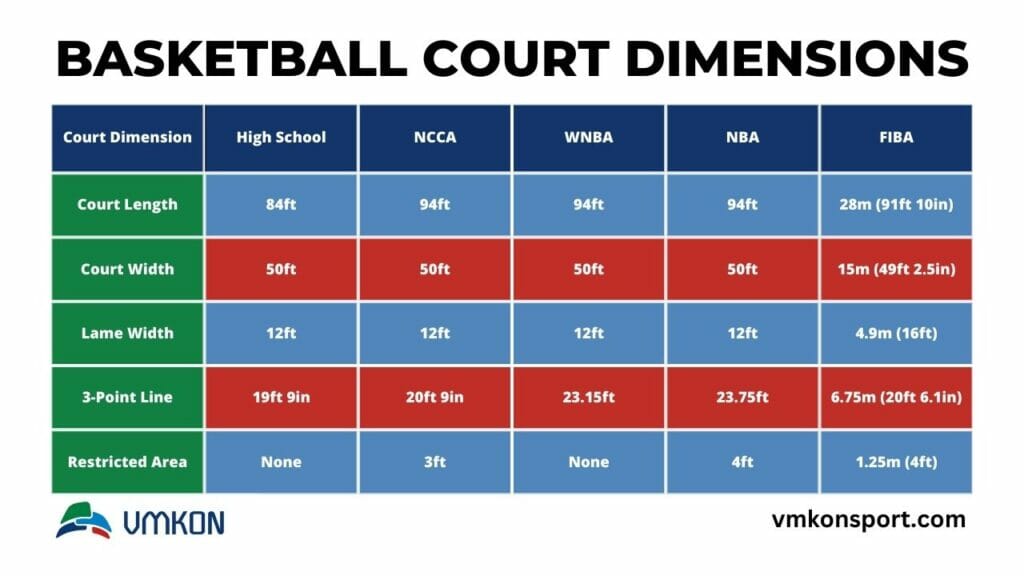
Image Source: vmkonsport.com
How Many Times Around A Basketball Court Is A Mile?
To determine how many times around a basketball court equals a mile, you need to know the basketball court length and the total distance of a mile. A standard NBA basketball court dimensions measure 94 feet long by 50 feet wide. The court perimeter, which is the total distance around the outside of the court, is calculated by adding up all four sides. This means you add the length twice and the width twice: (94 ft + 50 ft + 94 ft + 50 ft). Therefore, the basketball court perimeter is 288 feet. Since a mile is equal to 5,280 feet, you would divide the total feet in a mile by the court perimeter: 5,280 feet / 288 feet per lap ≈ 18.33 laps. So, it takes approximately 18.33 times around a basketball court to cover a mile distance.
Delving Deeper into Court Measurements and the Mile
For anyone looking to track their fitness or understand athletic training better, knowing the court measurements is key. Whether you’re a seasoned runner or just starting, covering a mile distance can feel different depending on the path. Running a lap around basketball court offers a consistent, defined space to measure your progress. Let’s break down the specifics of court dimensions and how they relate to the familiar mile distance.
The Foundation: What is a Mile?
Before we talk about basketball courts, let’s clarify what a mile distance actually is. A mile is a unit of length, primarily used in the United States and the United Kingdom.
- Standard Mile: One statute mile is exactly 5,280 feet.
- Conversions:
- 1 mile = 1,760 yards
- 1 mile = 1.609 kilometers
- 1 mile = 8 furlongs
This understanding of how far is a mile is crucial for our calculations.
The Canvas: Standard Basketball Court Dimensions
Basketball courts, while standardized in their purpose, can have slight variations in size depending on the league or governing body. However, for general fitness and athletic purposes, we typically refer to the NBA or FIBA basketball court dimensions.
NBA Court Dimensions: The Benchmark
The National Basketball Association (NBA) uses a specific set of basketball court dimensions that are widely recognized.
- Length: 94 feet
- Width: 50 feet
These are the primary measurements that define the playing area for a full court basketball game.
FIBA Court Dimensions: A Slight Variation
The International Basketball Federation (FIBA), which governs international play, has slightly different court measurements.
- Length: 28 meters (approximately 91.86 feet)
- Width: 15 meters (approximately 49.21 feet)
While these are different, the calculation for laps to a mile will be similar. For this discussion, we’ll primarily focus on the NBA court as it’s more commonly referenced in many contexts.
Calculating the Perimeter: The Path of a Lap
To figure out how many times around a basketball court makes a mile, we need to calculate the court perimeter. The perimeter is the total distance around the outside boundary of the court. For a rectangular court, this is calculated by adding up the lengths of all four sides.
Formula for Perimeter:
Perimeter = 2 * (Length + Width)
Applying the NBA Dimensions:
Using the NBA basketball court length of 94 feet and a width of 50 feet:
Perimeter = 2 * (94 feet + 50 feet)
Perimeter = 2 * (144 feet)
Perimeter = 288 feet
So, one lap around basketball court on an NBA court measures 288 feet.
The Math: Laps to a Mile
Now, let’s put it all together. We know the total distance of a mile in feet and the distance of one lap around basketball court in feet.
Calculation:
Number of Laps = Total Feet in a Mile / Feet per Lap
Number of Laps = 5,280 feet / 288 feet per lap
Number of Laps ≈ 18.33 laps
This means that if you run precisely along the outer boundary of a standard NBA basketball court, you will complete approximately 18.33 laps to cover a mile distance.
Considering FIBA Courts:
If we use the FIBA dimensions (28 meters by 15 meters):
- First, convert meters to feet:
- Length = 28 meters * 3.28084 feet/meter ≈ 91.86 feet
- Width = 15 meters * 3.28084 feet/meter ≈ 49.21 feet
- Calculate the perimeter:
- Perimeter = 2 * (91.86 feet + 49.21 feet)
- Perimeter = 2 * (141.07 feet)
- Perimeter ≈ 282.14 feet
- Calculate laps to a mile:
- Number of Laps = 5,280 feet / 282.14 feet per lap
- Number of Laps ≈ 18.71 laps
As you can see, the slight difference in court measurements results in a small variation in the number of laps required to complete a mile.
Practical Applications for Runners and Athletes
Knowing the exact number of laps for a mile can be incredibly useful for various fitness activities.
Precision in Training
For athletes or individuals focused on precision in their training, understanding this conversion is invaluable.
- Interval Training: If you’re doing interval sprints or endurance runs on a basketball court, knowing that 18.33 laps make a mile allows you to set precise workout parameters. You can aim for 18 full laps and then an additional portion of the next lap to hit your target.
- Pacing: While running on a court isn’t the same as running on a track, it can provide a controlled environment for practicing pace. By counting laps, you can get a feel for how long it takes you to cover specific distances.
- Warm-ups and Cool-downs: Even for shorter distances, knowing the court perimeter helps in structuring warm-up and cool-down routines efficiently.
Variations in Running Paths on the Court
It’s important to note that “around a basketball court” can be interpreted in a few ways.
Running the Perimeter:
This is the most straightforward calculation, where you run along the outer boundary lines. This is what we’ve calculated above.
Running the Boundary with Crossovers:
Some training drills might involve running the length of the court and then back, or incorporating specific movements. If the drills involve stopping and starting or changing direction frequently, it might affect the perceived distance or the time it takes to complete a mile, but the actual court perimeter remains the same.
Running within the Court Lines:
If you’re doing drills that involve running specific patterns within the full court basketball area (e.g., zig-zagging, suicides), the distance covered per “lap” will vary greatly. However, if the goal is simply to accumulate a mile, the most consistent method is to run the court perimeter.
Frequently Asked Questions (FAQ)
Here are some common questions about running a mile on a basketball court:
Q1: Is running laps on a basketball court a good way to train for a mile?
A1: Yes, running laps on a basketball court can be a good way to train, especially for specific types of training like interval sprints or agility drills. The consistent surface and defined boundaries can be helpful. However, it’s not the same as running on a track or road, as you’ll be making sharper turns, which can be harder on your joints. It’s good for building different types of strength and stamina.
Q2: Does the size of the basketball court matter for the number of laps to a mile?
A2: Yes, the size of the court does matter. As shown in our calculations, different court measurements (like NBA vs. FIBA) will result in a slightly different number of laps to complete a mile. Always use the specific dimensions of the court you are using for accurate calculations.
Q3: What is the easiest way to count laps around a basketball court?
A3: The easiest way to count laps is to assign a number to each completed lap around basketball court. You can do this mentally, by tapping your foot or hand at the end of each lap, or by using a clicker or a fitness tracker. If you have a friend with you, they can help count.
Q4: How far is a basketball court in total distance?
A4: A standard NBA basketball court dimensions have a perimeter of 288 feet. This is the total distance around the outside of the court.
Q5: If I run the length of a basketball court and back, how far is that?
A5: Running the length of a standard NBA basketball court length (94 feet) and back covers 188 feet (94 feet + 94 feet). This is less than one lap around the court perimeter.
Q6: How many basketball courts would I need to run to reach a mile if I just ran the length of one court?
A6: Since a mile is 5,280 feet and the length of a court is 94 feet, you would need to run the length of the court approximately 5,280 / 94 ≈ 56.17 times to reach a mile. This would involve a lot of turning around!
Q7: Can I use my GPS watch to track a mile on a basketball court?
A7: While GPS watches are great for outdoor tracking, they can sometimes be less accurate in enclosed spaces like gymnasiums due to signal interference. It’s often more reliable to use the known court measurements and count laps manually or with a clicker for precise distance tracking.
Q8: Is there a standard distance for a “full court basketball” length?
A8: Yes, for a full court basketball, the standard NBA length is 94 feet.
Q9: What are other ways to measure a mile besides counting laps?
A9: You can measure a mile using a measuring wheel, pacing it out and multiplying your average stride length by the number of steps, using a GPS device, or by finding a pre-measured track or path. Knowing your average stride length can also help you estimate distances. For example, if your stride is 3 feet long, it takes about 1,760 strides to cover a mile (5,280 feet / 3 feet/stride).
Q10: How does running a mile on a basketball court compare to running a mile on a track?
A10: Running a mile on a basketball court involves more sharp turns, which can increase the cardiovascular and muscular effort compared to running on a standard 400-meter track, which has banked curves designed for smoother running. The surface might also differ, with courts typically being hardwood and tracks often being synthetic.
Conclusion: Precision and Fitness
In summary, approximately 18.33 laps around a standard NBA basketball court will cover a mile distance. This calculation is based on the basketball court length of 94 feet and a width of 50 feet, resulting in a court perimeter of 288 feet. For athletes and fitness enthusiasts, this information allows for precise workout planning and an enhanced appreciation for the geometry of the spaces we use for exercise. Whether you’re aiming for peak performance or simply aiming to stay active, knowing the court measurements can add an extra layer of detail to your fitness journey, making every lap around basketball court a purposeful step towards your goals.