
A standard basketball court is 4,700 square feet. But what does that mean, and does it vary? Yes, the exact size can differ based on the league or governing body.
Whether you’re a budding athlete dreaming of slam dunks, a parent looking to build a backyard court, or just a curious fan, knowing the dimensions of a basketball court is key. This guide will break down the typical measurements and the reasons behind them. We’ll explore the nuances of basketball court dimensions, from the professional NBA court size to the setups used in schools and international play. Let’s dive into the standard basketball court area and what constitutes the playable area basketball court.
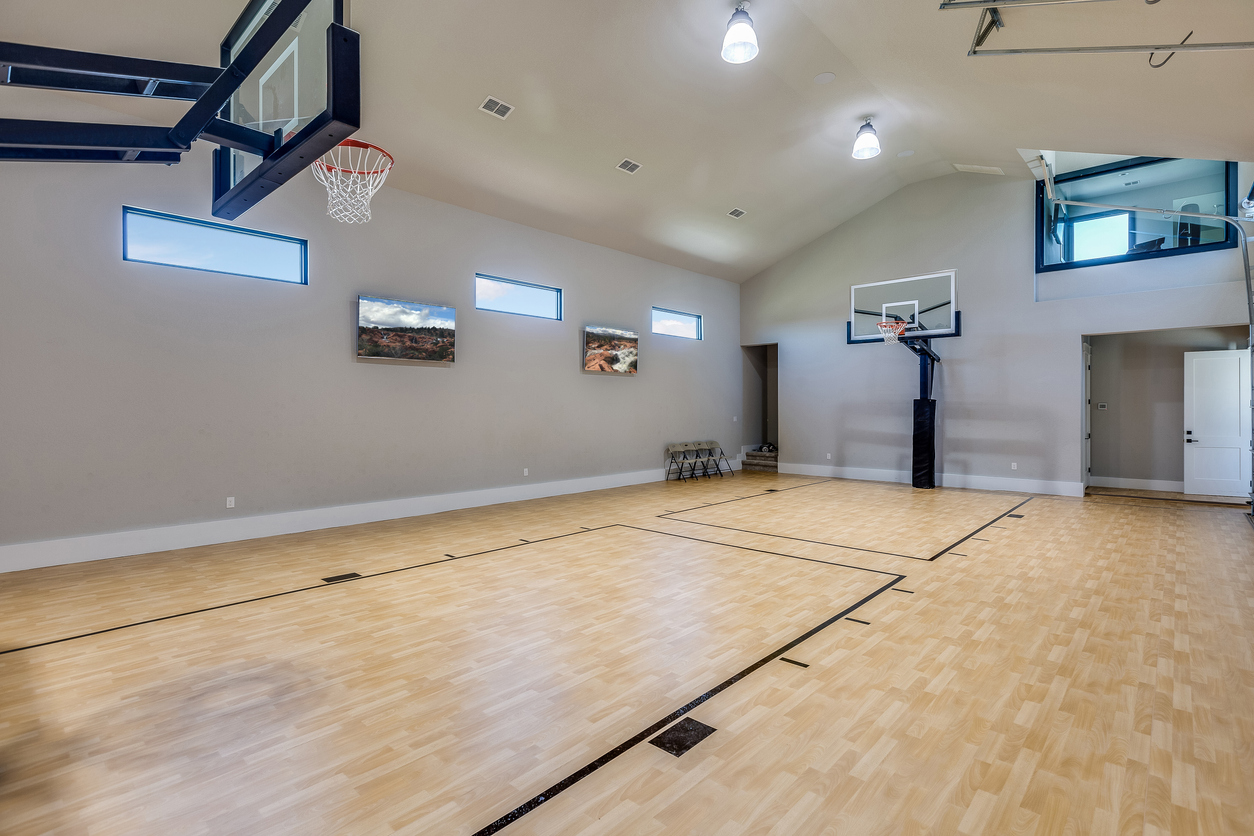
Image Source: www.dominatorhoop.com
Deconstructing Basketball Court Sizes
The game of basketball, at its core, requires a rectangular playing surface with specific markings. While the concept is simple, the actual court surface area can vary slightly depending on who is playing and where. These variations are generally minor but can impact gameplay, especially at higher levels where precise spacing is crucial.
The NBA Court: A Professional Standard
The National Basketball Association (NBA) has a very specific set of rules that dictate the size of its courts. The NBA court size is a benchmark for many aspiring players and is known for its generous dimensions compared to other international standards.
The NBA court measures:
- Length: 94 feet
- Width: 50 feet
To calculate the total area in square feet, we simply multiply the length by the width:
94 feet * 50 feet = 4,700 square feet
This means the standard basketball court area for the NBA is precisely 4,700 square feet. This size is designed to allow for fast-paced play, with ample space for offensive drives, defensive rotations, and long-range shooting.
Key Markings on an NBA Court:
Beyond the overall dimensions, the NBA court features specific markings that define different zones of play:
- The Free Throw Line: Located 15 feet from the front of the backboard.
- The Three-Point Line: This is a crucial element that defines the scoring area. On an NBA court, the three-point line is 23 feet, 9 inches from the center of the basket. In the corners, it curves to be 22 feet from the baseline.
- The Key (or Lane): This is the rectangular area under the basket, extending from the baseline to the free-throw line. It is 16 feet wide.
- Center Circle: A 12-foot diameter circle in the middle of the court.
- Sidelines and Baselines: These lines define the boundaries of the court.
The total playable area basketball court for an NBA game encompasses all of this space within the sidelines and baselines.
FIBA Court: The International Perspective
The Fédération Internationale de Basketball (FIBA) is the global governing body for basketball. FIBA sets the standards for international competitions, including the Olympics and the FIBA World Cup. The FIBA court size is slightly different from the NBA.
The FIBA court measures:
- Length: 91 feet 10 inches (28 meters)
- Width: 49 feet 2 inches (15 meters)
To calculate the total area in square feet:
- Convert meters to feet: 28 meters * 3.28084 feet/meter ≈ 91.86 feet
- Convert meters to feet: 15 meters * 3.28084 feet/meter ≈ 49.21 feet
So, the FIBA court size is approximately 91.86 feet * 49.21 feet.
91.86 feet * 49.21 feet ≈ 4,522 square feet
Therefore, a FIBA court is slightly smaller than an NBA court, with an area of around 4,522 square feet. This difference, while seemingly small, can influence offensive and defensive strategies.
Key Markings on a FIBA Court:
FIBA courts also have specific markings:
- The Free Throw Line: Similar to the NBA, it’s 15 feet from the front of the backboard.
- The Three-Point Line: The FIBA three-point line is 22 feet, 1.75 inches (6.75 meters) from the basket. This is shorter than the NBA’s three-point line.
- The Key (or Lane): FIBA’s key is also different. It’s trapezoidal in shape, measuring 19 feet 8.5 inches (6 meters) at its widest point (from baseline to baseline) and narrowing to 16 feet 5 inches (5 meters) at the free-throw line.
- Center Circle: Similar to the NBA, with a 12-foot diameter.
The playable area basketball court for FIBA games is within these dimensions, and the closer three-point line often encourages more perimeter shooting.
College Basketball Court Size
In the United States, collegiate basketball is governed by the National Collegiate Athletic Association (NCAA). For many years, college basketball courts were the same size as NBA courts. However, in 2019, the NCAA adopted the FIBA three-point line.
The college basketball court size for NCAA Division I men’s and women’s basketball is now:
- Length: 94 feet
- Width: 50 feet
This means the NBA court size and the current college basketball court size are identical in overall dimensions.
However, the key difference lies in the three-point line:
- College Three-Point Line: 22 feet, 1.75 inches (6.75 meters) from the basket, matching the FIBA distance.
This change brought college basketball in line with international standards, aiming to promote a more global style of play and better prepare players for international competition. The standard basketball court area for college play, therefore, remains 4,700 square feet, but the scoring geometry has been altered.
High School Basketball Court Size
High school basketball in the United States follows guidelines set by the National Federation of State High School Associations (NFHS). The high school basketball court size is typically the same as the FIBA dimensions, but with one key difference.
The high school basketball court size measures:
- Length: 84 feet
- Width: 50 feet
To calculate the total area:
84 feet * 50 feet = 4,200 square feet
So, a high school basketball court has a court surface area of 4,200 square feet. This is smaller than both NBA and FIBA courts.
Key Markings on a High School Court:
- Free Throw Line: 15 feet from the front of the backboard.
- Three-Point Line: The NFHS three-point line is 22 feet from the basket. This is a consistent distance, unlike the NBA’s.
- The Key (or Lane): Generally 12 feet wide.
The smaller dimensions of a high school court can lead to a more compact game, with quicker transitions and less space for players to operate. This affects the playable area basketball court, requiring players to be more efficient with their movements.
Comparing the Court Sizes
Let’s summarize the differences in the playable area basketball court for the major organizations in a table.
| Organization | Length | Width | Total Area (sq ft) | Three-Point Line Distance |
|---|---|---|---|---|
| NBA | 94 feet | 50 feet | 4,700 | 23′ 9″ (22′ in corners) |
| FIBA | 91′ 10″ (28m) | 49′ 2″ (15m) | ~4,522 | 22′ 1.75″ (6.75m) |
| NCAA (Men’s/Women’s) | 94 feet | 50 feet | 4,700 | 22′ 1.75″ (6.75m) |
| High School (NFHS) | 84 feet | 50 feet | 4,200 | 22 feet |
As you can see, the NBA and NCAA currently share the largest standard basketball court area. High school courts are the smallest among these primary examples, while FIBA courts fall in between.
Indoor vs. Outdoor Basketball Courts
The distinction between an indoor basketball court size and an outdoor basketball court size is not usually in the fundamental dimensions themselves, but rather in the context and quality of the playing surface.
Indoor Basketball Courts
Most professional, college, and even many high school basketball games are played on indoor basketball court size setups. These courts are typically constructed with polished hardwood floors (like maple) which provide optimal grip and bounce for the ball. The environment is controlled for temperature and humidity, ensuring consistent playing conditions. The lines and markings are precisely painted according to the relevant standards (NBA, FIBA, NCAA, etc.). The overall dimensions and playable area basketball court within these venues are strictly regulated.
Outdoor Basketball Courts
Outdoor courts, often found in parks, playgrounds, or driveways, can vary more in their dimensions and quality. While some may be built to specific basketball court dimensions, many are not. They are often made of asphalt or concrete, which can be more abrasive on shoes and provide a different bounce than hardwood. The condition of the surface and markings can also vary significantly due to weather exposure and wear and tear.
When people refer to an “outdoor basketball court,” they might be thinking of a half-court for casual shooting or a full court. The standard basketball court area is generally applied when courts are built for organized play, but casual courts can be any size.
Building a Backyard Court:
If you’re considering building a backyard court, you’ll need to decide which set of basketball court dimensions you want to adhere to.
- NBA/NCAA Size (94 ft x 50 ft): This offers the most space and is ideal if you want to replicate professional play. However, it requires a substantial amount of space. The total court surface area is 4,700 square feet.
- FIBA Size (approx. 92 ft x 49 ft): Slightly smaller, but still a full-size court. This might be a good compromise if space is a bit limited but you still want a regulation feel.
- High School Size (84 ft x 50 ft): This is more manageable for smaller yards. It’s a good option for recreational play.
When planning, remember to account for:
- Run-off Area: You need extra space around the court boundaries for safety. This is not typically included in the playable area basketball court calculation but is essential for a functional setup.
- Height Clearance: For indoor courts, ceiling height is critical. For outdoor courts, overhead obstructions like trees or wires need to be considered.
The Significance of Court Dimensions
The dimensions of a basketball court aren’t arbitrary; they are carefully considered to shape the game.
Impact on Strategy and Play
- Shooting: The distance of the three-point line significantly affects offensive strategy. A shorter line (FIBA/College) can lead to more three-point attempts and potentially a higher scoring game from beyond the arc. A longer line (NBA) demands greater range and accuracy.
- Pace of Play: Larger courts (NBA) allow for more room to run and space out players, facilitating faster transitions and more one-on-one opportunities. Smaller courts (High School) can feel more congested, leading to quicker drives and more physical play in closer quarters.
- Player Development: Different court sizes can influence how players develop. Smaller courts might emphasize quicker ball movement and shorter passes, while larger courts might encourage developing skills in isolation and covering more ground defensively.
- Fouling: The width of the key and the distance to the basket can influence how players defend in the paint and how often fouls occur.
The “Playable Area”
It’s important to distinguish between the total court surface area and the playable area basketball court. The playable area is the legal space where the game is conducted, defined by the boundary lines. Everything within those lines is considered playable. However, in practical terms, especially in professional settings, there’s also consideration for the immediate perimeter around the court for player safety and officials.
When constructing a court, particularly an indoor basketball court size facility, factors like the location of walls, bleachers, and other obstructions are crucial. The ideal setup ensures ample “run-off” space beyond the baselines and sidelines. This buffer zone is vital to prevent players from colliding with hard surfaces after an out-of-bounds play or a missed shot. While not part of the official basketball court dimensions, this safety perimeter is a critical aspect of court design.
Frequently Asked Questions (FAQs)
Q1: What is the difference between NBA and FIBA court sizes?
A1: The main differences are in length, width, and the three-point line distance. NBA courts are 94 feet by 50 feet, with a 23’9″ three-point line. FIBA courts are 91’10” by 49’2″, with a shorter 22’1.75″ three-point line.
Q2: Are college basketball courts the same size as NBA courts?
A2: Yes, in terms of overall length and width (94 ft x 50 ft), college courts are the same as NBA courts. However, college basketball recently adopted the FIBA three-point line distance of 22’1.75″.
Q3: How much bigger is an NBA court than a high school court?
A3: An NBA court is 94 feet long and 50 feet wide (4,700 sq ft). A high school court is typically 84 feet long and 50 feet wide (4,200 sq ft). So, an NBA court is 10 feet longer, offering an additional 500 square feet of court surface area.
Q4: Does the type of court surface affect the game?
A4: Yes, the surface significantly impacts the game. Hardwood floors found in indoor basketball court size facilities provide better grip and a consistent ball bounce compared to outdoor surfaces like asphalt or concrete, which can be harder, more abrasive, and affected by weather.
Q5: What is the minimum size for a playable basketball court?
A5: While there isn’t a universally mandated “minimum playable” size for casual settings, for organized play, adherence to the established dimensions (like high school, FIBA, or NBA) is standard. A half-court often requires at least 30×30 feet for decent play, but a full playable area basketball court needs to meet the official dimensions.
Q6: Does the “out of bounds” area count towards the total square footage?
A6: No, the official basketball court dimensions only refer to the marked playing area. The space around the court, known as the run-off area, is for safety and is not included in the standard basketball court area.
Q7: Why are there different court sizes for different leagues?
A7: Different sizes often stem from historical development, regional preferences, and strategic decisions by governing bodies to influence the style of play. For instance, the shorter three-point line in college and FIBA play can encourage more outside shooting.
By knowing these various basketball court dimensions, you gain a deeper appreciation for the game and the subtle factors that shape its presentation across different levels of play. Whether it’s the sprawling 4,700 square feet of an NBA arena or the more compact 4,200 square feet of a high school gym, each court provides a unique stage for the sport.