
A regulation basketball court is 4,700 square feet. This measurement applies to a standard NBA court, which is 94 feet long and 50 feet wide. Let’s dive into the specifics of basketball court dimensions and the regulation basketball court area.
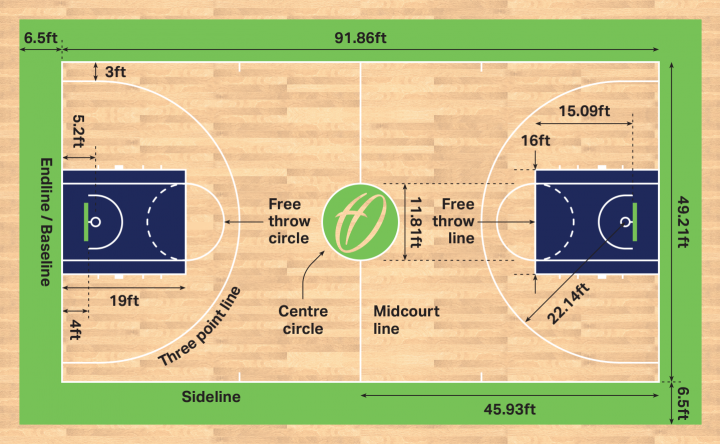
Image Source: www.harrodsport.com
Deciphering the Size of a Basketball Court
The size of a basketball court can vary slightly depending on the league or organization. However, when most people ask about the square footage of a basketball court, they are usually referring to the standard playing surface used in professional and collegiate play. This includes the NBA court size, the FIBA court size, and the college basketball court size. Each of these has specific dimensions that contribute to the overall basketball court square footage.
NBA Court Size: The Pinnacle of Professional Play
The National Basketball Association (NBA) has established precise basketball court dimensions. An NBA court measures 94 feet in length and 50 feet in width. To calculate the total square footage, we simply multiply these two figures:
94 feet (length) × 50 feet (width) = 4,700 square feet
This 4,700 square feet represents the main playing area, excluding any surrounding out-of-bounds space or spectator areas. This is the most commonly cited figure when discussing the regulation basketball court area.
FIBA Court Size: A Global Standard
The International Basketball Federation (FIBA), which governs international basketball, also has specific basketball court dimensions. FIBA courts are slightly smaller than NBA courts. A FIBA-regulation court measures 28 meters in length and 15 meters in width.
To convert these measurements to feet for comparison:
* 1 meter = 3.28084 feet
So, a FIBA court is approximately:
* Length: 28 meters × 3.28084 feet/meter = 91.86 feet
* Width: 15 meters × 3.28084 feet/meter = 49.21 feet
Now, let’s calculate the basketball court square footage for a FIBA court:
91.86 feet (length) × 49.21 feet (width) ≈ 4,520 square feet
As you can see, the FIBA court size is marginally smaller than the NBA court. The difference in area is roughly 180 square feet, which, while not massive, is noticeable in the overall full court basketball area.
College Basketball Court Size: Bridging the Gap
College basketball in the United States generally adheres to the NBA court dimensions. Therefore, a college basketball court is also typically 94 feet long and 50 feet wide. This means the college basketball court size is also 4,700 square feet, aligning with the NBA standard for the primary playing surface.
High School and Youth Basketball Courts: Variations to Consider
While professional and college play adheres to strict dimensions, high school basketball court dimensions and those for younger players can sometimes vary. Some high school gyms might have courts that are slightly shorter or narrower, particularly older facilities. However, for official competitions, high schools are expected to use courts that closely match the college and NBA standards.
Youth leagues and recreational play can have even more flexibility. Smaller courts are often used for younger age groups to accommodate their skill levels and the size of the ball. These courts will have a significantly smaller basketball court square footage.
Beyond the Playing Surface: Factors Affecting Total Area
When we talk about the basketball court square footage, we are primarily referring to the playing surface itself. However, in a real-world scenario, especially in an indoor basketball court dimensions context, there’s often more space around the court.
Out-of-Bounds Areas (Run-off)
Most organized basketball games, especially at higher levels, require a minimum amount of space beyond the boundary lines. This is known as the “run-off” area. This area is crucial for player safety, allowing players to stop quickly and preventing them from running into walls or spectators.
- NBA: The NBA typically requires a minimum of 3 feet of run-off space on the sidelines and 6 feet behind the baselines.
- FIBA: FIBA regulations often require a minimum of 2 meters (approximately 6.5 feet) of clear space around the court.
These run-off areas add to the total footprint of the basketball facility but are not included in the calculated regulation basketball court area.
Facility Size: Indoor vs. Outdoor
The concept of indoor basketball court dimensions versus outdoor basketball court size is also worth noting. While the playing surface dimensions remain consistent for regulation courts, the surrounding environment can differ vastly.
- Indoor Courts: These are typically found in gymnasiums, sports complexes, or recreational centers. The total square footage of the building or gymnasium will be much larger than the court itself to accommodate seating, locker rooms, concourses, and the required run-off areas.
- Outdoor Courts: These can range from simple painted courts on asphalt or concrete to more elaborate setups with proper fencing and spectator areas. The total area dedicated to an outdoor court might be more flexible, but the playing surface itself will still aim to meet regulation dimensions for competitive play.
Analyzing the Full Court Basketball Area
When considering the full court basketball area, it’s essential to differentiate between the playing surface and the entire space dedicated to the sport.
- Playing Surface: This is the 4,700 square feet for NBA and college, or approximately 4,520 square feet for FIBA.
- Total Facility Area: This includes the playing surface, run-off areas, spectator seating, backboards, scoreboards, and any other associated equipment. This can significantly increase the overall square footage needed for a basketball facility.
Calculating Basketball Court Square Footage: A Practical Guide
Let’s break down how to calculate the basketball court square footage for different scenarios.
The Basic Formula
The fundamental formula for calculating the area of any rectangle is:
Area = Length × Width
For a standard NBA or college court:
Area = 94 feet × 50 feet = 4,700 square feet
Example: Calculating a High School Gym’s Basketball Area
Imagine you are looking at a high school gym that hosts basketball games. The gymnasium itself is 100 feet long and 75 feet wide. However, the actual painted basketball court within this space is 90 feet long and 48 feet wide.
To find the basketball court square footage for this specific court:
Area = 90 feet × 48 feet = 4,320 square feet
In this case, while the gym is larger, the playing surface is slightly smaller than an NBA or college court.
Example: Estimating Total Area with Run-off
Let’s consider an NBA court (94 ft x 50 ft) with a 3-foot run-off on the sidelines and a 6-foot run-off behind the baselines.
- Total Length with run-off: 94 feet (court) + 6 feet (baseline run-off) + 6 feet (other baseline run-off) = 106 feet
- Total Width with run-off: 50 feet (court) + 3 feet (sideline run-off) + 3 feet (other sideline run-off) = 56 feet
The total area required for the court and its immediate run-off would be:
Total Area = 106 feet × 56 feet = 5,936 square feet
This illustrates how much additional space is needed beyond the regulation basketball court area for safe play.
Key Features and Their Impact on Dimensions
Several key features of a basketball court are defined by specific measurements and contribute to the overall layout, even if they don’t directly add to the primary square footage calculation.
The Free Throw Line and Lane
- Lane (The Paint): The lane, also known as the “paint,” is a rectangular area extending from the baseline under the basket to the free-throw line.
- NBA: The lane is 16 feet wide.
- FIBA/College: The lane is 12 feet wide.
- Free Throw Line: This line is 15 feet from the front of the backboard. The free-throw line itself is 12 feet long.
The Three-Point Line
This arc dictates where a successful shot is worth three points. The distance of this line varies between leagues:
- NBA: The three-point line is 23 feet 9 inches from the center of the hoop, arching to 22 feet at the wings.
- FIBA: The FIBA three-point line is 22 feet 1.75 inches (6.75 meters) from the basket.
- College (NCAA): The NCAA three-point line is 22 feet 1.75 inches from the basket, the same as FIBA.
- High School: High school three-point lines are typically 19 feet 9 inches from the basket.
The Center Circle and Jump Ball Circle
- Center Circle: Found at mid-court, this circle is used to start the game and certain restarts. It has a diameter of 12 feet.
- Jump Ball Circles: There are also smaller jump ball circles at each free-throw line’s extended side. These have a diameter of 2 feet.
While these elements are crucial for the game, they are within the boundaries of the playing court and thus part of the 4,700 square feet (or equivalent) full court basketball area.
Why Standardized Dimensions Matter
The precise basketball court dimensions are not arbitrary. They are established to ensure fair play and consistency across all levels of competition.
- Player Development: Knowing the exact size of the court helps players and coaches train effectively, understanding spacing, defensive rotations, and offensive strategies within a defined area.
- Equipment Design: The size of the court influences the design and placement of backboards, hoops, and even court surfacing materials.
- Spectator Experience: Consistent court sizes contribute to a familiar and predictable game experience for fans, regardless of where they are watching.
- International Competition: Having standardized dimensions, like those set by FIBA, is crucial for international tournaments and the global growth of the sport.
Frequently Asked Questions (FAQ)
Q1: Is the NBA court the largest regulation basketball court size?
Yes, the NBA court size of 94 feet by 50 feet is generally the largest among major international and professional leagues, offering the most regulation basketball court area.
Q2: How much space is needed around an indoor basketball court?
For an indoor basketball court dimensions setup, you need to account for out-of-bounds areas (run-off). For an NBA court, this typically means an additional 3 feet on the sides and 6 feet behind the baselines, significantly increasing the total space required beyond the basketball court square footage.
Q3: Does the painted area (the lane) count towards the total square footage?
Yes, the painted area, or the lane, is part of the regulation basketball court area and is included within the overall basketball court square footage.
Q4: What is the difference in square feet between an NBA and FIBA court?
An NBA court is 4,700 sq ft, while a FIBA court is approximately 4,520 sq ft. The difference is about 180 square feet, making the NBA court slightly larger.
Q5: Can I build a basketball court in my backyard?
Yes, you can build a basketball court in your backyard. However, the outdoor basketball court size can be customized. For a regulation game, you’ll need to adhere to the standard basketball court dimensions, which require a significant amount of space.
Q6: How many square feet is a high school basketball court?
A high school basketball court, when built to regulation standards, is typically the same size as a college or NBA court: 94 feet by 50 feet, totaling 4,700 square feet. However, some older facilities might have slightly smaller courts.
In conclusion, while the exact figures can vary slightly between governing bodies like the NBA and FIBA, the universally recognized regulation basketball court area for professional and most collegiate play is a substantial 4,700 square feet. This measurement defines the primary playing surface, the heart of the action on any full court basketball area.