
A regulation basketball court area typically covers between 4,700 and 5,100 square feet, depending on the specific league or governing body. This range accounts for the playing surface itself, plus any surrounding out-of-bounds areas required for safety and play.
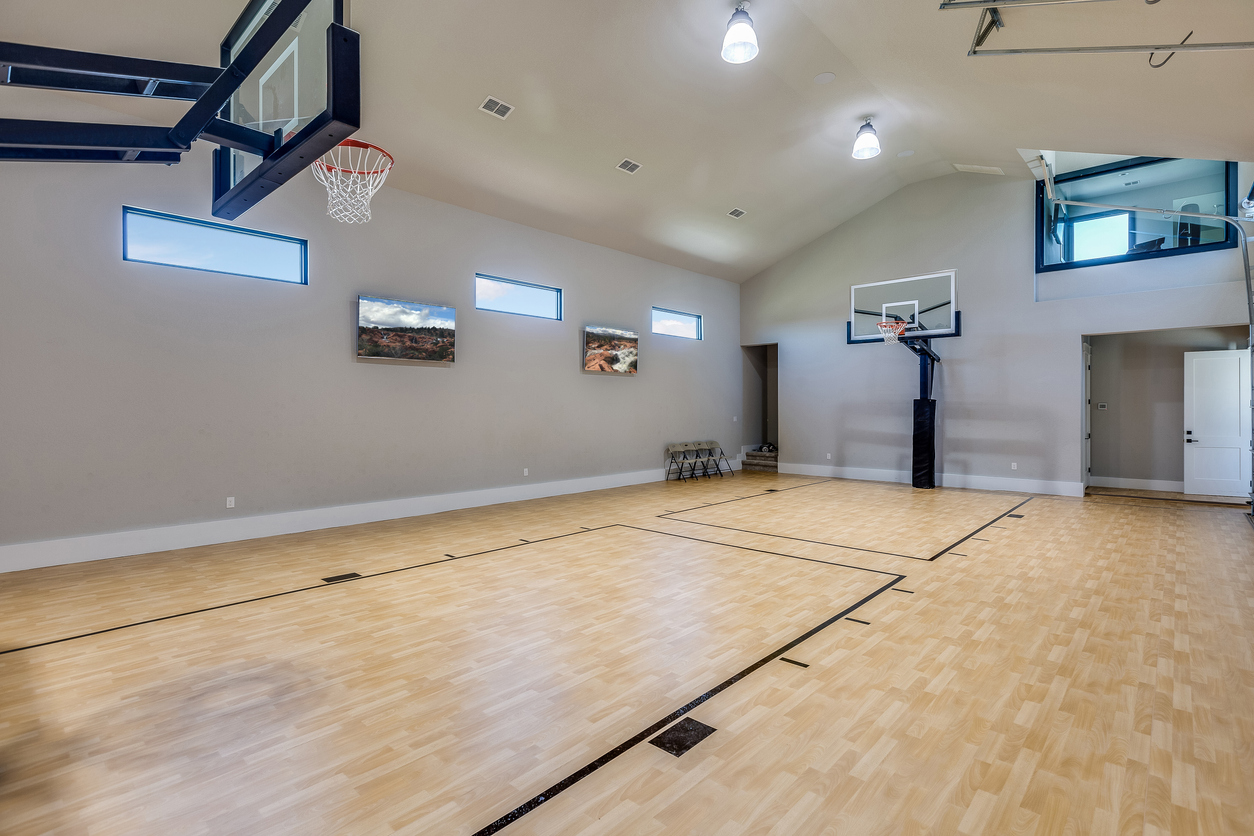
Image Source: www.dominatorhoop.com
The Blueprint of the Game: Basketball Court Dimensions Explained
The game of basketball, in its essence, is played on a rectangular court. However, the precise measurements of this playing surface can vary, often subtly, between different levels of play and organizations. These variations in basketball court dimensions are not arbitrary; they are designed to suit the particular style of play, the age of the participants, and the available space. Understanding these differences is key to appreciating the nuances of the sport, from the thunderous dunks of the pros to the fast breaks of high schoolers.
NBA Court Size: The Professional Standard
When most people think of a basketball court, they often envision the expansive hardwood floors of the National Basketball Association (NBA). The NBA court size is a specific and well-defined rectangle. The court measures 94 feet in length and 50 feet in width.
To calculate the basketball court square footage for an NBA court, we simply multiply the length by the width:
94 feet (length) * 50 feet (width) = 4,700 square feet
This area is the playable surface. It’s important to note that this figure does not typically include the surrounding space or run-off area that is often present around professional courts. This additional space is crucial for player safety, allowing for momentum after drives to the basket or aggressive defensive plays.
FIBA Court Dimensions: The International Arena
Across the globe, the Fédération Internationale de Basketball (FIBA) governs the sport and has its own set of basketball court dimensions. While similar to the NBA, there’s a slight difference in the width. A FIBA court measures 91 feet 10.15 inches (28 meters) in length and 49 feet 2.47 inches (15 meters) in width.
Let’s convert these measurements to feet for easier comparison and calculate the regulation basketball court area for FIBA:
- Length: 91 feet 10.15 inches = 91.84 feet
- Width: 49 feet 2.47 inches = 49.21 feet
Now, let’s calculate the square footage:
91.84 feet (length) * 49.21 feet (width) ≈ 4,522 square feet
As you can see, a FIBA court is slightly smaller than an NBA court, primarily due to its narrower width. This can lead to a slightly different feel to the game, potentially making defensive rotations a bit more challenging and open shots harder to come by.
NCAA Basketball Court Size: Collegiate Competition
The National Collegiate Athletic Association (NCAA) adheres to the same basketball court dimensions as the NBA. Therefore, an NCAA basketball court size is 94 feet long and 50 feet wide, resulting in a playing area of 4,700 square feet. This standardization ensures that college athletes are accustomed to playing on the same size court they would encounter if they were to turn professional.
High School Basketball Court Size: Developing Talent
The dimensions for high school basketball courts can sometimes be a bit more varied, but the standard is generally aligned with the professional and collegiate levels. Most high school basketball court size specifications follow the NBA and NCAA guidelines, meaning they are also 94 feet long and 50 feet wide, covering 4,700 square feet.
However, some older facilities or smaller school districts might have slightly smaller courts. While the ideal is the regulation size, it’s not uncommon for younger players or those in less resourced areas to play on courts that are a few feet shorter or narrower. The key is that the game remains fundamentally the same, just with slightly different spatial considerations.
Indoor vs. Outdoor Basketball Court Size: Similarities and Differences
When discussing the indoor basketball court size versus the outdoor basketball court size, the primary difference often lies in the quality of the playing surface and the presence of surrounding amenities, rather than a strict variance in the dimensions of the playing area itself.
-
Indoor Courts: Typically feature polished hardwood floors. The dimensions are usually regulated, adhering to NBA, FIBA, or NCAA standards. These courts are often found in gymnasiums and sports complexes. The enclosed nature of indoor courts means that the playing area is usually clearly defined, with minimal additional space beyond the painted lines, unless there are spectator areas or other facilities adjacent.
-
Outdoor Courts: Can vary significantly in their dimensions. While many public parks and recreational facilities aim for regulation sizes, especially those designated for organized play, others can be smaller or have irregular shapes. The playing surface is usually asphalt or concrete. The concept of “square footage” for an outdoor court can also be more fluid, as the out-of-bounds area might be less defined or simply consist of pavement or grass. However, for courts intended for serious play, the playing dimensions themselves are often kept consistent with indoor standards.
Therefore, while an indoor basketball court size is almost always a precisely measured and regulated space, an outdoor basketball court size can be more flexible, but the playing dimensions themselves are often replicated.
Deconstructing the Court: Key Markings and Their Significance
Beyond the overall length and width, a basketball court is a meticulously marked surface, with each line serving a purpose in the game. These markings are consistent across most regulation courts.
The Boundaries: Sidelines and Baselines
The perimeter of the court is defined by two sidelines (running the length of the court) and two baselines (running the width). The ball is out of bounds if it touches any of these lines or the area beyond them.
The Center Circle and Center Line
The court is divided into two halves by a center line, which runs parallel to the baselines. At the exact center of this line is a center circle. This circle is where the jump ball takes place to start the game and any subsequent overtime periods.
The Free Throw Line and Lane (The Paint)
The free-throw line is a 12-foot line parallel to the baseline. Directly in front of the basket, the free-throw line extends into a rectangular area known as the “lane” or “the paint.” The lane is 19 feet long from the baseline to the free-throw line. The width of the lane is 12 feet for NBA, NCAA, and FIBA courts. This area is crucial for offensive and defensive strategies, especially during free throws and post-up play.
The Three-Point Line: The Arc of Opportunity
The three-point line is an arc that surrounds the basket. Shots made from beyond this arc are worth three points, while shots from inside are worth two points (or one point for a free throw). The distance of the three-point line varies:
- NBA: 23 feet 9 inches at the top of the arc, curving to 22 feet at the wings.
- FIBA/NCAA: 22 feet 1.75 inches (6.75 meters) at the top of the arc, curving to 20 feet 4.5 inches (6.25 meters) at the wings.
- High School: Typically follows the NCAA/FIBA distance.
The Restricted Area Arc
Beneath the basket, there is a semi-circular arc marked on the court, known as the restricted area arc. This arc, typically 3 feet in radius from the center of the basket, is significant in determining charging fouls. Defenders cannot establish a position within this arc to draw an offensive charge if they are not fully set before the offensive player begins their drive.
Factors Influencing Basketball Court Size
While we’ve established standard basketball court dimensions, several factors can influence the actual size of a court, especially in non-professional settings.
Facility Constraints
Perhaps the most significant factor is the physical limitations of the building or outdoor space. A gymnasium might be built with specific dimensions that do not perfectly align with regulation sizes, particularly in older schools or multi-purpose facilities. Similarly, an outdoor court might be constrained by the available land or existing structures.
Governing Body Rules
As highlighted with NBA and FIBA, different organizations have their own rulebooks that dictate court dimensions. Even within a country, different youth leagues or associations might adopt slightly varied standards, although most strive for uniformity to prepare players for higher levels of competition.
Purpose of the Court
A court built for casual recreational play might not adhere to strict regulation sizes. A driveway basketball hoop might be set up on a court with dimensions tailored to the available space. Conversely, a court built for a competitive high school or college team will almost certainly follow the official specifications.
Fathoming the Square Footage: A Practical Look
Let’s recap the approximate basketball court square footage for the most common standards:
| Court Type | Length | Width | Approximate Sq Ft |
|---|---|---|---|
| NBA | 94 feet | 50 feet | 4,700 sq ft |
| FIBA | 91.84 feet | 49.21 feet | 4,522 sq ft |
| NCAA | 94 feet | 50 feet | 4,700 sq ft |
| High School | 94 feet | 50 feet | 4,700 sq ft |
These figures represent the playable area. It’s important to remember that the total square footage of a gymnasium or an outdoor recreational area where a court is located will be considerably larger to accommodate seating, concourses, storage, and safety zones.
The Importance of Accurate Dimensions
Why do these precise measurements matter?
- Fair Play: Consistent dimensions ensure that all teams play on the same playing field, eliminating any geographical or facility-based advantages.
- Player Development: Athletes train and develop their skills based on the spatial relationships on a court. Consistent dimensions allow for predictable movements and strategies.
- Safety: The out-of-bounds areas and the spacing around the court are crucial for player safety. Regulation dimensions ensure adequate room for players to decelerate and avoid collisions.
- Game Strategy: The distance of the three-point line, the width of the lane, and the overall court size influence offensive and defensive strategies. A wider court might favor teams with strong perimeter play, while a narrower court could make it easier to trap and force turnovers.
Frequently Asked Questions (FAQ)
Q1: What is the exact square footage of a basketball court?
A regulation basketball court area typically falls between 4,500 and 4,700 square feet, with the NBA and NCAA courts being 4,700 square feet (94 ft x 50 ft). FIBA courts are slightly smaller at approximately 4,522 square feet (28m x 15m).
Q2: Can I build a basketball court in my backyard with non-regulation dimensions?
Yes, you absolutely can build a basketball court in your backyard with non-regulation dimensions. Many backyard courts are customized to fit the available space and personal preference. However, if you aim to mimic professional play or prepare for organized leagues, sticking as closely as possible to regulation dimensions is beneficial.
Q3: Who determines the size of a basketball court?
The size of a basketball court is determined by the governing bodies of basketball. For professional play in North America, it’s the NBA. Internationally, it’s FIBA. For collegiate play, it’s the NCAA. High school and lower-level leagues typically adopt standards set by these major organizations or national governing bodies.
Q4: Does the thickness of the court lines affect the total square footage?
The thickness of the court lines themselves is negligible in terms of overall square footage. The official dimensions are measured from the outside edge of the boundary lines. The paint used for lines is very thin and doesn’t significantly alter the playable area calculation.
Q5: Are indoor and outdoor basketball courts the same size?
While the playing dimensions of indoor and outdoor courts are often the same (e.g., 94 ft x 50 ft), the overall environment and surrounding space can differ significantly. Indoor courts are typically in enclosed gymnasiums with polished wood floors, while outdoor courts are usually asphalt or concrete and can have more varied out-of-bounds areas.
Q6: What is the area of a FIBA court in square meters?
A FIBA court measures 28 meters in length and 15 meters in width. Therefore, the area is 28 m * 15 m = 420 square meters.
Q7: How much space do I need around a basketball court?
For safety and regulation play, it’s recommended to have at least 3 meters (about 10 feet) of clear space beyond the sidelines and baselines. Professional venues often provide even more. This “run-off” area is critical for player safety.
Q8: Why is the NBA court wider than a FIBA court?
The wider NBA court (50 feet vs. FIBA’s approximately 49.2 feet) can contribute to a slightly different pace and flow of the game. Some analysts suggest it allows for more space for dribble penetration and spacing for shooters. However, the difference is subtle and its impact on the game is debated.
By delving into the specifics of basketball court size, we gain a greater appreciation for the sport’s structure and the meticulous attention to detail required for fair and exciting competition at all levels. Whether it’s an NBA court size or a local high school basketball court size, these dimensions form the foundation upon which the game is played and enjoyed.