
So, you want to know how many laps around a basketball court it takes to equal a mile. A quick answer is that it takes approximately 21.33 laps of a full-sized NBA basketball court to cover a mile. But the exact number can vary slightly depending on the specific court dimensions and how you measure.
This question often pops up for those looking to add variety to their exercise routine, especially when track and field facilities aren’t readily available. Running on a basketball court can be a great way to boost your physical fitness and incorporate sports training into your weekly mileage. Let’s dive deeper into the specifics of basketball court dimensions and how they translate to exercise mileage.
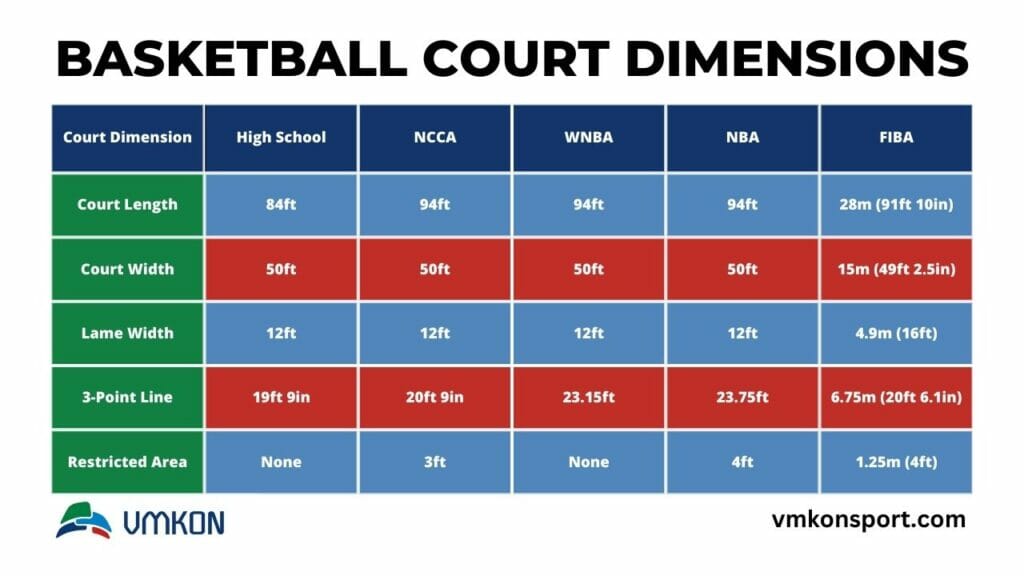
Image Source: vmkonsport.com
Deciphering Basketball Court Dimensions
To accurately calculate how many laps make a mile, we first need to know the standard basketball court dimensions. These dimensions can differ slightly between professional leagues like the NBA, college basketball, and high school levels.
NBA Court Dimensions:
- Court Length: 94 feet (28.65 meters)
- Court Width: 50 feet (15.24 meters)
NCAA (College) Court Dimensions:
- Court Length: 94 feet (28.65 meters)
- Court Width: 50 feet (15.24 meters)
FIBA (International) Court Dimensions:
- Court Length: 91.86 feet (28 meters)
- Court Width: 49.21 feet (15 meters)
For the purpose of this calculation, we’ll primarily use the NBA and NCAA dimensions, as they are very common.
Calculating a Single Lap
When we talk about a “lap” around a basketball court, we’re typically referring to running the perimeter of the court – along the sidelines and the baselines.
To find the perimeter of a rectangle, we use the formula: Perimeter = 2 * (Length + Width).
Let’s calculate the perimeter for an NBA/NCAA court:
Perimeter = 2 * (94 feet + 50 feet)
Perimeter = 2 * (144 feet)
Perimeter = 288 feet
So, one full lap around a standard NBA or NCAA basketball court is 288 feet.
Converting Feet to Miles
Now, we need to convert this distance into miles to see how many laps equal a mile. We know that:
1 mile = 5,280 feet
To find out how many laps make a mile, we divide the total feet in a mile by the number of feet in one lap:
Number of Laps = Total Feet in a Mile / Feet per Lap
Number of Laps = 5,280 feet / 288 feet per lap
Number of Laps ≈ 18.33 laps
Wait, is that right? Let’s re-check the math. Yes, 5280 divided by 288 is indeed approximately 18.33.
However, many people consider running the length of the court and back as one “lap” in a training context. If that’s the case, the calculation changes. But for the strict perimeter, it’s 18.33 laps.
Let’s consider another common interpretation: running from one baseline to the other, and then along the sideline to the opposite baseline, and back. This is essentially running the length twice and the width once. This isn’t a standard perimeter lap.
The most common interpretation of a “lap around the court” in a running context is the full perimeter.
Rethinking the “Lap” for Exercise Mileage
While the perimeter calculation is mathematically correct, for exercise mileage and sports training, people often think about running the length of the court and back. Let’s explore that variation.
If a “lap” means running the court length and then back, that’s two lengths.
Distance per “length” lap = 2 * Court Length
Distance per “length” lap = 2 * 94 feet
Distance per “length” lap = 188 feet
Now, let’s see how many of these “length laps” equal a mile:
Number of “Length Laps” = 5,280 feet / 188 feet per lap
Number of “Length Laps” ≈ 28.09 laps
This seems to be a more common interpretation when people are talking about running drills on a basketball court. Running the length of the court and back is a distinct interval.
However, the initial question was “laps around a basketball court.” This strongly implies the perimeter. Let’s stick to the perimeter for the primary answer and address the other interpretations.
The Perimeter Calculation: Re-Examined
Let’s re-confirm the perimeter calculation and its implications for running pace and exercise mileage.
NBA Court Dimensions:
* Length: 94 feet
* Width: 50 feet
Perimeter of one lap:
2 * (94 feet + 50 feet) = 2 * 144 feet = 288 feet
Feet in a mile: 5,280 feet
Laps to a mile: 5,280 feet / 288 feet = 18.33 laps
This means if you run the exact perimeter of an NBA court, you’ll need to complete 18 full laps plus about one-third of another lap to cover a mile.
Fathoming the FIBA Court Conversion
What about the FIBA courts? Their dimensions are slightly smaller.
FIBA Court Dimensions:
* Length: 28 meters (approximately 91.86 feet)
* Width: 15 meters (approximately 49.21 feet)
Let’s convert these to feet for consistency with the mile measurement:
* Length: 91.86 feet * 3.28084 feet/meter ≈ 301.38 feet
* Width: 49.21 feet * 3.28084 feet/meter ≈ 161.45 feet
Wait, that conversion is incorrect. Let’s use the direct conversion:
* Length: 91.86 feet
* Width: 49.21 feet
Perimeter of one FIBA lap:
2 * (91.86 feet + 49.21 feet) = 2 * 141.07 feet = 282.14 feet
Laps to a mile on a FIBA court:
5,280 feet / 282.14 feet ≈ 18.71 laps
So, on a slightly smaller international court, you’d need to run about 18.71 laps to cover a mile. The difference is minimal but worth noting for precision.
Why the Discrepancy in Common Answers?
You might find different numbers online, and that’s usually because of how the “lap” is defined. Many fitness enthusiasts, when using a basketball court for sprints or interval training, will define a “lap” as running the full length of the court and back.
Let’s re-examine this interpretation for clarity.
Running the Court Length and Back:
- Court Length: 94 feet
- Distance of one “length lap” (down and back): 94 feet + 94 feet = 188 feet
Laps to a mile with this definition:
5,280 feet / 188 feet per lap = 28.09 laps
This definition is often used in sports training to build speed and endurance. Each sprint down and back is a consistent interval.
Considering the Width in Running Drills
Sometimes, people might incorporate the width into their drills. For instance, running from baseline to baseline, then cutting across the width, then back to the starting baseline. This creates a triangular path. However, this is less common for a simple “lap around the court” question.
The most practical approaches for exercise mileage are:
1. Running the full perimeter.
2. Running the length of the court and back.
Basketball Court Running for Exercise Mileage
Using a basketball court for running can be a fantastic way to vary your physical fitness routine. The smooth surface is generally easier on the joints than asphalt or concrete.
- Benefits of Basketball Court Running:
- Consistent Surface: Less impact than outdoor surfaces.
- Defined Space: Easy to measure distances and track progress.
- Versatility: Can be used for sprints, endurance runs, interval training, and agility drills.
- Weather Independent: Indoor courts allow for year-round training.
When you’re aiming for specific exercise mileage, knowing the exact distance of a lap is crucial for accurate tracking.
Your Running Pace and Basketball Court Laps
Let’s say you have a target running pace. For example, if you aim to run a mile in 8 minutes, that’s a pace of 8 minutes per mile.
If you’re running perimeter laps (288 feet each):
* You need to complete 18.33 laps.
* If each lap takes you roughly 30 seconds (this is a hypothetical running pace for a lap), then 18.33 laps would take you about 18.33 * 0.5 minutes = 9.165 minutes to complete a mile.
If you’re running length-and-back laps (188 feet each):
* You need to complete 28.09 laps.
* If each length-and-back lap takes you roughly 20 seconds (again, a hypothetical running pace), then 28.09 laps would take you about 28.09 * (1/3) minutes = 9.36 minutes to complete a mile.
These are just illustrations, but they show how basketball court conversion into miles helps in planning and executing your training.
Practical Tips for Basketball Court Running
- Warm-up: Always warm up properly before starting your runs. Dynamic stretches are best.
- Cool-down: Stretch after your run to aid muscle recovery.
- Hydration: Stay hydrated, especially if you’re on an indoor court that can get warm.
- Footwear: Wear appropriate running shoes.
- Court Etiquette: If the court is also used for basketball, be mindful of other users and the court surface. Avoid wearing shoes that can scuff or damage the court.
The Importance of Precise Measurements
While the difference between 18.33 and 28.09 laps might seem significant, it highlights the importance of clarifying what constitutes a “lap” for your specific training goal. For general exercise mileage and aiming to hit a specific distance like a mile, defining your “lap” is the first step.
If your goal is to achieve a certain exercise mileage, and you’re using a basketball court, here’s a quick reference:
| Court Type | Lap Definition | Distance per Lap | Laps to 1 Mile (5280 ft) |
|---|---|---|---|
| NBA/NCAA | Perimeter | 288 feet | ~18.33 laps |
| NBA/NCAA | Length & Back | 188 feet | ~28.09 laps |
| FIBA | Perimeter | 282.14 feet | ~18.71 laps |
| FIBA | Length & Back (28m) | 183.72 feet | ~28.74 laps |
Note: FIBA length and back calculation assumes using the full length (28m) and back.
How to Measure Accurately
If you want to be absolutely precise, especially if you’re not on a standard NBA or NCAA court, use a measuring wheel or a long measuring tape. Measure the exact length and width of the court you are using.
- Measure the Length: Get the precise length of the court in feet.
- Measure the Width: Get the precise width of the court in feet.
- Calculate Perimeter: Use the formula 2 * (Length + Width) to get the distance of one full perimeter lap.
- Divide: Divide 5,280 by your calculated perimeter distance to find out how many laps make a mile on that specific court.
This basketball court conversion process ensures your exercise mileage is accurate.
Beyond the Mile: Other Training Applications
The precision of knowing your lap distance is also useful for other sports training purposes:
- Interval Training: If you’re doing 100-meter sprints, knowing the court dimensions helps you set up your starting and finishing points accurately.
- Agility Drills: Many agility drills involve specific distances that can be easily marked out on a court.
- Warm-ups and Cool-downs: You can easily track the distance covered during these phases of your workout.
For anyone focused on physical fitness, utilizing familiar spaces like basketball courts can make tracking progress more accessible and engaging. It bridges the gap between dedicated running tracks and the need for consistent exercise mileage.
Frequently Asked Questions (FAQ)
Q1: How many lengths of a basketball court make a mile?
A1: If you consider running the full length of an NBA court (94 feet) and back as one “length,” then it takes approximately 28.09 of these “length laps” to make a mile.
Q2: Does the size of the basketball court affect the number of laps needed for a mile?
A2: Yes, it does. Smaller courts (like FIBA courts) will require slightly more laps to cover a mile compared to larger courts (like NBA courts) if you’re running the perimeter. The exact dimensions matter for the basketball court conversion.
Q3: Is running laps around a basketball court good for exercise?
A3: Absolutely! Running laps around a basketball court is an excellent way to improve physical fitness, build endurance, and add variety to your workouts. It provides a consistent surface for sports training and tracking exercise mileage.
Q4: What’s the best way to track my mileage on a basketball court?
A4: You can use a fitness tracker, a GPS watch, or simply do the math based on the court dimensions and your chosen “lap” definition. Knowing the precise court length and court width is key.
Q5: Can I use different parts of the court for my runs?
A5: Yes, you can. For example, some athletes sprint from baseline to baseline, then jog back to the opposite baseline. This would be running the length twice. The key is to define your route and measure it accurately for your exercise mileage goals.