
Can you fit multiple basketball courts onto a football field? Yes, you can fit several basketball courts onto a football field, depending on their size and orientation. For example, you could fit approximately 10 standard NCAA basketball courts onto a typical American football field.
This question often sparks curiosity, especially for those involved in sports facility planning or simply trying to visualize the vastness of different sporting arenas. American football fields and basketball courts, while both popular sports venues, have vastly different dimensions. Let’s dive into the specifics and uncover some fascinating facts about how these two worlds collide.
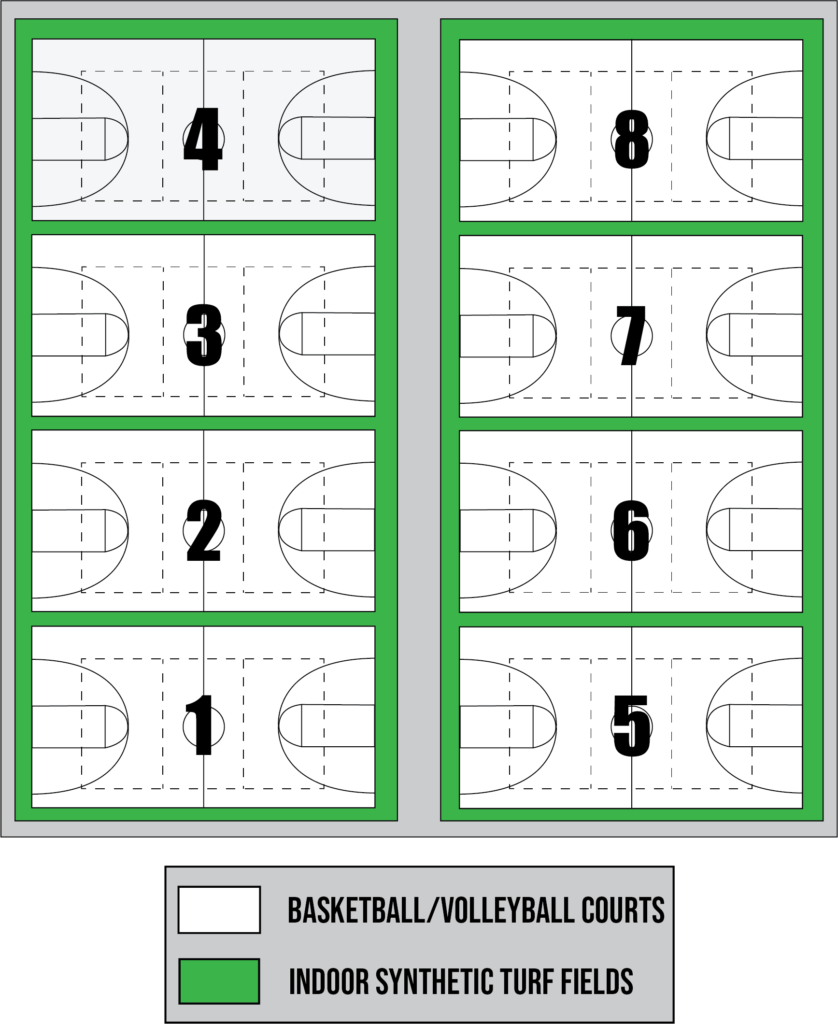
Image Source: mdsoccerplex.org
Deciphering the Dimensions: Football Field vs. Basketball Court
Before we start fitting courts, we need to know the exact sizes of both playing surfaces. This is the foundation for any effective sports field conversion or layout.
The American Football Field: A Gridiron of Possibility
An American football field is a long, rectangular expanse. The playing area itself is 100 yards long, with an additional 10 yards for each end zone. In total, this is 120 yards from goal line to goal line. The width of the field is 53.3 yards (or 160 feet).
To convert these imperial measurements to metric for broader comprehension, we have:
- Length: 120 yards = 109.73 meters
- Width: 53.3 yards = 48.76 meters
So, the total area of an American football field is approximately 120 yards x 53.3 yards.
The Basketball Court: A Hardwood Battleground
Basketball courts come in various sizes, often differing between professional, collegiate, and youth levels. The most common dimensions we’ll consider for comparison are:
- NBA Basketball Court: 94 feet long by 50 feet wide (28.65 meters x 15.24 meters).
- NCAA (College) Basketball Court: 94 feet long by 50 feet wide (28.65 meters x 15.24 meters).
- FIBA (International) Basketball Court: 28 meters long by 15 meters wide (91.86 feet x 49.21 feet).
For our calculations, we will primarily use the standard NBA/NCAA dimensions, as they are widely recognized in North America and provide a good basis for comparison with a North American football field.
Fact 1: The Grand Unveiling – How Many Courts Fit?
Let’s get down to the numbers. We need to see how many rectangular basketball courts can fit within the larger rectangular football field. This involves a bit of spatial reasoning and calculation.
Laying Out the Courts: Lengthwise Fit
Consider placing basketball courts end-to-end along the length of the football field.
- Football Field Length: 120 yards = 360 feet
- Basketball Court Length: 94 feet
Number of courts that fit lengthwise = Football Field Length / Basketball Court Length
Number of courts = 360 feet / 94 feet ≈ 3.83 courts
This means you can fit three full basketball courts end-to-end along the length of a football field, with some space left over.
Laying Out the Courts: Widthwise Fit
Now, let’s see how many courts fit side-by-side across the width of the football field.
- Football Field Width: 53.3 yards = 160 feet
- Basketball Court Width: 50 feet
Number of courts that fit widthwise = Football Field Width / Basketball Court Width
Number of courts = 160 feet / 50 feet = 3.2 courts
This tells us you can fit three full basketball courts side-by-side across the width of a football field.
The Maximum Fit: Combining Length and Width
To find the maximum number of courts, we multiply the number that fit lengthwise by the number that fit widthwise.
Maximum number of courts = (Number of courts lengthwise) x (Number of courts widthwise)
Maximum number of courts = 3 x 3 = 9 courts
So, you can fit approximately 9 full NBA/NCAA basketball courts onto a standard American football field if you orient them precisely. This is a significant number and highlights the scale difference between the two sports’ playing areas.
Table 1: Basketball Courts Fitting on a Football Field (NBA/NCAA Dimensions)
| Measurement | Football Field (Feet) | Basketball Court (Feet) | Number Fitting Along Length | Number Fitting Across Width | Total Maximum Courts |
|---|---|---|---|---|---|
| Length | 360 | 94 | ~3.83 | N/A | N/A |
| Width | 160 | 50 | N/A | 3.2 | N/A |
| Combined Fit | N/A | N/A | N/A | N/A | ~9 |
Note: These calculations assume no additional space is needed for out-of-bounds areas or walkways between courts.
Fact 2: The Indoor vs. Outdoor Conversion Advantage
The question of fitting basketball courts onto a football field often arises in the context of multi-purpose sports facilities. Both indoor basketball courts and outdoor basketball courts can be conceptualized within this space.
Outdoor Possibilities: Temporary Setups
An outdoor basketball court can be temporarily marked and set up on a football field. This is common for community events, festivals, or even temporary sporting tournaments. The asphalt or turf of a football field can easily accommodate painted lines for multiple basketball courts. This allows for simultaneous games or practice sessions.
Indoor Adaptations: The Facility Planner’s Dream
For sports facility planning, envisioning this conversion is crucial. A large indoor arena that hosts both football (or soccer, for indoor versions) and basketball needs efficient field layout. While a football field is typically outdoors, the concept of its dimensions can be applied to large indoor spaces. Imagine a convention center or a massive indoor stadium. Converting such a space to host multiple basketball games simultaneously would be a logistical feat. The same spatial principles apply.
The ability to reconfigure a large, open space like a football field’s footprint for different sports demonstrates the versatility of modern sports facility planning.
Fact 3: The FIBA Factor – A Slightly Different Fit
While we used NBA/NCAA dimensions, it’s interesting to see how FIBA (international) court sizes affect the calculation.
- FIBA Basketball Court Length: 28 meters ≈ 91.86 feet
- FIBA Basketball Court Width: 15 meters ≈ 49.21 feet
Now, let’s re-calculate using these dimensions and the football field measurements in feet:
Lengthwise FIBA Fit:
Number of FIBA courts lengthwise = 360 feet / 91.86 feet ≈ 3.92 courts
Widthwise FIBA Fit:
Number of FIBA courts widthwise = 160 feet / 49.21 feet ≈ 3.25 courts
Maximum FIBA Fit:
Maximum number of FIBA courts = 3 x 3 = 9 courts
Interestingly, even with slightly smaller international courts, you still fit approximately 9 FIBA basketball courts onto a football field. The difference is marginal in terms of the total number of courts, but the available space per court would be slightly larger.
Table 2: Basketball Courts Fitting on a Football Field (FIBA Dimensions)
| Measurement | Football Field (Feet) | Basketball Court (FIBA) (Feet) | Number Fitting Along Length | Number Fitting Across Width | Total Maximum Courts |
|---|---|---|---|---|---|
| Length | 360 | ~91.86 | ~3.92 | N/A | N/A |
| Width | 160 | ~49.21 | N/A | ~3.25 | N/A |
| Combined Fit | N/A | N/A | N/A | N/A | ~9 |
Note: Again, this assumes no buffer space.
Fact 4: Stadium Capacity and Multi-Sport Usage
The concept of fitting multiple basketball courts onto a football field is not just a hypothetical exercise; it has real-world implications for stadium capacity and sports facility planning.
Maximizing Event Revenue
For venues that host multiple sports, like large stadiums, the ability to quickly convert the playing surface is key. A football stadium could, in theory, be reconfigured to host a major basketball tournament, potentially accommodating several games at once. This would significantly increase the stadium’s utility and revenue-generating potential.
Think about the logistics: temporary flooring might be laid over the football turf, and then multiple basketball courts are marked out. This would require careful planning of the field layout to ensure accessibility and safety.
Beyond the Court: Other Sports Field Conversion
This principle of sports field conversion extends beyond basketball. Many stadiums can be adapted for soccer, concerts, track and field events, and more. The underlying idea is utilizing the large, open space effectively. However, the specific dimensions and requirements of each sport dictate how many playing areas can fit.
While you can fit many basketball courts, you might only fit one or two soccer fields (depending on the exact size of the soccer pitch) or a single large concert stage.
Fact 5: The “Empty Space” Factor – What’s Left Over?
Our calculations so far have focused on fitting complete courts. However, when you lay out multiple basketball courts on a football field, there’s always some leftover space. This unused area is important to consider in sports facility planning.
Lengthwise Leftovers
- We can fit 3 full NBA/NCAA courts lengthwise (3 x 94 feet = 282 feet).
- Total length of the field is 360 feet.
- Leftover space = 360 feet – 282 feet = 78 feet.
This 78-foot strip of leftover space could be used for additional warm-up areas, spectator walkways, or even smaller practice courts or drills.
Widthwise Leftovers
- We can fit 3 full NBA/NCAA courts widthwise (3 x 50 feet = 150 feet).
- Total width of the field is 160 feet.
- Leftover space = 160 feet – 150 feet = 10 feet.
This 10-foot strip on each side could be used as buffer zones or walkways.
The Total Unused Area
If we fit 9 courts, occupying 282 feet by 150 feet, the total area used by the courts would be 42,300 square feet.
The total area of the football field is 360 feet x 160 feet = 57,600 square feet.
The unused area is approximately 57,600 sq ft – 42,300 sq ft = 15,300 square feet. This is a significant amount of space, roughly equivalent to another 2.5 to 3 basketball courts worth of area, which can be strategically utilized.
Frequently Asked Questions (FAQ)
Q1: What are the standard dimensions for an indoor basketball court compared to an outdoor basketball court?
The standard dimensions for both indoor and outdoor basketball courts are generally the same. The primary difference lies in the playing surface and the surrounding infrastructure. Indoor courts typically have hardwood floors, while outdoor courts can be asphalt, concrete, or specialized outdoor surfaces. The basketball court dimensions themselves, whether for NBA, NCAA, or FIBA play, remain consistent regardless of being indoors or outdoors.
Q2: How does the size of a football field affect the number of basketball courts that can fit?
The larger the football field, the more basketball courts can be accommodated. The specific dimensions of the football field (length and width) directly determine the spatial constraints for fitting the smaller rectangular basketball courts. A smaller field would naturally fit fewer courts.
Q3: Can a football stadium be used for basketball games?
Yes, football stadiums can be converted to host basketball games. This often involves laying temporary flooring over the football turf and then marking out the basketball court(s). The stadium’s large capacity can be utilized for major basketball events.
Q4: What is the main challenge in sports field conversion?
The main challenges in sports field conversion include the time and cost involved in reconfiguring the playing surface, ensuring player safety on the converted surface, and the logistical complexity of moving and setting up equipment for different sports. Efficient sports facility planning is crucial to mitigate these challenges.
Q5: How much space is typically left over on a football field after fitting multiple basketball courts?
As calculated, fitting nine NBA/NCAA basketball courts onto a football field leaves approximately 15,300 square feet of unused space. This leftover area can be repurposed for auxiliary facilities or practice zones.
In conclusion, the question of how many basketball courts fit on a football field reveals fascinating insights into the scale of sporting arenas and the possibilities of sports facility planning. It’s a testament to the efficient use of space that such conversions are not only theoretically possible but are increasingly implemented in multi-purpose sports venues.