
This article answers the question: How many basketball courts fit in a soccer field? Generally, you can fit approximately 2 to 3 standard indoor basketball courts within the boundaries of a regulation soccer field, depending on the specific dimensions used for each.
When considering sports facility planning, the idea of maximizing space and versatility often leads to intriguing questions about fitting different types of playing areas together. One common query is about how many basketball courts could theoretically be laid out on a soccer field. This isn’t just an abstract thought experiment; it’s a practical consideration for municipalities, schools, and private organizations looking to optimize their recreational space. Whether you’re thinking about outdoor basketball courts for community use or planning for indoor basketball courts within a larger sports complex, understanding the relative sizes is key.
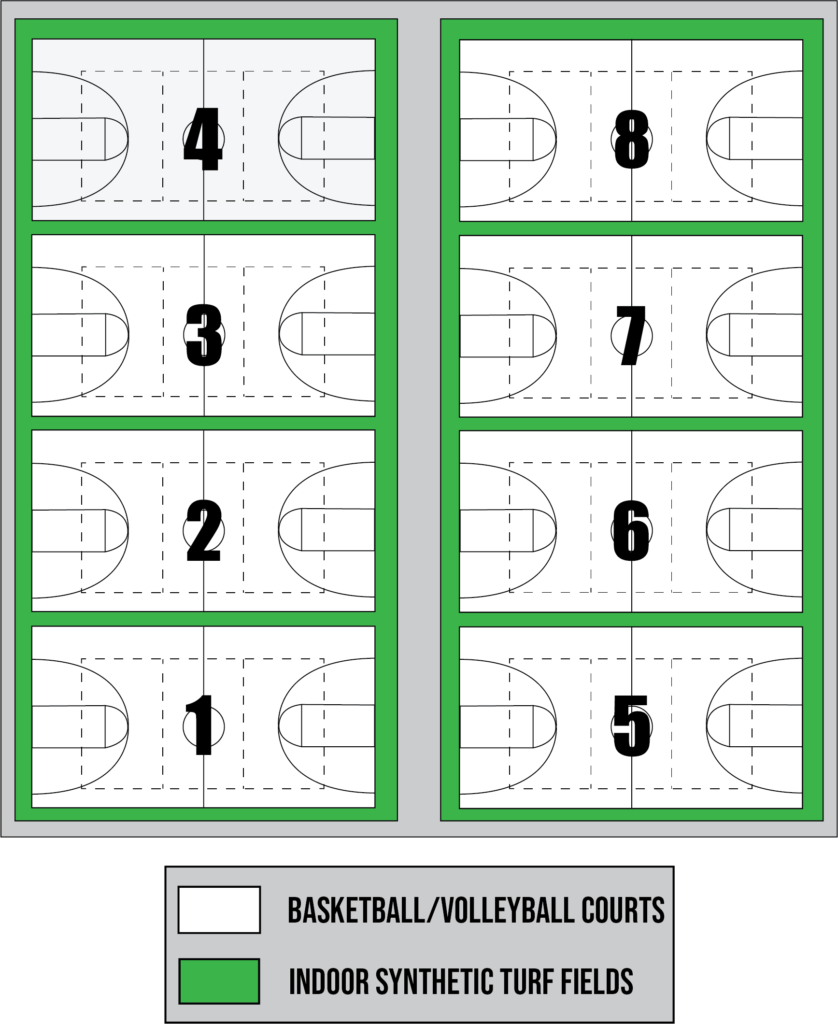
Image Source: mdsoccerplex.org
Deciphering the Dimensions: Soccer vs. Basketball
To answer our main question, we first need to establish the typical sizes of both a soccer field and a basketball court. These dimensions can vary slightly, but we’ll use standard measurements for a clear comparison.
Soccer Field Size: The Grand Arena
A regulation soccer field, often referred to as a pitch, has a wide range of acceptable dimensions. For international matches, FIFA (Fédération Internationale de Football Association) specifies:
- Length: Minimum 100 yards (90 meters) to a maximum of 130 yards (120 meters).
- Width: Minimum 50 yards (45 meters) to a maximum of 100 yards (90 meters).
For clarity in our comparison, let’s consider a commonly used size for professional and amateur play:
- Average Soccer Field: Approximately 110 yards long by 70 yards wide.
Converting these to feet for easier comparison with basketball court dimensions:
- Average Soccer Field Length: 110 yards * 3 feet/yard = 330 feet.
- Average Soccer Field Width: 70 yards * 3 feet/yard = 210 feet.
This gives us a total area of roughly 330 feet * 210 feet = 69,300 square feet.
Basketball Court Dimensions: The Hardwood Battleground
A standard basketball court, especially for professional and college play, also has well-defined dimensions. The National Basketball Association (NBA) and the International Basketball Federation (FIBA) have slightly different standards, but they are quite close.
NBA Standard Basketball Court Dimensions:
- Length: 94 feet.
- Width: 50 feet.
This results in an area of 94 feet * 50 feet = 4,700 square feet for a single NBA-standard court.
FIBA Standard Basketball Court Dimensions:
- Length: 91.9 feet (28 meters).
- Width: 49.2 feet (15 meters).
This gives an area of approximately 91.9 feet * 49.2 feet = 4,521.5 square feet.
For our calculation, we’ll primarily use the NBA dimensions as they are widely recognized and slightly larger, providing a more conservative estimate.
Laying Out the Courts: The Spatial Puzzle
Now, let’s take these dimensions and see how they fit. We’re essentially trying to tile a large rectangular area (the soccer field) with smaller rectangular areas (basketball courts).
Direct Comparison: Lengthwise Fit
First, let’s see how many basketball courts can fit end-to-end along the length of the soccer field.
- Soccer Field Length: 330 feet
- Basketball Court Length: 94 feet
Number of courts that fit lengthwise = Soccer Field Length / Basketball Court Length
= 330 feet / 94 feet
≈ 3.51 courts
So, you could fit 3 full-length basketball courts end-to-end along the length of an average soccer field, with some space left over.
Direct Comparison: Widthwise Fit
Next, let’s see how many basketball courts can fit side-by-side along the width of the soccer field.
- Soccer Field Width: 210 feet
- Basketball Court Width: 50 feet
Number of courts that fit widthwise = Soccer Field Width / Basketball Court Width
= 210 feet / 50 feet
= 4.2 courts
You could fit 4 full-width basketball courts side-by-side across the width of an average soccer field.
Combining Length and Width: The Tiling Challenge
To determine how many courts fit within the area, we multiply these findings.
Total courts = (Number of courts that fit lengthwise) * (Number of courts that fit widthwise)
Total courts ≈ 3.51 * 4.2
Total courts ≈ 14.74
This calculation, however, assumes we can perfectly tile the area without considering any necessary spacing between courts or the need for player/spectator access. This is where practical sports facility planning comes into play.
Realistic Layouts and Necessary Space
In reality, simply dividing areas doesn’t account for crucial factors:
- Run-off/Safety Zones: Basketball courts require space around the perimeter for players to run out of bounds safely. This is often referred to as run-off or safety clearance. For a standard court, this can add several feet on each side.
- Aisles and Walkways: For multiple courts to be accessible and usable, you need aisles between them and walkways for people to move around.
- Staggered Layouts: To optimize space, courts might be staggered rather than placed in a perfect grid.
- Orientation: The orientation of the basketball courts relative to the soccer field’s length and width can impact how many fit efficiently.
Let’s consider a more realistic scenario where we need a minimum of 10-15 feet of clearance around each basketball court. This increases the effective footprint of each court.
- Effective Basketball Court Length (with clearance): 94 feet + 15 feet (front) + 15 feet (back) = 124 feet.
- Effective Basketball Court Width (with clearance): 50 feet + 15 feet (side) + 15 feet (side) = 80 feet.
Now, let’s re-evaluate how many of these effectively larger courts fit:
- Courts lengthwise: 330 feet / 124 feet ≈ 2.66 courts. So, 2 courts.
- Courts widthwise: 210 feet / 80 feet ≈ 2.625 courts. So, 2 courts.
Using these effective dimensions, we can fit approximately 2 courts * 2 courts = 4 basketball courts onto a soccer field, with significant space still remaining.
However, this assumes a simple grid and doesn’t account for optimizing the remaining space. If we consider placing courts more efficiently and potentially sharing some run-off space, the number can increase.
Let’s revisit the initial, simpler calculation and think about it differently. If we don’t add large safety run-offs and focus on fitting the playable area with minimal buffer, we can think of the soccer field as a large open space.
Scenario 1: Maximum Courts, Minimal Spacing
Imagine laying out basketball courts with just enough space between them for players to move without colliding, perhaps 10 feet between courts.
- Effective Length per Court (including 5ft buffer on each end): 94 ft + 5 ft + 5 ft = 104 ft.
- Effective Width per Court (including 5ft buffer on each side): 50 ft + 5 ft + 5 ft = 60 ft.
Now, if we want to fit multiple courts side-by-side and end-to-end:
-
Along the 330ft length:
- First court: 94 ft. Remaining space: 330 – 94 = 236 ft.
- Space needed between courts (e.g., 10 ft).
- Second court: 94 ft. Total used: 94 + 10 + 94 = 198 ft. Remaining: 330 – 198 = 132 ft.
- Third court: 94 ft. Total used: 198 + 10 + 94 = 302 ft. Remaining: 330 – 302 = 28 ft.
- This means we can fit 3 full-length courts along the 330ft length, with 28 feet left over.
-
Along the 210ft width:
- First court: 50 ft. Remaining: 210 – 50 = 160 ft.
- Space needed between courts (e.g., 10 ft).
- Second court: 50 ft. Total used: 50 + 10 + 50 = 110 ft. Remaining: 210 – 110 = 100 ft.
- Third court: 50 ft. Total used: 110 + 10 + 50 = 170 ft. Remaining: 210 – 170 = 40 ft.
- Fourth court: 50 ft. Total used: 170 + 10 + 50 = 230 ft. This exceeds the width.
- So, we can fit 3 full-width courts along the 210ft width, with 40 feet left over.
With this minimal spacing, we could potentially fit 3 courts * 3 courts = 9 basketball courts.
However, this assumes a very tight layout. Most sports facility planning would require more generous spacing, especially if these are intended for organized play or tournaments.
The “Two-and-a-Half” Court Scenario
A more common practical approach to visualizing this is to think about fitting courts side-by-side along the width and then seeing how many rows fit lengthwise.
- Soccer Field Width: 210 feet
- Basketball Court Width: 50 feet
We can fit 4 basketball courts side-by-side across the width (4 * 50ft = 200ft, leaving 10ft).
Now consider the length:
- Soccer Field Length: 330 feet
- Basketball Court Length: 94 feet
If we have 4 courts placed side-by-side, each row of courts takes up 50 feet of the soccer field’s width.
- Row 1 (4 courts): Uses 50 feet of width. These courts are 94 feet long.
- Row 2 (4 courts): Uses another 50 feet of width (total 100 feet used). These courts are also 94 feet long.
- Row 3 (4 courts): Uses another 50 feet of width (total 150 feet used). These courts are also 94 feet long.
- Row 4 (4 courts): Uses another 50 feet of width (total 200 feet used). These courts are also 94 feet long.
So, we can fit 4 rows of 4 courts if the soccer field was wide enough to accommodate the length of the courts. But the soccer field is 330 feet long.
Let’s flip the orientation for better comparison.
Place the basketball courts with their length (94 ft) along the soccer field’s width (210 ft).
- Along the 210ft width: 210 ft / 94 ft ≈ 2.23 courts. This means we can fit 2 full-length courts end-to-end along the width, with space leftover. If we allow some spacing, maybe 2 courts with a generous gap.
Now, place the basketball courts with their width (50 ft) along the soccer field’s length (330 ft).
- Along the 330ft length: 330 ft / 50 ft = 6.6 courts. So, 6 full-width courts can fit end-to-end.
This orientation doesn’t seem optimal for fitting multiple courts.
Let’s go back to the original orientation:
Soccer field: 330 ft (L) x 210 ft (W)
Basketball court: 94 ft (L) x 50 ft (W)
Layout Strategy: Prioritizing Width
- Place courts with their 94 ft length along the 330 ft length of the soccer field.
- You can fit 3 courts end-to-end (3 x 94 ft = 282 ft), leaving 48 ft.
- Place these rows of 3 courts along the 210 ft width of the soccer field.
- Each row of 3 courts is 50 ft wide.
- How many such rows fit along the 210 ft width? 210 ft / 50 ft = 4.2.
- So, you can fit 4 rows of 3 courts.
This would give us 4 rows * 3 courts/row = 12 courts.
However, this assumes no spacing. Let’s add minimal spacing between rows and courts.
- Effective Footprint per Row (3 courts side-by-side): 50 ft (court width) + 10 ft (gap) = 60 ft.
- Number of rows: 210 ft / 60 ft = 3.5 rows. So, 3 full rows with space.
- Effective Footprint per Court (end-to-end): 94 ft (court length) + 10 ft (gap) = 104 ft.
- Number of courts per row: 330 ft / 104 ft = 3.17 courts. So, 3 courts per row.
This refined calculation suggests fitting 3 rows * 3 courts/row = 9 basketball courts, with reasonable spacing.
Layout Strategy: Prioritizing Length
- Place courts with their 50 ft width along the 330 ft length of the soccer field.
- You can fit 6 courts end-to-end (6 x 50 ft = 300 ft), leaving 30 ft.
- Place these rows of 6 courts along the 210 ft width of the soccer field.
- Each row of 6 courts is 94 ft wide.
- How many such rows fit along the 210 ft width? 210 ft / 94 ft = 2.23.
- So, you can fit 2 rows of 6 courts.
This would give us 2 rows * 6 courts/row = 12 courts.
Let’s add minimal spacing:
- Effective Footprint per Row (6 courts side-by-side): 94 ft (court length) + 10 ft (gap) = 104 ft.
- Number of rows: 210 ft / 104 ft = 2.01 rows. So, 2 full rows.
- Effective Footprint per Court (end-to-end): 50 ft (court width) + 10 ft (gap) = 60 ft.
- Number of courts per row: 330 ft / 60 ft = 5.5 courts. So, 5 courts per row.
This refined calculation suggests fitting 2 rows * 5 courts/row = 10 basketball courts, with reasonable spacing.
What About Court Conversion?
The concept of fitting basketball courts onto a soccer field often arises in contexts like sports facility planning where existing large outdoor spaces are considered for multiple uses. For example, a large, underutilized area could be paved and marked for various activities, including outdoor basketball courts. In some cases, multipurpose fields are designed to accommodate different sports through the use of temporary or adaptable court markings.
- Outdoor Basketball Courts: A soccer field, particularly a large, flat, and paved one (though typically soccer is played on grass), could potentially host multiple outdoor basketball courts. The primary challenge would be the surface and drainage if it’s not already a hard court.
- Indoor Basketball Courts: If we’re talking about the space of a soccer field and imagining an indoor facility, the calculation is more about the building’s footprint. A regulation soccer field is roughly the size of a large arena. You could certainly build a facility that houses multiple indoor basketball courts within the footprint of a soccer field.
Considering a “Half-Court” Scenario
Sometimes, when space is limited, organizers might opt for half-courts. A standard half-court is essentially half the length of a full court.
- Half-Court Dimensions: Approximately 47 feet x 50 feet.
Let’s see how many half-courts fit:
- Soccer Field Length: 330 feet
- Half-Court Length: 47 feet
- Soccer Field Width: 210 feet
- Half-Court Width: 50 feet
Layout Strategy (Half-Courts):
- Place half-courts with their 47 ft length along the 330 ft length of the soccer field.
- 330 ft / 47 ft ≈ 7.02 courts. So, 7 half-courts end-to-end.
- Place these rows of 7 half-courts along the 210 ft width of the soccer field.
- Each row of 7 half-courts is 50 ft wide.
- 210 ft / 50 ft = 4.2 rows. So, 4 rows.
This suggests 4 rows * 7 half-courts/row = 28 half-courts.
Adding minimal spacing (say 10 ft between courts and rows):
- Effective Footprint per Row (7 half-courts): 50 ft + 10 ft = 60 ft.
- Number of rows: 210 ft / 60 ft = 3.5 rows. So, 3 full rows.
- Effective Footprint per Half-Court (end-to-end): 47 ft + 10 ft = 57 ft.
- Number of half-courts per row: 330 ft / 57 ft = 5.78 courts. So, 5 half-courts per row.
This refined calculation suggests fitting 3 rows * 5 half-courts/row = 15 half-courts.
This shows that the number of courts you can fit depends heavily on whether you’re fitting full courts or half-courts, and the amount of spacing required for safety and access.
The “Two-and-a-Half” Court Interpretation
The common interpretation of fitting “two-and-a-half” basketball courts onto a soccer field likely comes from a different way of visualizing the space. Imagine the soccer field as a large rectangle.
If you were to place basketball courts lengthwise along the soccer field’s length:
* 330 ft (soccer length) / 94 ft (court length) = 3.51 courts.
If you were to place basketball courts widthwise along the soccer field’s width:
* 210 ft (soccer width) / 50 ft (court width) = 4.2 courts.
Now, if you consider laying out courts efficiently:
You can fit two full-width courts side-by-side along the soccer field’s width:
* 50 ft + 50 ft = 100 ft. This leaves 110 ft of width.
* You could potentially fit a third court’s width into that remaining space (50 ft), leaving 60 ft.
So, you can fit 2.5 courts across the width.
Now, consider how many rows of these courts fit along the soccer field’s length. Each row of courts will be 94 ft long.
- 330 ft (soccer length) / 94 ft (court length) = 3.51 rows.
This leads to a theoretical maximum of 2.5 courts/row * 3.5 rows = 8.75 courts. This is getting complicated and still doesn’t align with the “2.5” figure as a total.
The “two-and-a-half” likely refers to fitting courts in a specific, efficient arrangement, often seen in multipurpose indoor facilities or very large outdoor recreational areas. For example, you might fit two full courts with ample space, and then a third court partially, or perhaps just the main playing area without the full run-off.
A more plausible interpretation of “fitting two-and-a-half” might relate to a single large area. Imagine a soccer field. You could mark out two full basketball courts with their usual spacing. Then, in the remaining space, you could mark out a third court that might be shorter or narrower, or simply share boundary lines, effectively creating “two-and-a-half” playable areas within a portion of the soccer field.
Let’s simplify the “two-and-a-half” idea:
If you place two full basketball courts side-by-side (50ft + 50ft = 100ft width), you have 110ft of width left on the soccer field. This remaining width is more than enough for a third court’s width (50ft). So, across the 210ft width, you can comfortably fit 3 basketball courts.
Now, consider the length of the soccer field (330ft). Each of these basketball courts is 94ft long.
- How many rows of 3 courts fit along the 330ft length?
- 330ft / 94ft = 3.51 rows.
So, you can fit 3 full rows of 3 courts (total 9 courts) with some space left over. This interpretation still doesn’t yield “2.5”.
The figure “2.5” might be a simplified way of saying you can fit a couple of full courts and then some additional playing space, perhaps for practice or smaller games. For example, if you fit two full courts side-by-side, you use 100ft of the soccer field’s width. You have 110ft of width remaining. You can then fit another full court in that remaining space (using 50ft of width), and you’d still have 60ft of width. This means you can fit 3 courts across the width.
If we consider the length (330ft) and place courts along it:
* You can fit 3 full courts (3 x 94ft = 282ft). This leaves 48ft.
* The width needed for these 3 courts side-by-side is 50ft. This fits within the 210ft width.
* So, you can have multiple “lanes” of 3 courts.
Perhaps the “2.5” refers to fitting two full courts and a half court in terms of area coverage.
- Area of Soccer Field: 69,300 sq ft
- Area of 1 Basketball Court: 4,700 sq ft
Number of courts by area = 69,300 sq ft / 4,700 sq ft ≈ 14.74 courts.
This is the purely mathematical division without considering practical layouts.
The Most Common and Practical Answer
The most common and practical answer, considering reasonable spacing for multiple courts (not just cramming them in), points towards fitting approximately 2 to 3 standard indoor basketball courts if you are talking about the space of a soccer field, or perhaps laying out that many courts on a very large, paved area.
If we’re being generous with space, say needing 20-30 feet of run-off around each court:
* Effective Court Size: (94+30) ft x (50+30) ft = 124 ft x 80 ft.
* Soccer Field: 330 ft x 210 ft.
* Along Length: 330 / 124 = 2.66 -> 2 courts.
* Along Width: 210 / 80 = 2.625 -> 2 courts.
* Total: 2 x 2 = 4 courts.
If we are less generous, with 10 feet of spacing:
* Effective Court Size: (94+10) ft x (50+10) ft = 104 ft x 60 ft.
* Soccer Field: 330 ft x 210 ft.
* Along Length: 330 / 104 = 3.17 -> 3 courts.
* Along Width: 210 / 60 = 3.5 -> 3 courts.
* Total: 3 x 3 = 9 courts.
The idea of “2.5 courts” likely comes from a situation where you’re fitting courts efficiently in a very large, open space, and you can get two full courts with ample room and then a third court that might be slightly shorter or have less run-off, or perhaps it refers to the possibility of fitting two full courts plus a half court in certain configurations.
For sports facility planning, it’s always best to aim for the more conservative numbers when determining capacity and layout to ensure safety and functionality. Fitting 2-3 full courts with good spacing is a realistic target.
Factors Influencing the Fit
Several variables influence how many basketball courts can be placed within a soccer field’s area:
- Soccer Field Dimensions: As noted, soccer fields have variable sizes. A larger field naturally accommodates more courts.
- Basketball Court Size: While we used standard NBA dimensions, FIBA or high school courts are slightly smaller, potentially allowing for more to fit, though the difference is minimal.
- Required Spacing: This is the most significant factor.
- Safety Run-off: Essential for preventing injuries.
- Aisles and Walkways: Necessary for access and crowd movement.
- Spectator Seating: If intended for events.
- Layout Efficiency: How the courts are arranged. A grid is simple, but staggered or nested layouts can optimize space.
- Use Case: Are these for casual play, training sessions, or formal tournaments? This dictates the amount of space needed per court.
- Court Conversion: If the soccer field is being converted for basketball, the process involves paving, marking, and potentially installing lighting and boundaries. This conversion is often done for multipurpose fields.
Visualizing the Space
Imagine the soccer field as a vast green expanse. Now, picture laying down the wooden floor of a basketball court. The transition requires a hard surface.
- Surface Material: Soccer fields are typically grass or artificial turf. Basketball courts require a smooth, hard surface like asphalt or polished wood.
- Markings: Different sports have different line markings. Multiple basketball courts would need clear demarcation.
- Netting/Dividers: To prevent balls from interfering between courts, netting or dividers might be necessary.
Economic and Recreational Considerations
The decision to convert or utilize a soccer field for multiple basketball courts often stems from:
- Maximizing Recreational Space: Urban areas and schools often face pressure to provide diverse sporting options within limited grounds.
- Cost-Effectiveness: Paving and marking a section of a large field might be more economical than building a new, dedicated facility, especially for outdoor basketball courts.
- Community Needs: Increased demand for basketball facilities can drive such adaptations.
Frequently Asked Questions (FAQ)
Q1: Can I legally play basketball on a soccer field?
A: While you can physically place basketball hoops on a soccer field and mark out courts, it’s generally not ideal due to the surface (grass or turf). For proper play, you need a hard court. However, many parks and recreational areas have large open spaces that are paved and marked for multiple sports, including basketball, that might have once been used for other purposes like soccer.
Q2: How much space does a standard basketball court need, including surroundings?
A: A standard NBA court is 94×50 feet. With safety run-off areas (typically 10-15 feet on all sides) and minimal aisle space, a single court setup might occupy an area roughly 120×75 feet. For multiple courts, shared run-off areas and aisles need to be factored in, increasing the overall space requirement per court.
Q3: Are there specific regulations for laying out multiple basketball courts?
A: Yes, for professional or organized play, there are regulations regarding court dimensions, line markings, ceiling height (for indoor courts), and safety clearances. For recreational purposes, these can be more flexible, but basic safety considerations should always be met. Sports facility planning professionals can provide detailed guidance.
Q4: What is the difference between indoor and outdoor basketball court dimensions?
A: The playing dimensions of indoor and outdoor basketball courts are generally the same for a given league (e.g., NBA, FIBA). The difference lies in the facility: indoor courts are within a building with a roof and often specialized flooring, while outdoor courts are on paved surfaces like asphalt or concrete.
Q5: How does a regulation soccer field size compare to an indoor basketball court size?
A: A regulation soccer field is significantly larger. While a standard basketball court is 4,700 sq ft, a typical soccer field can range from 50,000 to over 80,000 sq ft, making it capable of holding many basketball courts within its area.
Q6: What does “court conversion” mean in sports facility planning?
A: Court conversion refers to repurposing an existing sports area or facility to accommodate a different sport or a modified version of the same sport. For example, converting a portion of a large paved area or even a dedicated track into basketball courts or multipurpose fields.
In conclusion, while the exact number can vary based on spacing and layout efficiency, a regulation soccer field offers ample space to accommodate between 2 to 3 standard indoor basketball courts with adequate safety zones and access pathways. The possibility of fitting more, especially half-courts or with very tight spacing, exists but is less practical for organized play.