
Can you fit multiple basketball courts onto an American football field? Yes, you can fit several basketball courts onto a standard American football field. This blog post will explore the precise dimensions involved in this sports field conversion and help you visualize the court to field ratio. We’ll delve into measuring sports fields and provide a definitive answer for athletic facility planning.
The seemingly simple question of how many basketball courts can fit within the confines of a football field opens up a fascinating discussion about spatial relationships and the varied dimensions of popular sports venues. It’s a question that often arises when considering multi-purpose athletic facilities or simply out of curiosity about the scale of these playing surfaces. To answer this definitively, we need to break down the exact measurements of both an American football field and standard basketball court dimensions.
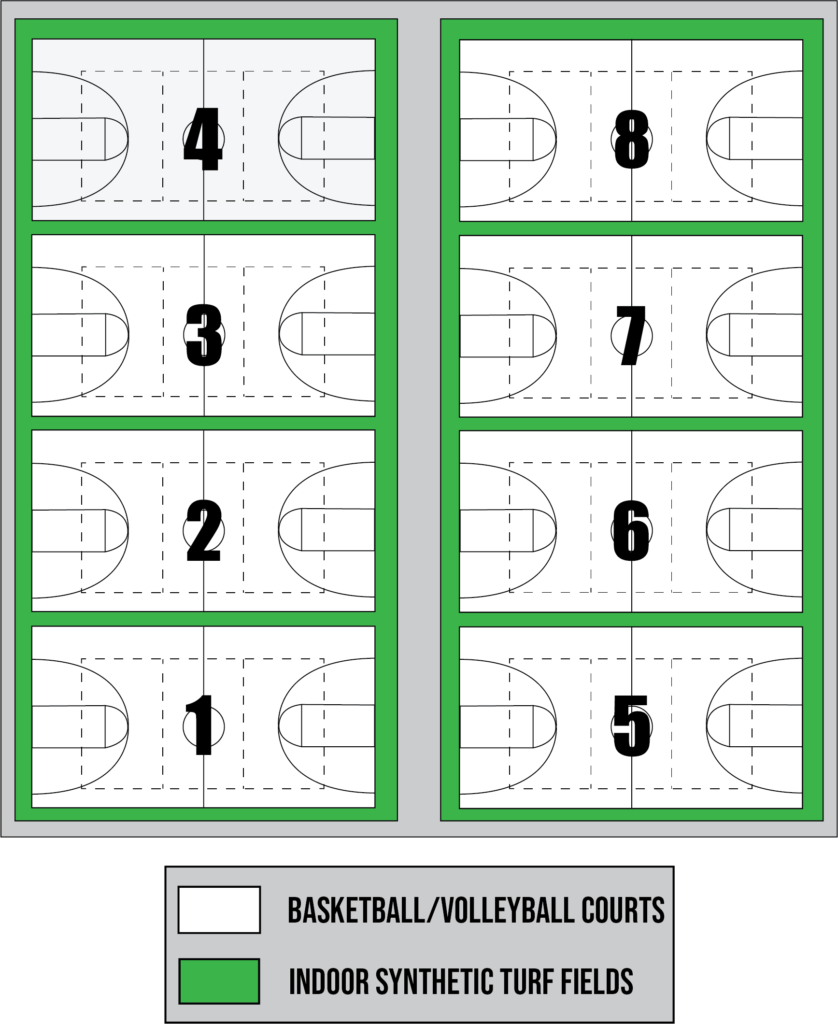
Image Source: mdsoccerplex.org
Deciphering the Dimensions: Football Field vs. Basketball Court
Before we start placing courts on fields, let’s establish the baseline measurements. This is crucial for accurate athletic facility planning and understanding the court to field ratio.
American Football Field Measurements
A standard American football field is a precisely defined rectangle. Its dimensions are governed by official rules to ensure fair play and consistency.
- Total Length: 120 yards (360 feet or approximately 109.7 meters)
- This includes the 100 yards of playing field plus two 10-yard end zones.
- Total Width: 53.3 yards (160 feet or approximately 48.8 meters)
So, the total area of an American football field is 120 yards * 53.3 yards = 6,396 square yards. In feet, this is 360 feet * 160 feet = 57,600 square feet.
Basketball Court Dimensions
Basketball courts, much like football fields, have standardized dimensions. However, there can be slight variations between different levels of play, most notably between an NBA basketball court and an Olympic basketball court. For our purposes, we’ll consider the most common international standard, which is also very close to NBA specifications.
-
NBA Basketball Court:
- Length: 94 feet (28.7 meters)
- Width: 50 feet (15.2 meters)
- Total Area: 94 ft * 50 ft = 4,700 square feet
-
Olympic/FIBA Basketball Court:
- Length: 28 meters (approximately 91.9 feet)
- Width: 15 meters (approximately 49.2 feet)
- Total Area: 28 m * 15 m = 420 square meters (approximately 4,520.8 square feet)
For simplicity and to ensure we can fit more courts, we will use the slightly larger NBA dimensions for our calculations. The difference is minimal, but it’s good to acknowledge the existence of different standards when measuring sports fields.
The Calculation: Fitting Courts onto the Field
Now, let’s get down to the core of the question. How many of these 94 ft x 50 ft basketball courts can we lay out on a 360 ft x 160 ft football field?
We need to consider two primary ways of orienting the basketball courts:
- Lengthwise: Aligning the 94-foot length of the basketball court along the 360-foot length of the football field.
- Widthwise: Aligning the 50-foot width of the basketball court along the 360-foot length of the football field.
Scenario 1: Courts Oriented Lengthwise
- Along the 360-foot length of the football field:
We can fit 360 feet / 94 feet = 3.83 courts. Since we can’t fit a fraction of a court, we can fit 3 full courts lengthwise. - Along the 160-foot width of the football field:
We can fit 160 feet / 50 feet = 3.2 courts. This means we can fit 3 full courts widthwise.
To find the total number of courts in this orientation, we multiply the number of courts that fit along each dimension: 3 courts (lengthwise) * 3 courts (widthwise) = 9 basketball courts.
Let’s visualize this. You would have three rows of three courts each. There would be some leftover space. The total area occupied by 9 NBA courts would be 9 * 4,700 sq ft = 42,300 sq ft. This leaves 57,600 sq ft – 42,300 sq ft = 15,300 sq ft of unused space.
Scenario 2: Courts Oriented Widthwise
This is where things get a bit more interesting and potentially allow for more courts. We’ll orient the 50-foot width of the basketball court along the 360-foot length of the football field, and the 94-foot length of the basketball court along the 160-foot width of the football field.
- Along the 360-foot length of the football field:
We can fit 360 feet / 50 feet = 7.2 courts. This means we can fit 7 full courts lengthwise. - Along the 160-foot width of the football field:
We can fit 160 feet / 94 feet = 1.7 courts. This means we can fit 1 full court widthwise.
In this orientation, we can fit 7 courts (lengthwise) * 1 court (widthwise) = 7 basketball courts.
This orientation is less efficient for maximizing the number of courts. The total area occupied by 7 courts would be 7 * 4,700 sq ft = 32,900 sq ft, leaving a significant portion of the football field unused.
Combining Orientations for Maximum Efficiency
To truly maximize the number of basketball courts, we can mix orientations and be clever about utilizing the space. We need to consider the leftover strips of land when fitting courts.
Let’s revisit Scenario 1 where we fit 3 courts by 3 courts.
* We used 3 * 94 ft = 282 ft of the 360 ft length. This leaves 360 ft – 282 ft = 78 ft of length unused.
* We used 3 * 50 ft = 150 ft of the 160 ft width. This leaves 160 ft – 150 ft = 10 ft of width unused.
Now, let’s look at the unused 78 ft x 160 ft strip along the side. Can we fit more courts here?
The dimensions of this strip are 78 feet by 160 feet.
-
Option A: Place courts lengthwise (94 ft x 50 ft) in this strip.
- Along the 78 ft dimension: We cannot fit the 94 ft length.
- Along the 160 ft dimension: We can fit 160 ft / 50 ft = 3.2 courts. So, 3 courts.
This doesn’t work efficiently.
-
Option B: Place courts widthwise (50 ft x 94 ft) in this strip.
- Along the 78 ft dimension: We can fit 78 ft / 50 ft = 1.56 courts. So, 1 court.
- Along the 160 ft dimension: We can fit 160 ft / 94 ft = 1.7 courts. So, 1 court.
This gives us an additional 1 court.
So, with this modification, we could potentially fit 9 + 1 = 10 basketball courts.
Let’s consider the unused 10 ft x 360 ft strip along the end. Can we fit courts here?
The dimensions are 10 ft x 360 ft. This strip is too narrow to fit any standard basketball court.
What if we rearrange our initial placement?
Let’s try to fit as many 50 ft widths along the 360 ft length as possible.
360 ft / 50 ft = 7.2. So, we can fit 7 courts with their 50 ft side along the 360 ft length.
This uses 7 * 50 ft = 350 ft of the 360 ft length, leaving 10 ft.
Now, along the 160 ft width of the football field, we need to fit the 94 ft length of the basketball courts.
160 ft / 94 ft = 1.7. So, we can fit 1 full court.
This uses 1 * 94 ft = 94 ft of the 160 ft width, leaving 160 ft – 94 ft = 66 ft.
So, we have placed 7 courts. The area used is 350 ft x 94 ft.
We have leftover space:
1. A 10 ft x 160 ft strip along one side (lengthwise).
2. A 360 ft x 66 ft strip along the end.
Let’s focus on the larger leftover strip: 360 ft x 66 ft.
Can we fit more courts here?
-
Option A: Place courts lengthwise (94 ft x 50 ft).
- Along the 360 ft dimension: 360 ft / 94 ft = 3.83. So, 3 courts.
- Along the 66 ft dimension: 66 ft / 50 ft = 1.32. So, 1 court.
This arrangement gives us 3 * 1 = 3 additional courts.
-
Option B: Place courts widthwise (50 ft x 94 ft).
- Along the 360 ft dimension: 360 ft / 50 ft = 7.2. So, 7 courts.
- Along the 66 ft dimension: 66 ft / 94 ft = 0.7. So, 0 courts.
This doesn’t work.
So, by fitting 7 courts initially, and then using the 360 ft x 66 ft leftover space, we can fit an additional 3 courts.
Total courts = 7 + 3 = 10 basketball courts.
Let’s verify the dimensions for these 3 additional courts:
They are placed with their 94 ft length along the 360 ft of the football field, and their 50 ft width along the 66 ft of the football field.
* 3 courts x 94 ft = 282 ft (fits within 360 ft)
* 1 court x 50 ft = 50 ft (fits within 66 ft)
This arrangement uses 282 ft x 50 ft from the 360 ft x 66 ft strip.
The total number of courts seems to be around 10.
Let’s consider a more structured approach by tiling the field with optimal orientations.
Tiling Strategy for Maximum Courts
The goal is to maximize the use of the 360 ft x 160 ft area using 94 ft x 50 ft rectangles.
We can fit:
* Along the 360 ft side: $\lfloor 360 / 94 \rfloor = 3$ courts (using 282 ft, leaving 78 ft) OR $\lfloor 360 / 50 \rfloor = 7$ courts (using 350 ft, leaving 10 ft).
* Along the 160 ft side: $\lfloor 160 / 50 \rfloor = 3$ courts (using 150 ft, leaving 10 ft) OR $\lfloor 160 / 94 \rfloor = 1$ court (using 94 ft, leaving 66 ft).
Let’s try the combination that maximizes the number of courts in the first pass:
Fit 7 courts along the 360 ft length (using 50 ft dimension of court) and 1 court along the 160 ft width (using 94 ft dimension of court).
This gives us 7 x 1 = 7 courts.
Area used: 350 ft x 94 ft.
Remaining area:
* Strip 1: 10 ft x 160 ft (along the 360 ft side)
* Strip 2: 360 ft x 66 ft (along the 160 ft side)
Now, focus on Strip 2 (360 ft x 66 ft):
Fit courts with 94 ft length along the 360 ft side and 50 ft width along the 66 ft side.
* Along 360 ft: $\lfloor 360 / 94 \rfloor = 3$ courts. Uses 3 x 94 ft = 282 ft. Leaves 78 ft.
* Along 66 ft: $\lfloor 66 / 50 \rfloor = 1$ court. Uses 1 x 50 ft = 50 ft. Leaves 16 ft.
This yields 3 x 1 = 3 additional courts.
Total courts so far: 7 + 3 = 10 courts.
Area used by these 3 courts: 282 ft x 50 ft within the 360 ft x 66 ft strip.
Let’s check the remaining space:
* Strip 1: 10 ft x 160 ft (untouched)
* From Strip 2 (360 ft x 66 ft):
* Remaining part of length: 78 ft x 50 ft (next to the 3 courts)
* Remaining part of width: 360 ft x 16 ft (below the 3 courts)
* Corner piece: 78 ft x 16 ft
Can we fit any more courts in these smaller remaining spaces?
* 10 ft x 160 ft: Too narrow.
* 78 ft x 50 ft: Too small for any orientation (need 94×50 or 50×94).
* 360 ft x 16 ft: Too narrow.
* 78 ft x 16 ft: Too small.
Therefore, in this configuration, we can fit a maximum of 10 basketball courts.
Let’s try another initial layout that maximizes the use of the 160 ft width.
Fit 3 courts along the 360 ft length (using 94 ft dimension of court) and 3 courts along the 160 ft width (using 50 ft dimension of court).
This gives us 3 x 3 = 9 courts.
Area used: 282 ft x 150 ft.
Remaining area:
* Strip 1: 78 ft x 160 ft (along the 360 ft side)
* Strip 2: 360 ft x 10 ft (along the 160 ft side)
Now, focus on Strip 1 (78 ft x 160 ft):
Fit courts with 94 ft length along the 160 ft side and 50 ft width along the 78 ft side.
* Along 160 ft: $\lfloor 160 / 94 \rfloor = 1$ court. Uses 1 x 94 ft = 94 ft. Leaves 66 ft.
* Along 78 ft: $\lfloor 78 / 50 \rfloor = 1$ court. Uses 1 x 50 ft = 50 ft. Leaves 28 ft.
This yields 1 x 1 = 1 additional court.
Total courts so far: 9 + 1 = 10 courts.
Area used by this 1 court: 94 ft x 50 ft within the 78 ft x 160 ft strip.
Let’s check the remaining space:
* Strip 2: 360 ft x 10 ft (untouched)
* From Strip 1 (78 ft x 160 ft):
* Remaining part of width: 66 ft x 50 ft (next to the 1 court)
* Remaining part of length: 78 ft x 110 ft (along the 160 ft side)
* Corner piece: 66 ft x 110 ft
Can we fit any more courts?
* 360 ft x 10 ft: Too narrow.
* 66 ft x 50 ft: Too small.
* 78 ft x 110 ft: Too small.
* 66 ft x 110 ft: Too small.
This strategy also yields 10 basketball courts.
Visualizing the Layout
Imagine the football field. You can lay out three rows of three basketball courts, each 94 feet long and 50 feet wide. This uses up 282 feet of the 360-foot length and 150 feet of the 160-foot width.
This leaves a strip of about 78 feet by 160 feet on one side and a thinner strip along the end. In the larger 78 ft x 160 ft area, you can place one more basketball court oriented the other way (50 feet by 94 feet), fitting snugly within those dimensions.
This leads to a maximum of 10 courts.
Table Summary of Fitting
| Football Field Dimension | Basketball Court Dimension | Courts Along Length (360 ft) | Courts Along Width (160 ft) | Total Courts (Initial Fit) |
|---|---|---|---|---|
| 360 ft x 160 ft | 94 ft x 50 ft | $\lfloor 360/94 \rfloor = 3$ | $\lfloor 160/50 \rfloor = 3$ | 3 x 3 = 9 |
| 50 ft x 94 ft | $\lfloor 360/50 \rfloor = 7$ | $\lfloor 160/94 \rfloor = 1$ | 7 x 1 = 7 |
Adding courts in leftover space:
After the initial 3×3 (9 courts) fit:
Leftover space: ~78 ft x 160 ft.
In this space, we can fit 1 court of 50 ft x 94 ft.
Total: 9 + 1 = 10 courts.
After the initial 7×1 (7 courts) fit:
Leftover space: ~360 ft x 66 ft.
In this space, we can fit 3 courts of 94 ft x 50 ft.
Total: 7 + 3 = 10 courts.
Factors Affecting the Number of Courts
While the pure geometric calculation suggests 10 courts, real-world athletic facility planning introduces other considerations:
- Run-off Areas: Basketball courts often have designated areas around them for players to move without immediately hitting a wall or another court. These are not accounted for in simple dimension fitting.
- Walkways and Aisles: For a functional multi-court facility, you need space for people to move between courts.
- Support Structures: Any infrastructure for lighting, seating, or scoreboards would reduce the available space.
- Entrances and Exits: Access points are critical for any facility.
- Flexibility: Sometimes, fewer courts are installed to allow for more space per court, which might be desirable for higher-level play or specific training needs.
- Staggered Layouts: More complex tiling patterns could potentially squeeze in an extra court, but this becomes highly impractical due to necessary pathways.
If we were to consider the dimensions of an Olympic basketball court, the numbers would be very similar. The difference between 94 ft x 50 ft and approximately 91.9 ft x 49.2 ft is marginal when fitting them into a much larger space. The principle remains the same: you can fit approximately 10 courts, with room to spare.
Stadium Capacity Comparison: A Different Perspective
While we’re talking about fitting courts onto a field, it’s worth briefly touching on stadium capacity comparison. A football stadium’s capacity is measured by the number of spectators it can hold, not playing area. This is why you can’t directly compare the number of basketball courts to stadium seating. However, the sheer size of a football field is what allows for the fitting of multiple smaller courts. Imagine the vastness of a football stadium – it’s designed to encompass a large playing surface and a much larger seating bowl for thousands of fans. The playing field itself, while large, is only one component of the overall stadium structure.
Sports Field Conversion: Practical Applications
The concept of sports field conversion is common in modern multi-purpose stadiums and sports complexes. For example, a stadium designed for American football can often be reconfigured for soccer, concerts, or other events. In a similar vein, understanding how different sports occupy space is key for athletic facility planning. A facility manager might consider transforming a large, underutilized area of a football field into multiple basketball courts for practice or smaller league play.
The court to field ratio is essentially a measure of how efficiently you’re using the larger space. In this case, 10 basketball courts of 4,700 sq ft each occupy 47,000 sq ft, within a 57,600 sq ft football field. This is a utilization of about 81.6% of the playing surface area. This leaves significant space for circulation and buffer zones.
Frequently Asked Questions (FAQ)
Q1: Are there any official guidelines on fitting multiple basketball courts onto a football field?
A1: There are no official rules dictating how many basketball courts can fit on a football field, as they are different sports with different venue requirements. However, geometric calculations based on official dimensions are used for athletic facility planning.
Q2: Can I fit more than 10 basketball courts if I use smaller basketball court dimensions?
A2: Yes, if you were to use smaller dimensions, such as those for youth leagues, you would be able to fit more courts. However, for standard NBA basketball court or Olympic basketball court sizes, 10 is the practical maximum.
Q3: Does the shape of the football field’s end zones matter when fitting basketball courts?
A3: The end zones are part of the overall length of the football field. While they provide additional length, they are usually not ideal for placing courts due to their tapered shape and the fact that standard basketball courts are rectangular. Our calculation uses the total rectangular area of the field for simplicity.
Q4: What is the typical space needed around a basketball court?
A4: A typical basketball court may require 3-5 feet of clear space around the sidelines and endlines for player movement and safety. For multi-court facilities, wider pathways between courts are also necessary. This is why simply dividing areas might give a theoretical maximum, but a practical maximum is usually lower.
Q5: How does the size of a soccer field compare to a football field for fitting basketball courts?
A5: A regulation soccer field (FIFA) is typically 100-130 yards long and 50-100 yards wide. While dimensions can vary, a soccer field is generally wider than a football field. For example, a common soccer field size is 110 x 70 yards (330 ft x 210 ft). This would allow for potentially more basketball courts due to its increased width, or a similar number depending on the exact dimensions. Measuring sports fields precisely is key to these comparisons.
Q6: Can a football stadium be converted into a basketball arena?
A6: While a football stadium can host a single basketball game with temporary flooring and seating arrangements, it’s not a practical or cost-effective conversion into a permanent basketball arena. The structural design, ceiling height, and acoustics are vastly different. However, the playing field area itself is large enough to contain multiple basketball courts.
Conclusion
When we meticulously break down the dimensions of both an American football field and standard basketball court dimensions, the definitive answer to how many basketball courts fit on a football field is approximately 10 standard NBA-sized courts. This calculation relies on efficient geometric packing, orienting the courts to maximize their fit within the larger rectangular space. However, it’s crucial to remember that practical athletic facility planning necessitates additional space for run-offs, walkways, and safety, which would reduce this number in a real-world application. Nevertheless, the football field’s generous dimensions provide a vast canvas that can, in theory, accommodate multiple basketball courts, illustrating the versatile nature of large sports venues and the possibilities of sports field conversion.