
A basketball bounces because of its internal structure, the air pressure inside it, and the surface it hits. These factors combine to create a rebound through a process involving force, motion, and energy transfer.
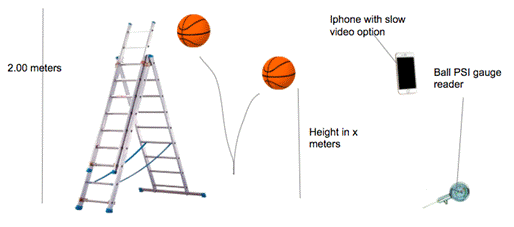
Image Source: tuhsphysics.ttsd.k12.or.us
The Core of the Bounce: Elasticity and Inflation
The familiar bounce of a basketball is a marvel of physics, governed by the interplay of the ball’s material properties, its internal pressure, and the force applied during impact. At its heart, the elasticity of basketball materials allows it to deform and then return to its original shape, storing and releasing energy.
Deciphering Basketball Physics
The science behind a basketball’s bounce is deeply rooted in fundamental principles of basketball physics. When a basketball is dropped or struck, it experiences a collision. This collision involves a rapid exchange of momentum and energy between the ball and the surface it impacts.
Force and Motion in Play
The core of a basketball’s bounce lies in the principles of force and motion. When a ball is propelled downwards, it gains velocity. Upon impact with a surface, a force is exerted on the ball, opposing its motion. This force causes the ball to compress. The greater the force applied, the more the ball deforms. This deformation is crucial, as it stores potential energy within the ball’s structure.
The Ball Rebound Mechanism
The ball rebound is an energy transformation process. When the ball hits the ground, its kinetic energy is converted into elastic potential energy as it squishes. This stored energy is then released, pushing the ball back into motion, propelling it upwards. The efficiency of this energy transfer dictates how high the ball bounces.
Basketball Properties: What Makes it Bounce
The basketball properties are meticulously designed to optimize its bouncing characteristics.
- Material Composition: Most basketballs are made of rubber or synthetic leather. These materials are chosen for their durability and, more importantly, their elasticity. The outer cover, often with deep channels, helps with grip but also contributes to how the ball deforms.
- Bladder and Air Cushion: Inside the outer cover is a butyl rubber bladder. This bladder is filled with air at a specific pressure. This internal air acts like a spring, cushioning the impact and contributing significantly to the rebound. The basketball inflation level is critical here.
- Construction: The way the ball is constructed, including the winding of nylon or polyester cords around the bladder, provides structural integrity and further influences the elastic properties.
The Role of Inflation: More Than Just Air
The amount of air inside a basketball, or basketball inflation, is one of the most significant factors influencing its bounce. Proper inflation ensures that the air inside acts as an effective spring.
How Inflation Affects Bounce Height
- Under-inflated Balls: A ball with too little air will feel soft and mushy. It deforms excessively upon impact, and a significant portion of the energy is lost as heat and sound. This results in a much lower bounce height. The internal air pressure is too low to efficiently push the ball back upwards.
- Over-inflated Balls: An over-inflated ball is hard and rigid. While it might seem like more pressure would mean a higher bounce, it can actually lead to less energy being absorbed and stored during the deformation. This can cause the ball to “die” on impact or even result in the ball being more prone to damage. The optimal range for inflation is crucial for maximizing the bounce height.
- Properly Inflated Balls: A correctly inflated ball strikes a balance. It has enough internal pressure to resist excessive deformation, allowing for efficient storage and release of elastic potential energy. This results in the characteristic high, responsive bounce that players expect.
Achieving Optimal Inflation
The ideal inflation pressure for a basketball is usually printed on the ball itself, typically around 7-9 PSI (pounds per square inch). Using a pressure gauge is the most accurate way to ensure proper inflation.
The Impact of the Surface: Where the Bounce Happens
The surface on which a basketball bounces plays a crucial role in the surface interaction and the resulting rebound. Different surfaces absorb energy differently, affecting the bounce height.
Surface Properties and Energy Loss
- Hard Surfaces (Concrete, Wood): These surfaces are generally firm and absorb minimal energy. They allow for a greater transfer of energy back to the ball, resulting in a higher bounce. This is why outdoor courts or indoor gymnasium floors are ideal for basketball.
- Softer Surfaces (Grass, Sand): These surfaces are designed to absorb impact and reduce shock. When a basketball hits grass or sand, a large amount of the impact energy is dissipated into the ground, leaving less energy to propel the ball upwards. This results in a very low or almost non-existent bounce.
- Uneven Surfaces: Bumps or debris on a surface can disrupt the smooth deformation and rebound, leading to unpredictable bounces.
The Science of Surface Interaction
When the ball contacts a surface, both the ball and the surface deform to some extent. The amount of deformation in the surface depends on its own elastic properties.
- Elastic Surfaces: If the surface is also elastic (like a well-maintained wooden court), it can store and return some energy, further enhancing the bounce.
- Inelastic Surfaces: If the surface is inelastic (like mud), it absorbs almost all the energy, and the ball will not bounce.
Dribbling Mechanics: The Art and Science of Bouncing
Dribbling mechanics is the practical application of basketball physics to control the ball’s bounce. It’s how players manipulate the force and motion to move the ball effectively.
The Dribble Cycle
A dribble involves a continuous cycle of the ball hitting the court and returning to the player’s control.
- Downward Force: The player applies a downward force with their hand.
- Impact and Deformation: The ball strikes the court, deforms, and stores elastic potential energy.
- Rebound: The ball’s stored energy propels it upwards.
- Player’s Hand: The player’s hand intercepts the ball as it rises, controlling its momentum.
- Pushing Down Again: The player then pushes the ball back down to repeat the cycle.
Optimizing the Dribble
- Force Control: Experienced players can control the amount of force they apply. A softer dribble allows the ball to rise higher, giving more time to react. A harder dribble brings the ball back down faster, useful for quick movements.
- Hand Position: The player’s hand position and the angle of their wrist influence the direction and force of the push-down, allowing for directional changes and fakes.
- Body Position: A low center of gravity and bent knees provide stability and allow for quicker reactions to the ball’s bounce.
Kinetic Energy Transfer in Dribbling
Each dribble is a demonstration of kinetic energy transfer. The player’s hand transfers kinetic energy to the ball, which is then partially stored as elastic potential energy during the bounce. This stored energy is then converted back into kinetic energy, returning the ball towards the player. The efficiency of this transfer is key to a smooth, controlled dribble.
Factors Affecting Bounce Height: A Summary
Several factors contribute to how high a basketball bounces. These elements, when working together, create the dynamic rebound we see on the court.
Key Influences on Bounce Height
- Basketball Inflation: As discussed, proper inflation is paramount. Too little or too much air significantly reduces the potential bounce.
- Ball Material and Condition: The elasticity of basketball materials can degrade over time, especially with frequent use or exposure to extreme temperatures. A worn-out ball may not bounce as well.
- Impact Velocity: The faster the ball is moving when it hits the surface, the more kinetic energy it possesses, generally leading to a higher initial bounce. This is directly related to the force and motion applied to the ball.
- Surface Type and Condition: The firmness and elasticity of the playing surface are critical. Hard, smooth surfaces offer the best rebound.
- Angle of Impact: While primarily vertical bounces are discussed, angled impacts can also influence the rebound direction and height.
Quantifying Bounce: The Coefficient of Restitution
In physics, the coefficient of restitution (COR) is a measure of how “bouncy” an object is. It quantifies the ratio of the speed of separation after a collision to the speed of approach before the collision. For a basketball, a higher COR means a more efficient transfer of energy and thus a higher bounce. The basketball properties, inflation, and surface all contribute to the ball’s COR.
Common Misconceptions About Basketball Bounce
While the science is straightforward, some common ideas about basketball bounces are not entirely accurate.
Addressing Popular Myths
- “A harder ball always bounces higher.” This is only true up to a point. An over-inflated ball can actually bounce less efficiently than one with optimal inflation.
- “The brand of the ball makes the biggest difference.” While quality manufacturing matters, the fundamental physics of inflation and material elasticity are more significant than branding alone.
- “Temperature doesn’t matter much.” Temperature can affect the air pressure inside the ball, thereby influencing its bounce. Colder temperatures can lead to slightly lower bounces.
Frequently Asked Questions (FAQ)
Q1: What is the ideal inflation pressure for a basketball?
A1: The ideal inflation pressure is typically between 7-9 PSI, though it’s best to check the specific recommendations printed on the ball itself.
Q2: Can I make my old basketball bounce higher?
A2: You can try reinflating it to the correct pressure. However, if the ball’s material has deteriorated or the bladder is damaged, its elasticity may be compromised, limiting its bounce potential.
Q3: Who is responsible for setting the rules on basketball inflation?
A3: Governing bodies like the NBA, FIBA, or NCAA set standards for ball specifications, including inflation, for official games.
Q4: Why does a basketball bounce differently on different courts?
A4: Different courts have different surface materials and conditions, which absorb energy differently. Harder, more elastic surfaces lead to higher bounces than softer, more absorbent surfaces.
Q5: How does the weight of a basketball affect its bounce?
A5: While weight is a factor in the ball’s momentum (mass x velocity), the primary drivers of bounce height are its elasticity and internal air pressure. For regulation balls, weight is kept within a specific range.
Q6: What happens to the energy when a basketball bounces?
A6: When a basketball bounces, kinetic energy is converted into elastic potential energy during deformation, and then back into kinetic energy as the ball returns to its shape. Some energy is lost as heat and sound during the process.
Q7: Does the pattern of the basketball (channels and seams) affect its bounce?
A7: While the primary bounce is due to the internal structure and inflation, the seams and channels do play a role in surface interaction and dribbling mechanics by providing grip and influencing how the ball deforms upon impact.
By delving into the science of basketball physics, we see that the familiar bounce of a basketball is a complex yet elegant interplay of elasticity of basketball materials, precise basketball inflation, and the fundamental laws of force and motion. Each bounce is a testament to efficient kinetic energy transfer and controlled surface interaction, making the game dynamic and exciting.