
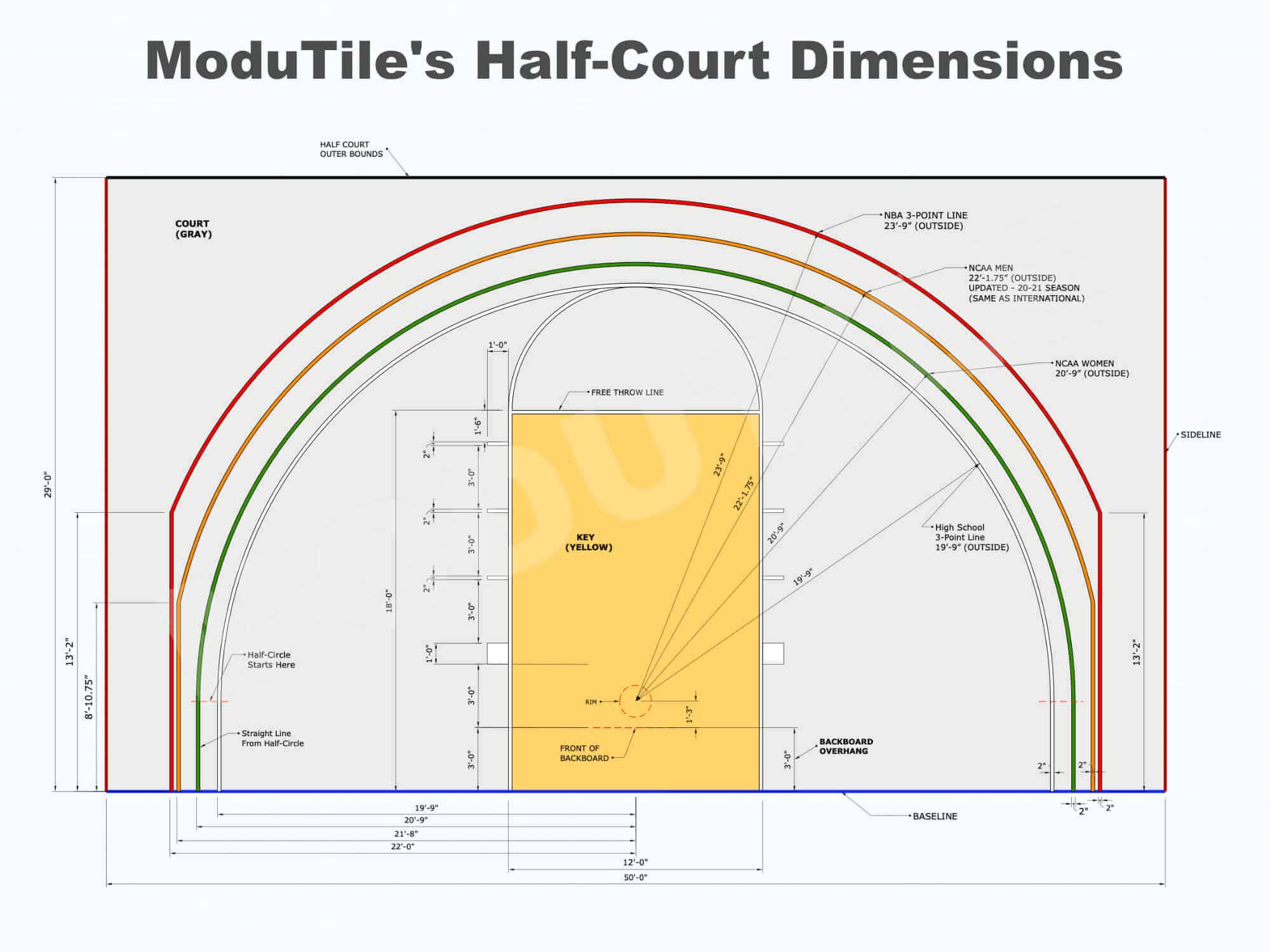
Image Source: modutile.com
Half Court Dimensions: How Big Is A Half Court Basketball Court?
A half court basketball court is precisely half the length of a standard full court. For official NBA and FIBA games, the length of a full court is 94 feet, meaning a standard half court stretches 47 feet from the half-court line to the baseline. The width of a full court is 50 feet, so a half court maintains this full width.
Navigating the Dimensions of a Half Court
Basketball, a sport celebrated for its dynamic action and strategic play, relies heavily on the precise layout of its playing surface. While the full court is the arena for competitive matches, the concept of a half court is fundamental to understanding the game’s nuances, practice drills, and casual play. This exploration delves into the specifics of half court dimensions, dissecting how big this crucial portion of the basketball court truly is, and how it compares to its full-court counterpart.
The Genesis of Court Size: A Historical Perspective
The evolution of basketball court sizes is intertwined with the sport’s development. From its rudimentary beginnings in the late 19th century, the game’s playing area has undergone significant standardization. Early games were often played on modified tennis courts or simple outdoor courts, with dimensions varying widely. As the sport gained popularity and professional leagues emerged, the need for consistent regulations became apparent. This led to the establishment of official basketball court size guidelines, which have largely remained consistent for decades, with minor adjustments catering to different governing bodies like the NBA and FIBA. Understanding this historical context helps appreciate why current half court dimensions are what they are.
Deconstructing the Half Court: Length and Width
When we talk about a half court, we’re essentially discussing one of the two equal halves that comprise a full basketball court, divided by the center line. Let’s break down the measurements:
The Half Court Length: Reaching for the Hoop
The half court length is determined by dividing the total length of a regulation basketball court by two.
- NBA Full Court Length: 94 feet (28.65 meters)
- Half Court Length: 94 feet / 2 = 47 feet (14.33 meters)
This 47-foot measurement signifies the distance from the center line to the baseline, encompassing the free-throw line, the three-point arc, and the basket itself. This segment of the court is crucial for offensive strategies, defensive positioning, and understanding shooting ranges.
The Half Court Width: The Sideline Span
The width of a basketball court dictates the lateral space available for play. This dimension remains constant whether you’re considering a full court or a half court.
- Full Court Width: 50 feet (15.24 meters)
- Half Court Width: 50 feet (15.24 meters)
Therefore, a half court width provides 50 feet of playing space from one sideline to the other. This width is vital for dribbling, passing, and defensive maneuvers that require lateral movement.
Standard Half Court Dimensions: A Universal Measurement
Across various levels of play, the concept of a standard half court revolves around these fundamental measurements. While minor variations might exist in recreational settings or specific indoor facilities, professional and collegiate play adheres to these established figures. The half court area within these dimensions is a critical zone for many game-defining actions.
Comparing Full Court vs. Half Court
The distinction between a full court vs. half court is significant. A full court encompasses both halves, providing the complete playing field. It includes two baskets, two free-throw lines, and two three-point lines. A half court, on the other hand, is simply one of these halves. This distinction is important for understanding:
- Game Play: Full court is for official games. Half court is often used for drills, informal games, or specific types of training.
- Practice Drills: Many offensive and defensive drills are performed on a half court to simulate game situations in a condensed space. This allows for more repetitions and focused practice.
- Equipment: While the hoop and backboard are the same, the overall space required for a half court is less than a full court.
NBA Half Court Size: The Professional Standard
The NBA half court size is directly derived from its full court dimensions. As mentioned, the NBA court measures 94 feet in length and 50 feet in width. Consequently, an NBA half court is 47 feet long and 50 feet wide. This precise measurement ensures a consistent playing environment for all professional teams.
FIBA Half Court Dimensions: An International Perspective
The governing body for international basketball, FIBA (Fédération Internationale de Basketball), also has established court dimensions. While very similar to the NBA, there are slight differences in overall court size, which in turn affects the half court measurements.
- FIBA Full Court Length: 28 meters (approximately 91.86 feet)
- FIBA Full Court Width: 15 meters (approximately 49.21 feet)
From these figures, we can deduce the FIBA half court dimensions:
- FIBA Half Court Length: 28 meters / 2 = 14 meters (approximately 45.93 feet)
- FIBA Half Court Width: 15 meters (approximately 49.21 feet)
While the width is nearly identical, the slight reduction in the FIBA full court length results in a marginally shorter half court length. These differences, though seemingly small, are important in international competition.
Basketball Court Markings: Defining the Half Court
Beyond the basic length and width, a basketball court is adorned with various markings that delineate crucial areas and influence gameplay. Within a half court, several of these markings are particularly relevant:
The Half-Court Line
This is the most defining marking of a half court. It’s a line that bisects the full court directly at its center, separating the two halves. The half court line is crucial for enforcing the backcourt violation, which prevents offensive players from returning the ball to their own frontcourt once it has crossed the half-court line.
The Center Circle
Typically located at the center of the court, the center circle is used for tip-offs to start games or jump ball situations. While part of the center line, it’s a distinct visual element.
The Free-Throw Line
Positioned 15 feet from the face of the backboard, the free-throw line is a critical marking within each half court. It denotes the area from which players shoot free throws. The shape of the lane (or “key”) extends from this line.
The Three-Point Line
This arc extends from the baseline and around the basket, marking the boundary for three-point shots. Shots made from beyond this line are worth three points, while those from inside are worth two. The distance of the three-point line varies between leagues:
- NBA Three-Point Line: 23 feet, 9 inches (7.24 meters) at the top of the arc, curving to 22 feet (6.71 meters) in the corners.
- FIBA Three-Point Line: 6.75 meters (approximately 22.15 feet) from the center of the basket.
The Key (or Lane)
The rectangular area extending from the baseline under the basket to the free-throw line is known as the key or lane. Its dimensions are regulated, and specific rules apply within this area, such as the three-second rule for offensive players.
The Baseline
The line at either end of the court that the basket is situated on. The half court length is measured from the center line to the baseline.
The Significance of Half Court Play
While official games are played on a full court, the half court area holds immense importance for player development and informal games.
-
Drills: Coaches frequently use half courts for a variety of drills, including:
- 1-on-1 and 2-on-2: These games naturally occur within a half court and are excellent for developing offensive moves, defensive techniques, and decision-making.
- Shooting Practice: Players can focus on their shooting form and range without the need for a full court.
- Transition Defense Drills: Simulating fast breaks and defensive rotations can be effectively practiced on a half court.
- Defensive Slides and Footwork: The confined space allows for focused improvement of defensive fundamentals.
-
Informal Games: Many pickup games and recreational play often occur on a half court, especially when full courts are unavailable or when fewer players are present. This fosters a casual yet competitive environment.
-
Training Facilities: Many gyms and training facilities will designate half courts for team practice, allowing multiple teams to utilize the space simultaneously.
The Half Court Area: A Closer Look
To quantify the half court area, we simply multiply its length by its width.
-
For an NBA half court:
- Area = Half Court Length × Half Court Width
- Area = 47 feet × 50 feet = 2,350 square feet
-
For a FIBA half court:
- Area = FIBA Half Court Length × FIBA Half Court Width
- Area = 45.93 feet × 49.21 feet = 2,260.45 square feet (approximately)
This area represents a significant portion of the court where critical actions unfold.
Variations and Adaptations
While the professional and international standards are well-defined, it’s important to acknowledge that variations exist, particularly in recreational settings or for specific purposes.
- Youth Basketball: Courts for younger players may be smaller to accommodate their physical development and skill levels. This often means a shorter half court length.
- Streetball Courts: Outdoor courts can have less precise dimensions, but they often mimic the general proportions of a standard court.
- Multi-sport Facilities: Some multi-purpose courts might have lines for other sports, which can sometimes lead to slight deviations from exact basketball dimensions.
However, when discussing standard half court dimensions, the NBA and FIBA figures are the benchmarks.
Key Takeaways on Half Court Dimensions
To summarize the essential points regarding half court dimensions:
- A half court is precisely half the length of a full basketball court.
- The half court length for the NBA is 47 feet.
- The half court width is the same as the full court width, which is 50 feet.
- FIBA courts have slightly different full court dimensions, resulting in a FIBA half court length of approximately 45.93 feet.
- The basketball court markings within a half court, such as the free-throw line and three-point line, are critical for gameplay.
- The half court area is a vital space for drills, informal games, and player development.
- Full court vs. half court play differs in scope and application, with the full court being for official games and the half court for focused practice and smaller games.
Frequently Asked Questions (FAQ)
Q1: What is the standard half court length?
A1: The standard half court length, as per NBA regulations, is 47 feet.
Q2: How wide is a half court basketball court?
A2: A half court basketball court maintains the full width of the court, which is 50 feet.
Q3: Can I play a full game on a half court?
A3: While you can play a modified game on a half court, official full-length games require a full court with two baskets.
Q4: Are FIBA half court dimensions different from NBA half court dimensions?
A4: Yes, FIBA courts are slightly shorter overall, resulting in a slightly shorter half court length (approximately 45.93 feet) compared to the NBA’s 47 feet. The width is largely the same.
Q5: What is the purpose of the half court line?
A5: The half court line is used to prevent a team from stalling the ball in their backcourt and enforces the backcourt violation.
Q6: How big is the half court area in square feet for the NBA?
A6: The NBA half court area is 2,350 square feet (47 feet x 50 feet).
Q7: Do the three-point line dimensions affect the half court size?
A7: The three-point line dimensions are part of the overall court markings within the half court, but they do not change the fundamental length and width of the half court itself.
Q8: Why are court dimensions standardized?
A8: Standardization ensures fair play and consistency across all games and leagues, allowing players to train and compete on a predictable surface.