
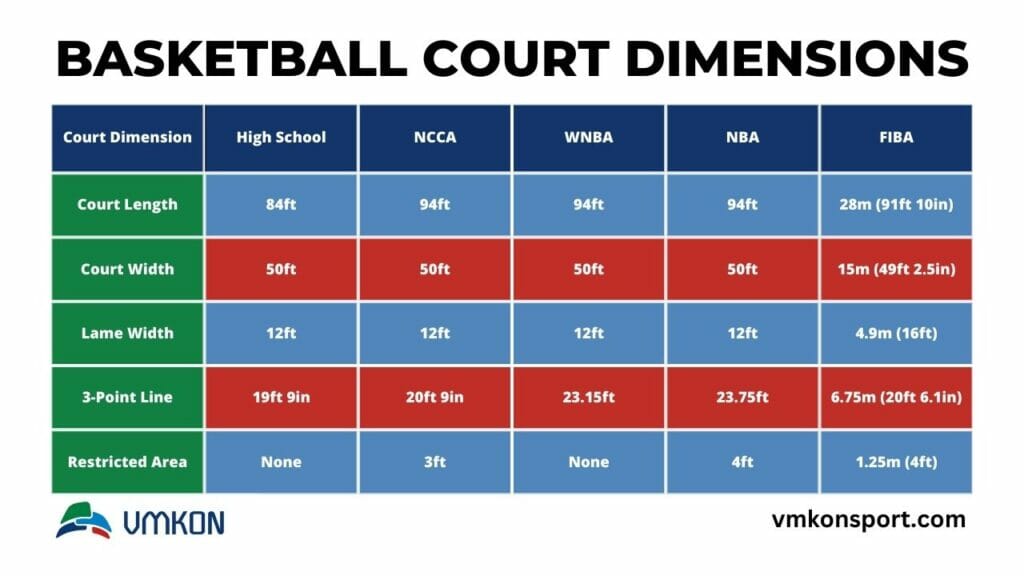
Image Source: vmkonsport.com
How Many Laps Is A Mile Around A Basketball Court?
To figure out how many laps it takes to run a mile on a basketball court, you need to know the court’s perimeter. A standard NBA basketball court is 94 feet long and 50 feet wide. This means the perimeter, or the total distance around the court, is 288 feet. Since a mile is 5,280 feet, you’ll need to complete approximately 18.3 laps around the court to run a mile.
Navigating a basketball court for fitness can be a fun way to get some exercise. While it might not be as common as using a dedicated running track, many people find themselves with access to a basketball court and wonder about its suitability for running. This article will delve deep into the specifics of basketball court dimensions and how they relate to measuring out a mile. We’ll explore the basketball court length and width, calculate the court perimeter, and then perform the necessary track lap calculation to answer your question precisely. We’ll also touch upon how this compares to running track laps and provide some helpful athletic track conversion insights.
Deciphering Basketball Court Dimensions
Before we can determine how many laps equal a mile, we must first establish the exact measurements of a basketball court. The dimensions can vary slightly depending on the league or governing body, but we will focus on the most common standards.
NBA Court Measurements
The National Basketball Association (NBA) has specific rules regarding court size.
- Basketball Court Length: The length of an NBA court is 94 feet.
- Basketball Court Width: The width of an NBA court is 50 feet.
These dimensions are crucial for calculating the total distance around the court.
FIBA Court Measurements
The International Basketball Federation (FIBA) has slightly different dimensions for its courts.
- FIBA Court Length: 28 meters (approximately 91.86 feet).
- FIBA Court Width: 15 meters (approximately 49.21 feet).
While there’s a difference, the NBA measurements are often what people are most familiar with, especially in North America. For the purpose of this article, we will primarily use the NBA basketball court dimensions.
Calculating the Court Perimeter
The perimeter of a rectangle is found by adding up the lengths of all four sides. For a basketball court, this means adding the length twice and the width twice.
Full Court Length and Width
We know the full court length is 94 feet, and the full court width is 50 feet.
The calculation for the perimeter is:
Perimeter = (2 × Length) + (2 × Width)
Perimeter = (2 × 94 feet) + (2 × 50 feet)
Perimeter = 188 feet + 100 feet
Court Perimeter = 288 feet
This means that running one complete lap around the outside boundary of an NBA basketball court covers a distance of 288 feet.
Converting to Miles: The Core Calculation
Now that we have the perimeter of a basketball court in feet, we can determine how many of these laps are needed to reach a mile.
The Definition of a Mile
A mile is a standard unit of distance in the imperial system.
- 1 mile = 5,280 feet.
Laps per Mile on a Basketball Court
To find out how many laps it takes to run a mile, we need to divide the total distance of a mile by the distance of one lap around the court.
Track Lap Calculation:
Number of Laps = Total Distance (in feet) / Distance per Lap (in feet)
Number of Laps = 5,280 feet / 288 feet per lap
Number of Laps ≈ 18.33 laps
So, you need to complete approximately 18.33 laps around the perimeter of an NBA basketball court to run a mile.
What About Half Court?
Sometimes, people might consider running the length of the court and back. Let’s break down what that means for distance.
Half Court Length and Full Court Length
The full court length is 94 feet. The half court length is, therefore, 47 feet.
Running from one baseline to the other baseline (the full length) is 94 feet. Running from one baseline to the half-court line is 47 feet.
If you were to run from one baseline to the opposite baseline and back, you would cover 94 feet + 94 feet = 188 feet. This is only a portion of the court’s perimeter.
Comparing Basketball Court Laps to Running Tracks
It’s helpful to compare the effort and distance covered on a basketball court to that of a standard running track. This provides context for your basketball court distance efforts.
Standard Running Track Laps
Most outdoor running tracks are 400 meters in length. To convert this to feet:
- 1 meter ≈ 3.281 feet.
- 400 meters × 3.281 feet/meter ≈ 1,312.4 feet.
So, a standard outdoor running track is approximately 1,312.4 feet long.
Athletic Track Conversion
To run a mile (5,280 feet) on a standard outdoor track:
Number of Laps = 5,280 feet / 1,312.4 feet per lap
Number of Laps ≈ 4.02 laps
This means that on a typical running track, you complete a mile in just over 4 laps. This highlights the significant difference in scale between running on a track and running laps around a basketball court.
Indoor Track Laps
Indoor tracks can vary in size, but many are 200 meters.
- 200 meters × 3.281 feet/meter ≈ 656.2 feet.
To run a mile on a 200-meter indoor track:
Number of Laps = 5,280 feet / 656.2 feet per lap
Number of Laps ≈ 8.05 laps
This gives us another reference point for our indoor track laps comparison.
Practical Considerations for Running on a Basketball Court
While you can certainly run laps around a basketball court, there are a few things to keep in mind for comfort and safety.
Surface Differences
Basketball courts are typically made of hardwood or a synthetic material. While firm, these surfaces are not designed for the repetitive impact of running as much as a dedicated track surface. Be mindful of potential stress on your joints.
Gaining Traction
The polished surface of a basketball court might offer less grip than a running track, especially if you are wearing shoes not designed for running. This could lead to slipping.
Obstructions and Boundaries
Remember that the basketball court has boundaries, including the out-of-bounds lines, the three-point line, and the free-throw lines. When running laps around the perimeter, you’ll be following these lines. If you decide to incorporate shuttle runs or other drills within the court, be aware of the different lines as markers.
Optimizing Your Workout
If you choose to use a basketball court for your running, here are some tips:
- Warm-up Properly: Always start with a thorough warm-up to prepare your muscles and joints for the activity.
- Wear Appropriate Shoes: Running shoes with good cushioning and grip are essential.
- Listen to Your Body: Pay attention to any discomfort or pain. If something doesn’t feel right, stop or modify your workout.
- Vary Your Routine: To avoid monotony and overuse injuries, consider incorporating different types of running or exercises on the court, such as sprints, interval training, or even just walking laps.
Frequently Asked Questions (FAQ)
Q1: Does the size of a basketball court change the number of laps needed for a mile?
A1: Yes, absolutely. As we saw with the NBA versus FIBA court dimensions, a larger court will have a larger perimeter, meaning fewer laps are needed to cover a mile. Our calculation of 18.3 laps is specifically for a standard NBA court.
Q2: Can I run on the hardwood surface of a basketball court without damaging it?
A2: Generally, yes. Most basketball courts are built to withstand significant activity. However, it’s always a good idea to check if any specific rules or concerns apply to the facility you are using. Ensure your shoes are clean and don’t have any debris that could scratch the floor.
Q3: Is running laps around a basketball court good exercise?
A3: Yes, running laps around a basketball court is a good cardiovascular exercise. It helps improve stamina, burn calories, and strengthen your legs. It’s a practical alternative when a track isn’t available.
Q4: What is the distance of a basketball court?
A4: The basketball court distance from baseline to baseline is 94 feet for an NBA court. The total perimeter is 288 feet.
Q5: How many shuttle runs down a basketball court equal a mile?
A5: Running the length of the court (94 feet) and back is 188 feet. To cover 5,280 feet, you would need 5,280 / 188 = approximately 28 shuttle runs (down and back).
Q6: Is a basketball court perimeter the same as an indoor track lap calculation?
A6: No. As we’ve shown, a basketball court perimeter is 288 feet, requiring about 18.3 laps for a mile. An indoor track lap calculation for a 200-meter track (656.2 feet) requires about 8.05 laps for a mile. The distances and lap counts are significantly different.
Conclusion
In summary, running a mile on a standard NBA basketball court involves completing approximately 18.3 laps around its perimeter. While it offers a viable option for exercise when other facilities aren’t accessible, it’s important to be aware of the differences in surface and compare it to the more familiar running track laps. By knowing the basketball court dimensions and performing the correct track lap calculation, you can effectively incorporate basketball court running into your fitness routine. Whether you’re looking at basketball court length, court perimeter, or performing an athletic track conversion, the key is accurate measurement and diligent execution.