

Remember that feeling of staring at a wall of math textbooks, each one promising to unlock the secrets of numbers and equations? It can feel overwhelming, right? Picking the perfect math textbook is like choosing a guide for an adventure – you need one that’s clear, engaging, and actually helps you reach your destination.
For students in 6th and 7th grade, math concepts are building blocks for everything that comes next. But the wrong textbook can make this exciting journey feel like a confusing maze. It might explain things too simply, or too complicatedly. It might not have enough practice problems, or the problems might feel boring. These little frustrations can add up and make math feel harder than it needs to be.
This post dives deep into what makes a great math textbook for you. We’ll explore how to spot the ones that truly explain things well, offer plenty of helpful examples, and even make practicing fun. By the end, you’ll know exactly what to look for, so you can find a textbook that makes math click and helps you build a strong foundation for your future learning.
Our Top 5 Math Textbooks Recommendations at a Glance
Top 5 Math Textbooks Detailed Reviews
1. Everything You Need to Ace Math in One Big Fat Notebook: The Complete Middle School Study Guide (Big Fat Notebooks)

Rating: 9.1/10
Crushing middle school math just got a whole lot easier with “Everything You Need to Ace Math in One Big Fat Notebook: The Complete Middle School Study Guide.” This comprehensive resource packs all the essential concepts for 6th and 7th graders into one engaging and easy-to-understand volume. Forget scrambling for notes or feeling overwhelmed; this notebook simplifies complex topics, making them accessible and even fun.
What We Like:
- Comprehensive Coverage: It covers all the key middle school math topics, from fractions and decimals to algebra basics and geometry.
- Engaging Format: The “Big Fat Notebook” style uses humor, doodles, and a conversational tone to keep students interested and help information stick.
- Clear Explanations: Concepts are broken down into bite-sized pieces with step-by-step examples, making them easy to follow.
- Self-Paced Learning: Students can work through it at their own speed, reinforcing what they learn in class or catching up on missed material.
- Great Value: This single pack provides immense educational value for a reasonable price.
What Could Be Improved:
- Limited Practice Problems: While explanations are great, more practice problems could be beneficial for deeper skill mastery.
- Digital Companion: A supplementary digital component or online resources could enhance interactivity.
This Big Fat Notebook is an indispensable tool for any middle schooler aiming to build a strong math foundation. It transforms math study from a chore into an achievable and even enjoyable experience.
2. The Big Fat Middle School Math Workbook: 600 Math Practice Exercises (Big Fat Notebooks)

Rating: 8.6/10
The Big Fat Middle School Math Workbook: 600 Math Practice Exercises (Big Fat Notebooks) offers a comprehensive approach to reinforcing essential math skills for students in grades 6-7. This hefty workbook packs a punch with 600 practice exercises designed to cover a wide range of middle school math topics. It aims to build confidence and proficiency through consistent practice.
What We Like:
- Vast quantity of exercises: 600 problems provide ample opportunity for practice and skill mastery.
- Broad topic coverage: The workbook addresses key areas typically encountered in middle school math curricula.
- “Big Fat Notebooks” format: This familiar and engaging style often appeals to students, making learning feel less daunting.
- Reinforces learning: Consistent use helps solidify concepts learned in the classroom.
- Builds confidence: Successfully completing problems boosts a student’s self-assurance in their math abilities.
What Could Be Improved:
- Lack of detailed explanations: While practice is key, some students might benefit from more in-depth explanations or worked examples for challenging problems.
- No answer key provided within the book: An answer key, even a partial one, would be incredibly helpful for self-checking and independent study.
- Potential for overwhelm: The sheer volume of exercises might seem intimidating to some students at first glance.
This workbook truly delivers on its promise of extensive practice. It’s an excellent resource for students looking to sharpen their math skills and prepare for upcoming challenges.
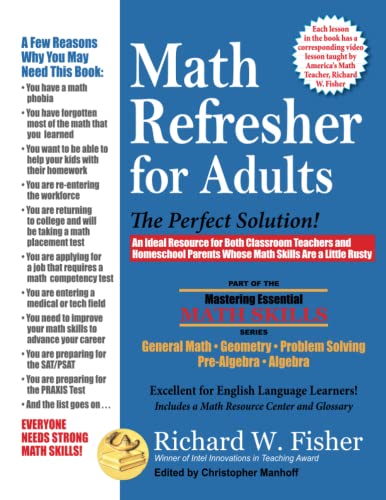
3. Math Refresher for Adults: The Perfect Solution (Mastering Essential Math Skills)
Rating: 9.4/10
Feeling a bit rusty with your math skills? You’re not alone! “Math Refresher for Adults: The Perfect Solution (Mastering Essential Math Skills)” is here to help. This product is designed to bring back those fundamental math concepts you might have forgotten. It’s ideal for anyone who wants to feel more confident with numbers, whether for personal finance, understanding everyday problems, or just for a mental boost. The focus is on making essential math accessible and manageable for adults.
What We Like:
- Makes learning math enjoyable and less intimidating.
- Breaks down complex topics into simple, understandable steps.
- Helps build confidence in everyday math situations.
- Provides a solid foundation for more advanced learning if desired.
What Could Be Improved:
- Could benefit from more interactive exercises or real-world application examples.
- More visual aids might enhance understanding for some learners.
- Digital access or online components would be a great addition.
This refresher is a valuable tool for anyone looking to strengthen their mathematical grasp. It offers a clear path to mastering essential skills, making math feel achievable again.
4. The Big Fat High School Algebra 1 Workbook: 400+ Algebra 1 Practice Exercises (Big Fat Notebooks)

Rating: 9.4/10
The Big Fat High School Algebra 1 Workbook: 400+ Algebra 1 Practice Exercises (Big Fat Notebooks) offers a massive collection of practice problems. It aims to solidify understanding of Algebra 1 concepts for students. This workbook provides ample opportunities to work through various types of problems, reinforcing what is taught in the classroom. It’s designed to be a comprehensive resource for mastering the fundamentals of Algebra 1.
What We Like:
- Extensive practice problems offer thorough skill development.
- The sheer volume of exercises ensures students can practice until mastery.
- It directly supports learning for Algebra 1, covering key topics.
- The “Big Fat Notebooks” series is known for its engaging approach.
- It provides a solid foundation for future math courses.
What Could Be Improved:
- The sheer volume can feel overwhelming for some students initially.
- Detailed explanations for every single problem are not always provided, which could be a drawback for independent learners.
- The content is geared towards a specific grade level, limiting its broader application.
This workbook is a powerful tool for any student serious about excelling in Algebra 1. It’s an excellent resource to supplement classroom learning and build confidence through consistent practice.
5. Everything You Need to Ace Pre-Algebra and Algebra 1 in One Big Fat Notebook (Big Fat Notebooks)

Rating: 8.9/10
Struggling with pre-algebra or Algebra 1? The “Everything You Need to Ace Pre-Algebra and Algebra 1 in One Big Fat Notebook” is your ultimate study buddy. This comprehensive guide breaks down complex math concepts into easy-to-understand chunks. It covers all the essential topics you need to master, from fractions and decimals to graphing linear equations. You’ll find clear explanations, helpful examples, and plenty of practice problems to solidify your understanding.
What We Like:
- Covers both pre-algebra and Algebra 1 in one place.
- Breaks down difficult concepts into simple terms.
- Provides clear examples and practice problems.
- Makes learning math feel less intimidating.
- Great for visual learners with its engaging format.
What Could Be Improved:
- The sheer volume of information might feel overwhelming to some students initially.
- Some students might prefer more in-depth explanations on certain advanced topics.
This Big Fat Notebook simplifies math, making it accessible and even enjoyable. It’s an excellent resource for any student aiming to conquer their algebra classes.
Choosing the Right Math Textbook: Your Guide to Success
Math can be tricky, but the right textbook makes all the difference! Whether you’re a student, a parent helping with homework, or a teacher picking materials, this guide will help you find the perfect math textbook.
Why a Good Math Textbook Matters
A good textbook is like a helpful friend for learning math. It breaks down tough ideas into easy steps. It gives you practice problems to get better. It also shows you how math is used in the real world.
Key Features to Look For
When you pick a math textbook, keep these important features in mind:
1. Clear Explanations
- Does the book explain concepts simply?
- Are there examples that are easy to follow?
- Are definitions of math terms clear and understandable?
Look for books that don’t just give you formulas. They should tell you *why* they work. Good explanations build a strong understanding.
2. Plenty of Practice Problems
- Does the book offer a variety of problems?
- Are there easy, medium, and hard problems?
- Are there answers to check your work?
Practice makes perfect in math. A textbook with lots of exercises helps you master new skills. Some books even have online practice too.
3. Real-World Connections
- Does the book show how math is used in everyday life?
- Are there examples from science, technology, or other subjects?
Seeing how math applies outside the classroom makes it more interesting. It helps you understand why learning math is important.
4. Helpful Graphics and Visuals
- Are there diagrams, charts, or pictures?
- Do visuals help explain the math concepts?
Pictures can make abstract math ideas easier to grasp. They can show patterns or relationships that words alone might miss.
Important Materials to Consider
Beyond the main text, other materials can boost your learning:
- Answer Key: This lets you check your homework and see where you made mistakes.
- Teacher’s Edition: If you’re a teacher, this offers lesson plans and extra tips.
- Online Resources: Many textbooks come with websites offering extra practice, videos, or interactive tools.
Factors That Improve or Reduce Quality
What makes a math textbook great?
Improving Quality
- Up-to-Date Content: Math is always growing. A recent edition ensures you’re learning current methods.
- Logical Flow: Topics should build on each other smoothly. You shouldn’t jump around too much.
- Engaging Tone: A book that feels boring can make math feel like a chore. A friendly tone helps.
Reducing Quality
- Confusing Language: If the words are too hard, you won’t understand the math.
- Too Few Examples: Not enough examples leave you unsure of how to solve problems.
- Outdated Information: Old methods might not be the best way to learn today.
User Experience and Use Cases
Who uses math textbooks and how?
- Students: For classroom learning, homework, and preparing for tests.
- Parents: To help their children with homework and understand the curriculum.
- Tutors: To guide students through challenging topics.
- Teachers: To plan lessons, assign work, and teach new material.
A good textbook makes learning math easier and more enjoyable for everyone.
Frequently Asked Questions About Math Textbooks
Q: What are the main Key Features to look for in a math textbook?
A: The main Key Features are clear explanations, plenty of practice problems, real-world connections, and helpful graphics and visuals.
Q: Are answer keys really important?
A: Yes, answer keys are very important. They let you check your work and learn from your mistakes.
Q: Should I buy the newest edition of a math textbook?
A: Buying the newest edition is usually a good idea. It ensures the content is up-to-date.
Q: What if a textbook’s explanations are too hard to understand?
A: If explanations are too hard, look for a different textbook. Sometimes, a simpler book or one with more examples can help.
Q: Can I learn math just from a textbook without a teacher?
A: A good textbook can help a lot, but a teacher can offer guidance and answer questions you can’t figure out on your own.
Q: What are “real-world connections” in a math textbook?
A: These are examples that show how math is used in jobs, everyday life, or other school subjects like science.
Q: How much practice is enough practice?
A: A textbook should offer a good variety of problems, from easy to challenging, so you can practice different skills.
Q: Do online resources make a textbook better?
A: Yes, online resources like extra practice or videos can greatly improve a textbook’s usefulness.
Q: What’s the difference between a student edition and a teacher’s edition?
A: A student edition has the main content for learning. A teacher’s edition includes extra notes, lesson plans, and sometimes answers for the teacher.
Q: How can visuals help me learn math?
A: Visuals like diagrams and charts can make math ideas clearer by showing patterns and relationships.
In conclusion, every product has unique features and benefits. We hope this review helps you decide if it meets your needs. An informed choice ensures the best experience.
If you have any questions or feedback, please share them in the comments. Your input helps everyone. Thank you for reading.