
The official NBA rim height is 10 feet (3.05 meters) from the playing surface to the top edge of the rim. This standard applies to all professional basketball leagues, including the NBA, WNBA, and FIBA.
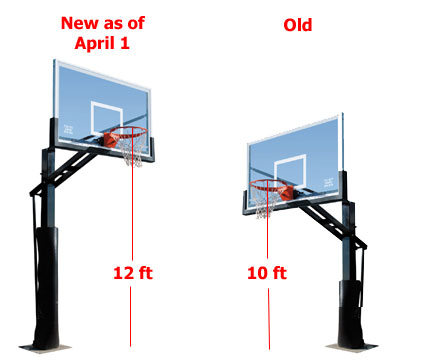
Image Source: blogger.googleusercontent.com
The Unchanging Standard: NBA Rim Height and Its Impact
The question of how high is a basketball hoop in the NBA often leads to discussions about the sport’s evolution, player athleticism, and the very fabric of the game. While the equipment might appear simple—a hoop, a backboard, and a net—the precise NBA rim height of 10 feet is a foundational element that dictates strategy, skill development, and the spectacular displays of athleticism we witness. This seemingly minor measurement has profound implications for every aspect of professional basketball, from shooting mechanics to defensive schemes.
The standardization of regulation basketball hoop height has been a constant since the early days of the sport. While other basketball specifications have evolved over time, the 10-foot rule has remained steadfast. This unwavering commitment to a specific height ensures a level playing field for all competitors and allows for a consistent basis of comparison across different eras and teams. It’s a testament to the foresight of the game’s creators, who established a framework that has endured for over a century.
Deciphering the Official Basketball Rim Height
The official basketball rim height of 10 feet is not an arbitrary number. It was established by Dr. James Naismith, the inventor of basketball, in 1891. His goal was to create a game that was challenging but accessible, requiring skill and strategy rather than brute force. The 10-foot height was chosen to balance the difficulty of scoring with the athleticism of the players. If the rim were lower, layups and dunks would be too easy, potentially turning the game into a continuous barrage of close-range shots. If it were higher, shooting would become excessively difficult, potentially discouraging players and limiting the scoring opportunities.
This specific measurement has allowed for the development of a diverse range of offensive and defensive tactics. Guards can drive to the basket and execute graceful layups, while forwards and centers can battle for rebounds and score from closer proximity. The 10-foot height also creates the exciting spectacle of slam dunks, a defining element of modern basketball.
The Precision of Basketball Hoop Specifications
Beyond the height, other basketball hoop specifications contribute to the game’s integrity and fairness. The basketball rim diameter is another crucial measurement. For regulation play, the inner diameter of the rim is 18 inches (45.7 cm). This diameter, combined with the ball’s size (a circumference of approximately 29.5 inches for men’s and 28.5 inches for women’s professional basketball), requires a significant degree of accuracy from shooters. Missing the rim entirely or hitting the edge can result in a missed shot or a change of possession, adding another layer of skill to the game.
The backboard, typically made of tempered glass or acrylic, is also designed with specific dimensions and placement. The backboard is usually 6 feet wide by 3.5 feet high. Its placement, centered behind the rim, influences the trajectory of shots, particularly bank shots, adding strategic depth to offensive plays. The basketball net length, typically 15 to 18 inches, ensures that the ball passes cleanly through the rim, providing a satisfying swish and a clear indication of a successful shot.
The Professional Basketball Rim Height: A Universal Standard
The professional basketball rim height is universally recognized as 10 feet. This consistency is vital for fair competition. Imagine if different leagues or even different arenas had varying rim heights; it would create an unfair advantage for teams accustomed to specific conditions. Players train their entire careers to master shooting, dribbling, and defensive maneuvers within the confines of this 10-foot standard. Changing it would necessitate a complete re-evaluation of fundamental techniques and could drastically alter the scoring dynamics of the game.
The 10-foot measurement is directly tied to player physiology and biomechanics. A 10-foot rim presents a significant challenge for players of all sizes, but especially for shorter players. It forces guards to develop exceptional shooting accuracy and creative ways to get their shots off over taller defenders. For taller players, it allows for powerful dunks and rebounds, but still requires precision and control to score consistently.
The NBA Court Dimensions: A Complementary Framework
The NBA court dimensions also play a role in how the NBA rim height is perceived and utilized. An NBA court measures 94 feet long by 50 feet wide. These dimensions create a vast playing area where players can execute fast breaks, set up intricate plays, and employ defensive strategies. The size of the court, combined with the 10-foot hoop, dictates the pacing of the game and the types of plays that are most effective. For instance, the length of the court allows for dramatic drives to the basket from half-court, culminating in a high-arcing shot or a powerful dunk.
The three-point line, another significant element of the court, is set at 23 feet 9 inches at its furthest point and 22 feet in the corners. This distance further emphasizes the importance of shooting skill and the 10-foot rim. Players must generate enough force and accuracy to shoot effectively from this distance, making every made three-pointer a feat of skill.
How Tall is a Basketball Hoop? The Practicalities
When asking “how tall is a basketball hoop?”, it’s important to distinguish between recreational and professional standards, though the 10-foot mark is the most common across most organized play. For backyard hoops or youth leagues, adjustable-height poles are common, allowing the rim to be set at lower heights for younger or less experienced players. However, as players progress and aim for higher levels of competition, they will invariably encounter the 10-foot standard.
The physical act of reaching a 10-foot rim requires significant vertical leap or a combination of height and jumping ability. A player who is 6’0″ needs to jump approximately 4 feet to touch the rim, while a 7’0″ player might only need to jump around 3 feet. This difference highlights how player attributes interact with the fixed NBA rim height.
The Basketball Net Length: A Subtle but Important Detail
The basketball net length might seem like a minor detail, but it contributes to the overall aesthetics and flow of the game. A properly sized net allows the ball to pass through cleanly, creating the visual and auditory cue of a successful shot. If the net were too short, the ball might ricochet out unexpectedly, or it might not hang low enough to clearly indicate a score. Conversely, an overly long net could obstruct the view of the rim or create a sense of “hanging” that could affect subsequent shots. The standard 15 to 18 inches ensures a good balance, allowing for a satisfying swish and clear visibility.
The Physics of a 10-Foot Rim
The 10-foot NBA rim height is a constant that interacts with the laws of physics in fascinating ways. When a player shoots a basketball, they impart a specific amount of force and angle to the ball. This trajectory is influenced by gravity, air resistance, and the spin imparted on the ball. The 10-foot rim requires a precise combination of these factors for a shot to be successful.
- Trajectory: A shot aimed at a 10-foot rim needs to have a parabolic trajectory. Too flat a shot will hit the rim or backboard directly, while too arced a shot may not have enough forward momentum to go in.
- Spin: Backspin on the ball is crucial. It helps to slow the ball down upon contact with the rim or backboard, increasing the chances of it bouncing in rather than out. This is often referred to as a “soft touch.”
- Force: The amount of force applied determines the speed and distance the ball travels. Players must learn to modulate their force based on their shooting distance and angle.
Evolution of the Game and the Steadfast Rim
While the standard basketball hoop height has remained unchanged, the game itself has evolved dramatically. Player athleticism has increased exponentially, with players being taller, stronger, and more agile than ever before. This has led to more dunks, more spectacular aerial plays, and a faster overall pace of play.
However, the 10-foot rim has acted as a natural check on these advancements. If the rim were lower, the game might become dominated by dunks, with less emphasis on shooting and passing. The 10-foot height ensures that even the most athletic players must still possess fundamental shooting skills.
Comparing NBA Rim Height to Other Levels
It’s worth noting that the 10-foot professional basketball rim height is also the standard for most organized youth basketball, though often with adjustable poles to accommodate younger players. For example, FIBA (International Basketball Federation) also uses a 10-foot rim. High school, college, and even recreational leagues typically adhere to this standard to prepare players for potential professional careers.
However, there can be variations in equipment quality and materials. While the height is the same, the sturdiness of the rim, the rebound characteristics of the backboard, and the material of the net can differ, subtly impacting the game.
The Impact of Rim Height on Player Development
The 10-foot rim significantly influences how players develop their skills.
- Shooting Mechanics: Players spend countless hours refining their shooting form to consistently hit shots from various distances. The arc and power required to shoot over a 10-foot rim are ingrained from an early age.
- Dribbling and Driving: To score at the rim, players must develop effective dribbling techniques to navigate defenses and create opportunities for layups or dunks. The 10-foot height necessitates a strong vertical leap and the ability to finish with either hand.
- Rebounding: The 10-foot rim makes rebounding a crucial aspect of the game. Players must anticipate the trajectory of missed shots and position themselves effectively to secure the ball. This involves timing, positioning, and a willingness to battle for space.
- Defensive Strategy: Defenders must learn to protect the rim by challenging shots, blocking attempts, and contesting rebounds. The 10-foot height allows for spectacular shot-blocking plays, which can significantly shift the momentum of a game.
How the Hoop Diameter Affects Play
The basketball rim diameter is another critical specification that affects gameplay. An 18-inch rim is narrow enough to make scoring a challenge, requiring precision from shooters. A slightly smaller rim would dramatically increase the difficulty of making shots, potentially lowering scoring averages and changing the offensive strategy of teams. Conversely, a wider rim would make scoring easier, potentially leading to higher-scoring games but possibly diminishing the importance of shooting accuracy.
The interaction between the ball and the rim is also influenced by the rim’s material and construction. Professional rims are designed to be sturdy and responsive, providing a consistent bounce and feel.
The Importance of the Net’s Length and Material
The basketball net length and its material also contribute to the game. A net made of nylon or other durable materials helps to slow the ball down after it passes through the rim, giving a clear indication of a score. The way the net hangs can also influence the acoustics of a made shot, with the classic “swish” being a satisfying auditory cue for fans and players alike.
Frequently Asked Questions About NBA Rim Height
Q: Is the NBA rim height different from college or high school?
A: No, the official basketball rim height for the NBA, WNBA, NCAA (college), and most high school basketball is universally 10 feet (3.05 meters). This standardization ensures consistency across different levels of play.
Q: Why is the NBA rim height 10 feet?
A: The 10-foot height was established by Dr. James Naismith in 1891. It was chosen to create a balance between the difficulty of scoring and the athleticism of the players, making the game challenging and exciting.
Q: What is the diameter of an NBA basketball rim?
A: The basketball rim diameter for the NBA is 18 inches (45.7 cm) on the inside.
Q: Does the basketball hoop height ever change during a game?
A: No, the regulation basketball hoop height remains constant throughout a game.
Q: Are there any basketball leagues that do not use a 10-foot rim?
A: While 10 feet is the standard for most organized basketball, some youth leagues may use adjustable hoops set at lower heights for younger players. However, any league aspiring to professional standards will adhere to the 10-foot rule.
Q: How does the NBA rim height affect the game?
A: The 10-foot NBA rim height significantly impacts shooting mechanics, player athleticism, defensive strategies, and the overall pacing and excitement of the game. It necessitates skill, precision, and a strong vertical leap for scoring.
Q: What is the standard basketball net length?
A: The typical basketball net length is between 15 and 18 inches, designed to allow the ball to pass through cleanly and provide a clear indication of a score.
In conclusion, the NBA rim height of 10 feet is a cornerstone of professional basketball, influencing every facet of the game. From the physics of a shot to the strategies employed by teams, this seemingly simple measurement is fundamental to the sport’s enduring appeal and competitive integrity. The consistent standard basketball hoop height ensures that players can develop their skills with a clear target in mind, leading to the incredible displays of talent we witness on the court.