
In a standard basketball game, there are four quarters.
Basketball games are divided into distinct playing periods to manage the flow of the game, allow for breaks, and ensure fair competition. This structure is fundamental to understanding basketball rules and the overall basketball game length. The number of quarters remains consistent across most levels of play, from youth leagues to professional circuits. This guide will delve into the specifics of basketball periods, the quarter length basketball at various levels, and what makes up the NBA game duration.
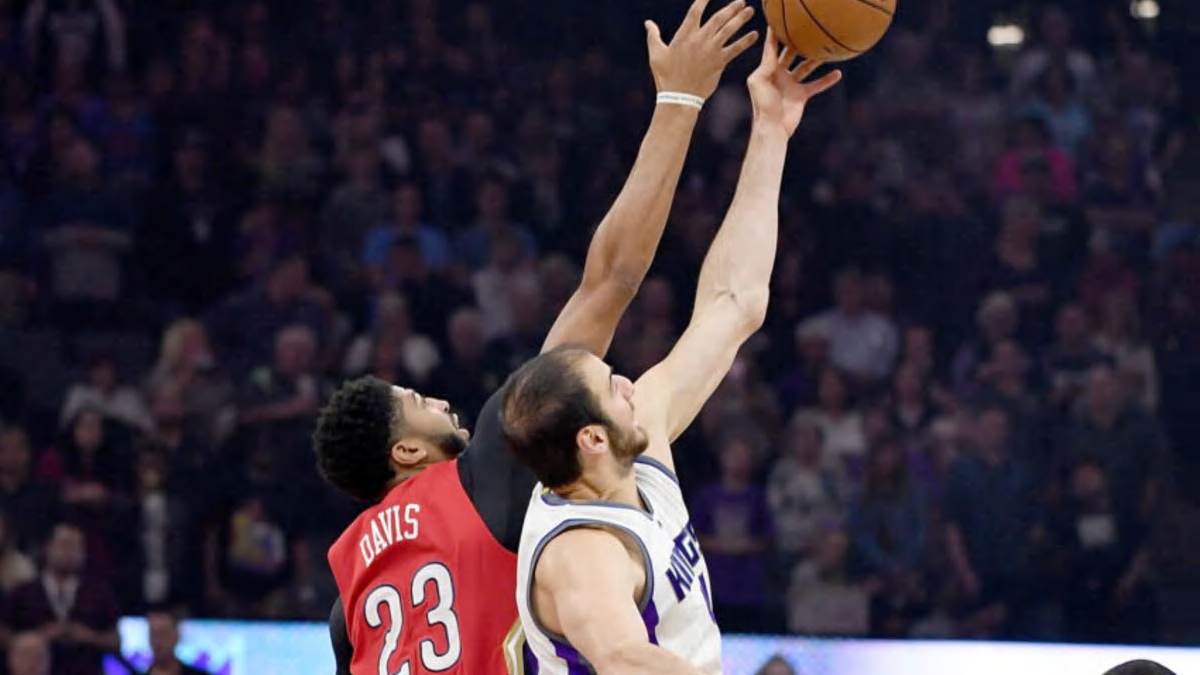
Image Source: images2.minutemediacdn.com
The Basic Structure: Four Quarters
The core of any basketball game is its division into four quarters. These periods provide natural stopping points for strategy discussions, player substitutions, and brief rest. This segmented approach helps maintain player stamina and allows officials to manage the game effectively.
Why Four Quarters?
The decision to use four quarters rather than two halves, for instance, is a historical and practical one. It breaks down the game into more manageable segments, making it easier for both players and spectators to follow. It also allows for more frequent opportunities for timeouts and breaks, which are crucial in a physically demanding sport like basketball.
Quarter Length Basketball: Variations by Level
While the number of quarters is consistently four, the actual duration of each quarter can vary depending on the league or level of play. This difference is a key factor in determining the overall NBA game duration or how long is a quarter in basketball at different stages.
Professional Basketball Quarters (NBA)
In the National Basketball Association (NBA), the professional pinnacle of the sport, the quarter length basketball is 12 minutes of game clock time per quarter. This means an NBA game duration, in terms of actual playing time, is 48 minutes. However, due to fouls, timeouts, and other stoppages, the actual elapsed time for an NBA game is significantly longer.
NBA Quarter Time: More Than Just 12 Minutes
The specified NBA quarter time of 12 minutes refers to the active game clock. When the clock stops, time does not run. This is a critical distinction. Factors that stop the clock include:
- Fouls: When a foul is called, play stops.
- Out of Bounds: If the ball goes out of bounds.
- Timeouts: Called by either team or the officials.
- Jump Balls: Though less frequent after the initial tip-off.
- Substitutions: When players are entering or leaving the game.
- Injuries: If a player is hurt and needs attention.
Because of these frequent stoppages, an NBA game duration can easily extend to 2 to 2.5 hours. This extended time allows for natural breaks and strategic adjustments between quarters and at halftime.
College Basketball Quarters
In NCAA Division I college basketball, the structure has seen some changes. Historically, college basketball used halves. However, more recently, many college basketball competitions have adopted a quarter system, mirroring the professional game for consistency and flow.
- NCAA Division I (Men’s and Women’s): Most NCAA Division I games now feature four 10-minute quarters. This makes the total regulation playing time 40 minutes (4 x 10 minutes). Similar to the NBA, game clock stoppages mean the actual game duration is longer.
Youth Basketball Quarters
For younger players, the emphasis is often on development and participation rather than strict adherence to professional-level game pacing. Therefore, youth basketball quarters are typically shorter.
- Typical Youth Basketball: Youth basketball quarters often range from 6 to 8 minutes of game clock time. The specific quarter length basketball can depend on the age group and the league’s rules. For instance, younger age groups might play shorter quarters or even have a running clock that only stops for timeouts and severe injuries.
Basketball Rules Quarters: Standard Procedures
Across all levels, the fundamental basketball rules quarters govern how the game progresses. Each quarter starts with a jump ball or an inbounds pass, depending on possession after the previous quarter or a coin toss to begin the game.
Starting a Quarter
The game begins with a jump ball. After that, possession typically alternates at the start of subsequent quarters. However, the team that wins the coin toss to start the game gets the ball first in the first quarter. In subsequent quarters, the team that did not get the ball to start the previous quarter will get possession at the start of the next quarter.
Ending a Quarter
A quarter ends when the game clock reaches 0:00. If a foul occurs before the clock hits zero, the quarter can extend slightly as free throws are shot. If a player releases the ball before the clock hits zero, the shot counts even if it goes through the hoop after the buzzer.
Overtime in Basketball
What happens when a basketball game is tied at the end of regulation four quarters? This is where overtime periods come into play.
How Overtime Works
If the score is tied after the fourth quarter, a standard 5-minute overtime period is played. The teams switch ends of the court from where they played the second half. Play begins with a jump ball, just like the start of the game.
- Multiple Overtime Periods: If the game is still tied after the first overtime period, subsequent 5-minute overtime periods are played until one team has a lead at the end of an overtime period. Each overtime period counts as an additional period for the purpose of player fouls.
The Impact of Quarter Length on Game Strategy and Flow
The duration of basketball periods significantly influences game strategy and overall basketball game length.
Strategic Timeouts
Timeout rules are crucial. In the NBA, teams are allotted a certain number of timeouts per half and per overtime period. These timeouts are strategic opportunities to:
- Discuss plays: Coaches can design new offensive or defensive sets.
- Make adjustments: React to the opponent’s strategy.
- Rest players: Give key players a brief break.
- Stop momentum: Disrupt the opposing team’s scoring run.
Shorter quarter lengths in youth basketball might mean fewer timeouts are needed or available, as the overall game is shorter and player fatigue is less of a factor.
Player Stamina and Rotation
The 12-minute quarters in professional basketball require a high level of stamina from players. Coaches must manage their player rotations carefully to ensure their key players are fresh for the crucial final minutes. College basketball’s 10-minute quarters also demand significant endurance, though perhaps slightly less than the NBA. In youth basketball, shorter quarters allow younger players to participate without becoming overly fatigued, promoting enjoyment and skill development.
Pace of Play
The quarter length basketball directly impacts the pace of play. A longer quarter allows for more possessions and more opportunities for teams to establish rhythm and execute their strategies. This is why NBA games, with their 12-minute quarters, often feature a higher number of possessions compared to games with shorter quarters.
Fathoming the Elapsed Time: Beyond the Clock
When people ask “how long is a quarter in basketball?”, they often want to know the real-world time it takes to play that quarter. As discussed, the game clock is only part of the story.
NBA Game Duration Breakdown
Let’s consider a typical NBA game duration.
| Component | Estimated Time | Notes |
|---|---|---|
| First Quarter | 15-20 minutes | Includes clock stoppages, timeouts, etc. |
| Break between Quarters | 2-3 minutes | Official break and substitutions |
| Second Quarter | 15-20 minutes | Includes clock stoppages, timeouts, etc. |
| Halftime | 15 minutes | Longer break between the 2nd and 3rd quarters |
| Third Quarter | 15-20 minutes | Includes clock stoppages, timeouts, etc. |
| Break between Quarters | 2-3 minutes | Official break and substitutions |
| Fourth Quarter | 15-20 minutes | Often longer due to late-game strategy |
| Potential Overtime | 5+ minutes per period | If the game is tied |
This breakdown illustrates why a 48-minute regulation NBA game duration can easily stretch to over two hours. The breaks, timeouts, and frequent clock stoppages are integral to the game’s experience.
College and Youth Basketball Time
College games, with 10-minute quarters, will naturally be shorter in actual elapsed time than NBA games, but the principle of clock stoppages still applies. Youth games, with even shorter quarters, are generally the quickest to conclude in terms of total elapsed time, making them more accessible for younger participants and their schedules.
The Role of Referees and Officials
The officials play a vital role in managing the clock and enforcing basketball rules quarters. They are responsible for:
- Starting and stopping the clock: Accurately when play is live or stopped.
- Signaling fouls and violations: Ensuring play pauses appropriately.
- Managing timeouts and substitutions: Ensuring these occur correctly.
- Ensuring fair play: Upholding the integrity of the game.
Their efficiency and accuracy contribute to the smooth flow of the game and the accurate determination of the basketball game length.
Frequently Asked Questions (FAQ)
Q1: How many quarters are there in a basketball game?
A1: There are four quarters in a standard basketball game.
Q2: How long is a quarter in the NBA?
A2: An NBA quarter is 12 minutes of game clock time.
Q3: Does the clock stop in basketball?
A3: Yes, the clock stops frequently in basketball for fouls, timeouts, out-of-bounds plays, and other stoppages. This is why the actual game duration is longer than the regulation clock time.
Q4: How long does a professional basketball game typically last?
A4: A professional basketball game, like an NBA game, typically lasts between 2 to 2.5 hours due to the 12-minute quarters and numerous clock stoppages.
Q5: Do all basketball leagues have four quarters?
A5: While four quarters is standard across most professional and many collegiate leagues, some youth leagues or specific variations of basketball might use different structures (e.g., two halves) or shorter quarter lengths. However, the most common structure is four quarters.
Q6: What is the total playing time in an NBA game?
A6: The total regulation playing time in an NBA game is 48 minutes (4 quarters x 12 minutes per quarter). The actual elapsed time is much longer.
Q7: How long are college basketball quarters?
A7: Most NCAA Division I college basketball games now feature four 10-minute quarters, totaling 40 minutes of regulation playing time.
Q8: What happens if a basketball game is tied after four quarters?
A8: If a game is tied after the fourth quarter, overtime periods are played. Typically, these are 5-minute periods until a winner is determined.